Bolivian man crosses the country on foot seeking right to withdraw part of his pension fund
RIO DE JANEIRO, BRAZIL – (EFE) At a slow pace but firm in his convictions, Bolivian Gonzalo Melgar has already walked 550 kilometers and still has some 380 kilometers to go to reach his goal and walk to the seat of the Government of Bolivia to ask President Luis Arce in person for the withdrawal of part of the contributions he has made to the Pension Fund Administrator (AFP).
The 53-year-old Bolivian told EFE that he decided to start this pilgrimage last May 10 from eastern Santa Cruz, driven by the desperation of having to support seven children with his wife. He worked almost all his life as an accountant in companies, banks, and supermarkets until he became unemployed in 2018.

The Covid-19 pandemic also worsened his situation: one of his children had to “freeze” his studies because he did not have enough resources to pay the monthly tuition, while the man sent his resume wherever he could but could not find a steady job; he did carpentry work, masonry and ground work to help with expenses.
Against this backdrop, Melgar saw that the withdrawal of his contributions from at least 23 years of work would be of great help in meeting expenses, so in December of last year, he began his first “crusade” to achieve his goal.
Melgar began a strike asking for right to withdraw the contributions together with a group of people, then traveled to La Paz where he maintained his pressure, in total 53 days without success, but with the hope that Parliament will approve a bill sent by President Arce in January for the partial withdrawal of the funds contributed by people.
THE CROSSING
After the strike, Melgar tried to convince his colleagues to march to La Paz to make their demand heard, but many believed it was a futile effort.
He was convinced that this action would help and without saying anything, he got a backpack, went to church to ask for God’s protection, and began his pilgrimage to the city of La Paz.
Melgar said that the first 100 kilometers were the hardest, he was exhausted by the sun and the long walks, for a moment he thought about returning home, but the need for that money was greater so he asked God to help him on the way.
It has been 36 days since the beginning of his journey in which he is carrying a backpack weighing 48 kilos with a mattress, a tent, three changes of clothes, medicines and cleaning supplies, as well as a Bolivian flag.
The man has already traveled 550 kilometers, every day he advances at least 20 kilometers, he is in the central department of Cochabamba and already had to change his shoes due to the wear of the soles, his feet are “burned” and full of blisters that sometimes delay his plans to fulfill his daily route.
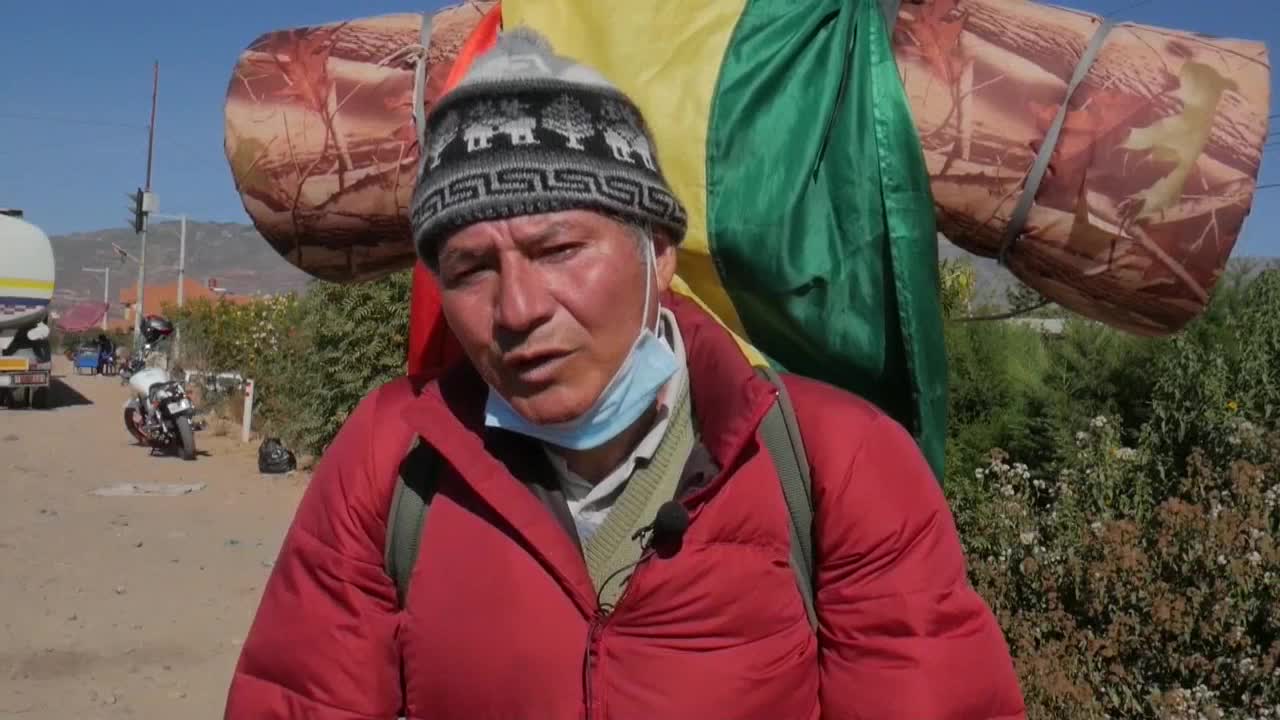
In spite of this, he remains firm with his goal and hopes to reach the city of La Paz in approximately 18 days, although he fears that the winter cold will affect his health.
The man has a Facebook page where he uploads some videos of his journey and receives messages of support that help him not to give up.
Melgar wants to get a meeting with President Arce to explain his situation and that he understands the reasons why he, like many other Bolivians, ask for the right to withdraw his pension fund contributions, as neighboring country Chile did during the pandemic.
“I want to withdraw that money that I have saved throughout my working life (…) I want to get some back, not even all of it, because it is utopia, but at least a part of it,” Melgar told Efe.
He also wants to ask Arce to speed up the analysis of the bill by the Parliament so that the withdrawal of the contributions becomes a reality that will help thousands of Bolivians who are in the same conditions as him and who cannot find work.
Arce sent to the Parliament a bill to “mitigate” the economic effects of the pandemic that was part of his promises in his electoral campaign, but it is stalled in Parliament.
“The hunger of the people is of every day and not only hunger but also disease, people are dying of covid and need money to buy medicines,” he concludes.
More: Bolivia news in English, every day from The Rio Times.
Editorial responsibility: Matthias Camenzind, Editor-in-Chief · Editorial standards · Report an error