Bolivia Fuel Crackdown Blocks 6,700 Vehicles in a Month

ENERGY · BOLIVIA
Key Facts
- —The country Bolivia, a landlocked Andean country where petrol is still subsidised and diesel has been sold at market prices since 18 September.
- —What happened On 2 October the hydrocarbons minister said a month of state control over the fuel regulator had blocked about 6,700 vehicle plates and led to 31 arrests.
- —The numbers 24 vehicles confiscated, eight found with extra tanks and more than 14 million litres kept from diversion, according to the minister’s report of 2 October.
- —What it means for you Drivers who load more fuel than their tank or normal use allows can be blocked at the pump. To be unblocked, they must explain where the fuel went.
- —Still open Reports of the volume seized differ, from 10 million to 17 million litres. No breakdown or independent audit of the figures has been published.
The Bolivia ANH intervention has blocked about 6,700 vehicle plates from buying fuel in its first month, the government said on Friday. Hydrocarbons and Energy Minister Marcelo Blanco also reported 31 arrests for illegal storage and resale of fuel.
The ANH, or National Hydrocarbons Agency, is the state fuel regulator, which the government took over in early September. Blanco said smuggling networks have shifted from diesel to petrol since the diesel subsidy ended.
What the government reported after one month
Blanco gave the figures at a press conference on 2 October, marking 30 days since the state took over the regulator. Plates were blocked through B-SISA, the agency’s system that records fuel loads by number plate.
He said the blocks had protected more than 14 million litres of diesel and petrol. Red Uno, a national television network, gave the figure as 14.43 million litres.
In the same period, he said, 24 vehicles were confiscated. Eight more were found fitted with additional fuel tanks, one of which Blanco said he found himself in Cochabamba.
Opinión and Visión 360 quoted more than 10 million litres of petrol and about 7 million of diesel. Opinión said the fuel went to the state oil company YPFB.
Reports of the seized volume differ, and Brújula Digital gave 10 million litres in total. The ministry has not published a breakdown, so the combined 17 million figure is not independently confirmed.
Why petrol is now the target
Diesel has been priced by the market since Supreme Decree 5716 of 18 September. It cost Bs 17.95 a litre (about US$1.49, at 12.03 bolivianos to the dollar on 2 October) when the decree took effect.
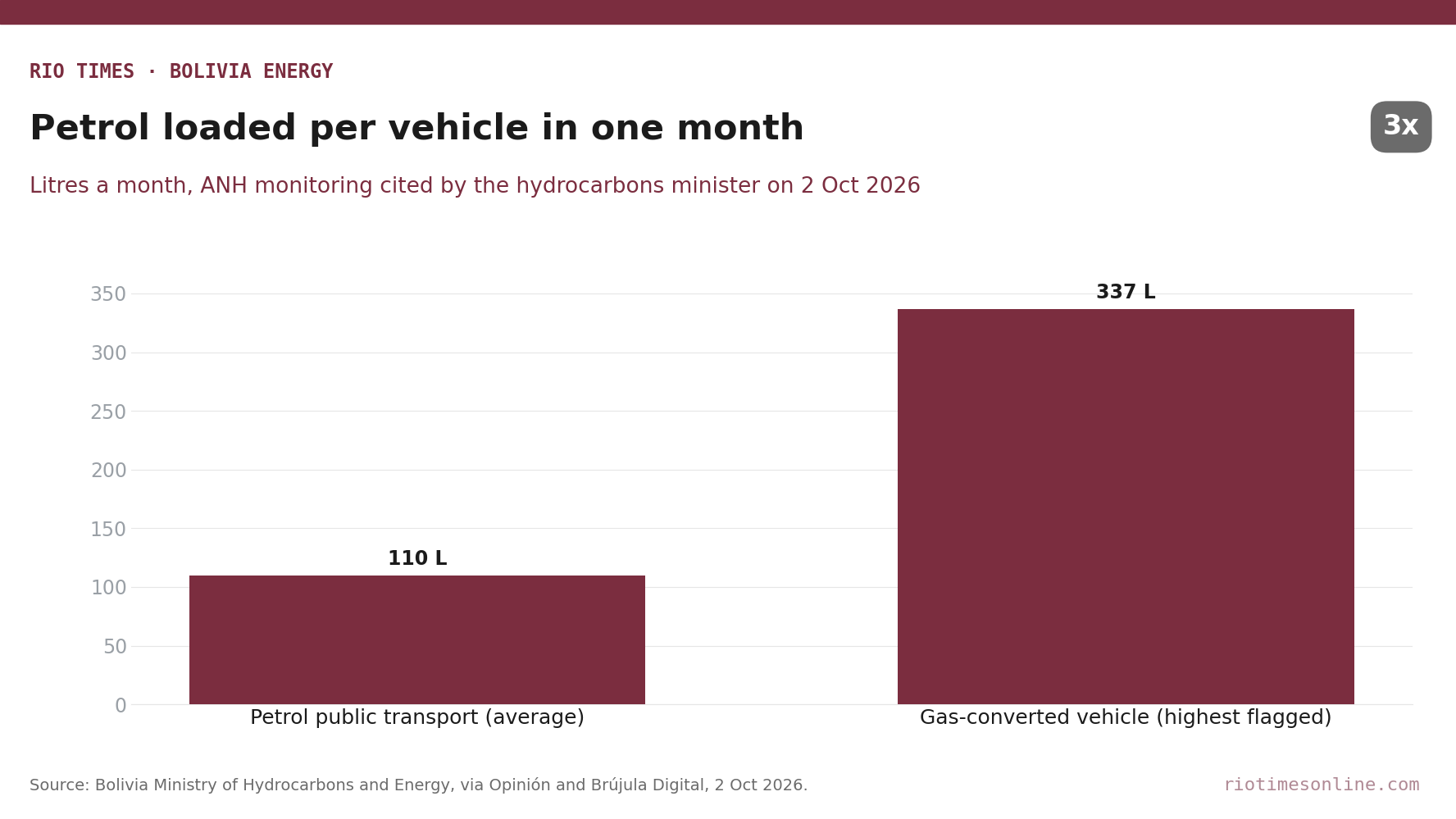
Petrol is still subsidised, which makes it the more profitable fuel to divert. Blanco said a petrol vehicle in public transport uses about 110 litres a month, yet some gas-converted vehicles loaded 337 litres.
Deputy Minister Yamil García cited a 2002 Toyota Land Cruiser with a 96-litre tank. It was repeatedly filled with up to 215 litres in a single day.
That case has gone to prosecutors in Potosí, he said. Further complaints have been filed in the Beni and Potosí regions.
Penalties for drivers and filling stations
García said the Penal Code punishes unauthorised storage or sale of fuel with three to six years in prison. Buyers of black-market fuel face two to four years, plus confiscation of vehicles used.
Filling stations suspected of helping are also being pursued, under criminal and administrative law. Red Uno reported that complicit stations can lose their operating licence permanently.
Blanco warned that any vehicle with “irrational consumption” will be blocked and its owner referred to prosecutors. Visión 360 reported that drivers seeking to be unblocked must explain where the fuel went.
Faster permits and shorter queues
A commission of five ministries now runs the regulator. Blanco said rule changes have cut approval times for fuel procedures from months to 48 hours.
Red Uno reported 37 new licences for fuel sales and own consumption in September. Diesel queues vanished after the price rise, Visión 360 said (see Bolivia Diesel Subsidy Ends: Price Rises 83% as Fuel Queues Shrink).
The government has committed to the International Monetary Fund to remove fuel subsidies in 2027, Visión 360 reported. The Fund’s board approved a US$1.9 billion programme on 2 October (see Bolivia IMF Loan Approved With US$214 Million Up Front).
What Is Not Yet Known
The government has not published plate-level data from the Bolivia ANH intervention or a breakdown of the seized fuel. It is not clear how many of the 6,700 plates have since been cleared.
The ministry announced on 17 August that the ANH would be closed and replaced. No closure date or new structure was announced on Friday (see Bolivia Fuel Regulator Takeover and Closure Plan, 4 September).
Sources: Minister Marcelo Blanco and Deputy Minister Yamil García, press conference of 2 October 2026, as reported by Opinión, Brújula Digital, Visión 360 and Red Uno.
In depth
Editorial responsibility: Matthias Camenzind, Editor-in-Chief · Editorial standards · Report an error