Bitcoin at US$64,725: Latin America Crypto Wrap, July 31
Key Facts
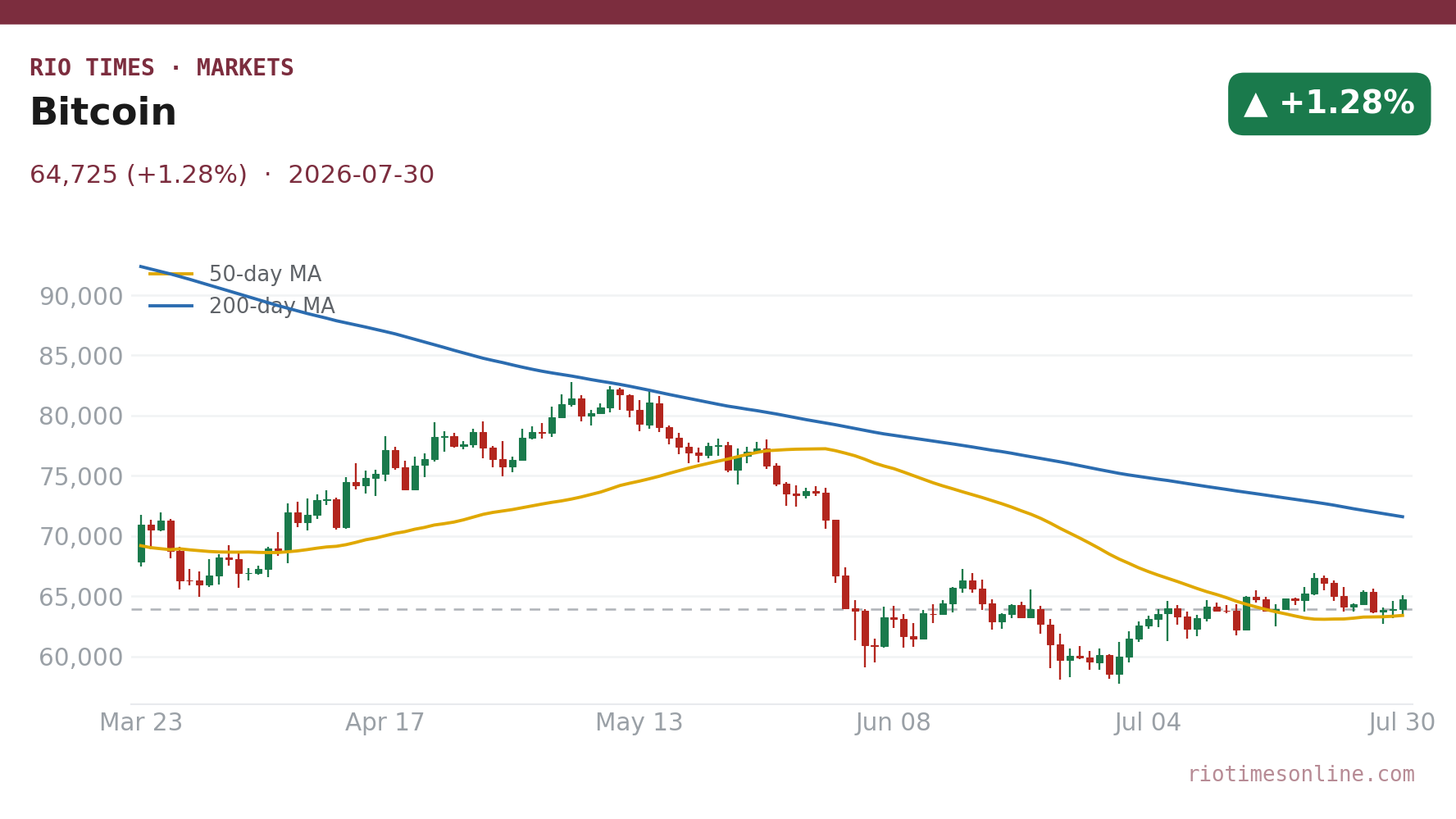
- Bitcoin gained 1.28% to US$64,725, with investors weighing slower US inflation data against ongoing US exchange scrutiny.
- Ethereum edged 0.46% higher to US$1,917, supported by its dominant role in global stablecoin transfers and decentralised finance.
- Solana advanced 1.18% to US$74.47, extending a recovery driven by retail traders using its low-fee, high-speed transaction rails.
- XRP rose 1.02% to US$1.0838, after court approvals kept the token listed on US exchanges following partial legal wins.
- Latin American remittance fintechs are testing Solana-based rails to cut cross-border transfer times from hours to seconds using stablecoins.
- Argentine freelancers increasingly ask overseas clients to pay in dollar-linked stablecoins as a way to receive dollars instantly outside official foreign-exchange controls.
Today’s Focus
Bitcoin rose 1.28% to US$64,725 on Thursday, leading a broad advance across major crypto assets as traders absorbed cooler US inflation figures. Ethereum added 0.46% to US$1,917, Solana gained 1.18% to US$74.47 and XRP climbed 1.02% to US$1.0838. The session’s gains were underpinned by rising Bitcoin futures open interest, which signals more leveraged bets rather than purely spot retail buying.
For Latin America, the price moves are only half the story. The region’s adoption of stablecoins—tokens that track the US dollar—continues to reshape how ordinary savers in Argentina and Brazil protect their purchasing power and how families receive money from abroad. Remittance fintechs are testing Solana’s network to move stablecoins across continents in seconds, while Argentine freelancers routinely ask for payment in digital dollars to bypass currency controls.
Brazil’s central bank is pushing forward with its digital real pilot and has clarified tax rules for crypto trades. That formalisation pushes some savers towards dollar-linked stablecoins, which they can hold alongside traditional savings products as inflation steadily erodes the real. In El Salvador, where Bitcoin remains legal tender, everyday usage remains limited despite the government’s continued promotion of tourism and a state-backed wallet.
The regulatory backdrop is tightening from Brazil to Mexico. Authorities are requiring stricter customer identification and reporting from exchanges, which pushes larger platforms to comply while leaving informal peer-to-peer markets in a legal grey zone. For foreign investors, that regulatory clarity will determine whether global exchanges and institutional funds expand aggressively or remain cautious across Latin America.
What matters today. Bitcoin’s US$64,725 session masks the deeper story: Latin America’s adoption of stablecoins and crypto payment rails is advancing faster than the daily price swings suggest.
01 The session in one read
Bitcoin settled at US$64,725, a gain of 1.28% on the day, as traders digested slower US inflation data that eased fears of further sharp rate rises. The move higher was accompanied by a rise in Bitcoin futures open interest reported by major brokers, suggesting that leveraged positioning rather than fresh retail buying drove much of the advance.
The three other major tokens followed Bitcoin upward in a session marked more by macro relief than by any crypto-specific catalyst. XRP’s 1.02% rise to US$1.0838 reflected continued legal clarity after US courts allowed exchanges to keep listing the token, while Solana’s 1.18% gain to US$74.47 showed the network’s persistent appeal among retail traders seeking low-fee transfers.
This session’s broad crypto gains had a distinctly American catalyst—slower inflation—but the real structural shift continues in Latin America, where stablecoin usage for savings and remittances grows independent of daily Bitcoin price direction. The variable to watch is whether Brazil’s advancing digital real pilot and Argentina’s currency turmoil accelerate formal stablecoin regulation, which could either integrate digital dollars into the mainstream financial system or push more activity into unregulated peer-to-peer channels.
02 The board
The board reveals a synchronised but modest rally. Bitcoin’s climb to US$64,725 outpaced the rest of the field in percentage terms, consistent with its role as the first asset traders buy when macro conditions improve. Ethereum’s smaller 0.46% advance to US$1,917 suggests that its value proposition—stablecoin transfers and decentralised finance—is already priced in by markets that expect continued network usage regardless of short-term price action.
Solana’s recovery to US$74.47 and XRP’s steady climb to US$1.0838 tell a story of networks that are carving out practical niches in payments and trading. Solana’s speed attracts remittance fintechs that want to settle stablecoin transfers in seconds, while XRP’s partial legal wins keep the token accessible on US exchanges, preserving liquidity for Latin American users who access it through mobile apps.
| Asset | Level | Change |
|---|---|---|
| Bitcoin | US$64,725 | +1.28% |
| Ethereum | US$1,917 | +0.46% |
| Solana | US$74.47 | +1.18% |
| XRP | US$1.0838 | +1.02% |
Source: RT close, 2026-07-30. Where a commodity has no spot feed, an exchange-traded tracker or leading producer is shown as a labelled proxy.
Live Market IntelligenceThe live market board
Rio Times · Live Market Intelligence
Latin America — Cross-Market Board
| Instrument | Last | Change | YoY | Prev. | High | Low | Volume |
|---|---|---|---|---|---|---|---|
| IBOV | 183,827.59 | +0.46% | +21.85% | 182,991.13 | 168,310 | 167,142 | — |
| IPSA | 11,055.91 | -0.73% | — | 11,137.23 | 11,210 | 10,984 | 1,513,213,483 |
| IPC MEX | 65,110.57 | +0.26% | +12.17% | 64,944.41 | 66,121 | 65,405 | 108,886,187 |
| MERVAL | 2,782,561 | +0.00% | +30.51% | 3,022,485 | 3,042,365 | 2,991,150 | — |
| COLCAP | 2,558.92 | -0.79% | — | 9.04 | 9.05 | 9.02 | 4,133 |
| BVL PERÚ | 60,220.45 | +0.32% | — | — | — | — | — |
| USD/BRL | 5.16 | +0.01% | -5.13% | 5.16 | 5.18 | 5.14 | — |
| EUR/BRL | 5.95 | +1.01% | -5.83% | 5.89 | 5.98 | 5.94 | — |
| USD/MXN | 17.06 | -0.24% | -8.58% | 17.10 | 17.08 | 17.01 | — |
| USD/CLP | 913.98 | +0.04% | -5.67% | 913.65 | 915.11 | 906.68 | — |
| USD/COP | 3,140 | +0.03% | -22.04% | 3,139 | 3,141 | 3,105 | — |
| USD/PEN | 3.36 | -0.66% | -4.82% | 3.38 | 3.38 | 3.35 | — |
| USD/ARS | 1,493 | +0.10% | +12.96% | 1,491 | 1,494 | 1,480 | — |
| USD/UYU | 40.27 | +1.24% | +1.80% | 39.77 | 40.27 | 40.23 | — |
| USD/PYG | 5,939 | +1.68% | -19.54% | 5,841 | 5,939 | 5,925 | — |
| USD/BOB | 11.64 | -0.76% | +72.04% | 11.73 | 11.72 | 11.64 | — |
| USD/DOP | 58.34 | +1.25% | -3.44% | 57.62 | 58.34 | 58.04 | — |
| USD/CRC | 445.92 | +0.89% | -9.71% | 441.97 | 448.50 | 445.92 | — |
03 What moved it
Slower US inflation data was the session’s dominant driver. Investors read the figures as reducing the likelihood of aggressive monetary tightening, which tends to lift risk assets including crypto tokens. That macro easing offset ongoing regulatory scrutiny of large US exchanges, which has been a persistent source of uncertainty for the sector all year.
Rising Bitcoin futures open interest pointed to a build-up of leveraged positions rather than a surge of new spot buyers. Developers are also preparing further upgrades to reduce transaction fees on Ethereum’s base layer, which matters for the secondary networks that Latin American users rely on for remittances and savings built atop Ethereum.
04 The Latin American read
For Argentina, crypto is increasingly a survival tool. Years of strict currency controls and persistent high inflation have made dollar-linked stablecoins a popular store of value, bought on local platforms without needing the official foreign-exchange market. Argentine freelancers and small exporters now routinely ask overseas clients to pay in stablecoins, receiving digital dollars instantly in a local wallet that can later be cashed out in pesos or spent on international services.
Brazil presents a more institutional picture. Millions of Brazilians now hold Bitcoin or stablecoins in local apps alongside traditional savings products, using them as a hedge as the real’s purchasing power erodes. The central bank’s digital real pilot and clearer tax rules are encouraging formal investment, yet they also push some savers towards dollar-linked stablecoins when they want to hold value entirely outside the domestic currency system.
05 The names to watch
Brazil’s large crypto exchanges are the regional bellwethers, reporting that millions of users now treat Bitcoin and stablecoins as routine parts of their savings mix. Solana-based payment rails are being tested by several Latin American remittance fintechs that aim to cut cross-border transfer times from hours to seconds, moving stablecoins between continents before paying out in local currencies.
In El Salvador, the government’s state-backed digital wallet that supports Bitcoin remains central to its legal-tender experiment, yet most remittances from Salvadorans abroad still arrive in dollars through traditional channels. Banks and money-transfer firms across the region continue to experiment cautiously with XRP’s messaging and settlement technology, though retail users still access XRP mainly through exchanges and mobile apps rather than bank channels.
06 The outlook
Latin American regulators from Brazil to Mexico are tightening rules on crypto exchanges, requiring clearer customer identification and reporting. This forces larger platforms to register and comply, while leaving informal peer-to-peer markets in a legal grey zone that could face sudden crackdowns. For foreign investors, the regulatory trajectory will determine whether the region becomes a thriving institutional market or remains a patchwork of formal and informal crypto economies where adoption runs ahead of oversight.
07 What to watch
- US regulatory actions: New enforcement cases against large exchanges could cap Bitcoin’s ability to hold above US$64,725, regardless of inflation data.
- Brazil digital real progress: The central bank’s pilot phase updates will signal whether the state competes with or complements stablecoin use among Brazilian savers.
- Stablecoin remittance volumes: Quarterly data from remittance fintechs using Solana and Ethereum rails will show whether crypto-based transfers are taking meaningful share from traditional operators.
- Argentine currency policy shifts: Any loosening of Argentina’s strict currency controls could reduce the premium that drives stablecoin demand, altering a key adoption case.
Frequently Asked Questions
Why did Bitcoin rise to US$64,725?
Slower US inflation data reduced expectations of aggressive rate rises, which tends to lift risk assets including Bitcoin.
What do these moves mean for Latin America?
Daily price swings matter less than the region’s growing use of stablecoins for savings and remittances, which continues independently of Bitcoin’s direction.
How are stablecoins used in Argentina and Brazil?
Argentines buy dollar-linked tokens to protect savings from inflation and currency controls; Brazilians use them alongside traditional savings as the real weakens.
Is El Salvador still using Bitcoin as legal tender?
Yes, but everyday usage remains limited; most remittances still arrive in dollars through traditional channels rather than via the government’s Bitcoin wallet.
This article was produced by The Rio Times’ automated newsroom system. How we use AI · Report an error
LatAm Markets: Live Signals → — real-time movers, turnover leaders and FX across Latin America.
Read More from The Rio Times