
JUSTICE · BENIN
Key Facts
- —The country Benin is a coastal West African state between Nigeria and Togo, whose northern regions border the Sahel, where jihadist groups operate.
- —Why it matters The Benin CRIET, a special court for economic crimes and terrorism created in 2018, hears Benin’s graft, jihadist and politically sensitive cases.
- —Why now The court opened its 2026-2027 judicial year on Monday 12 October under the theme of humanising criminal justice.
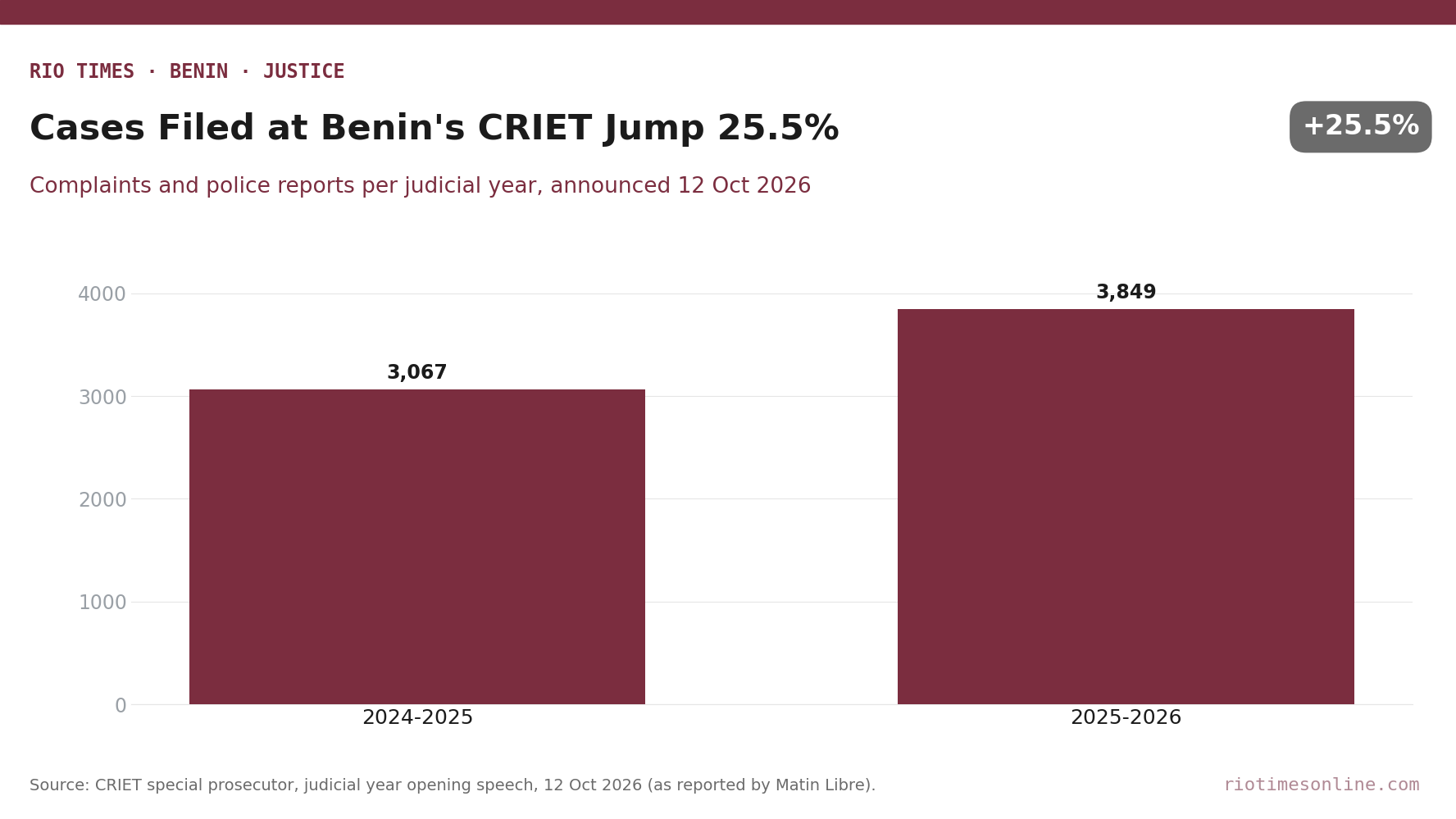
- —What happened Special prosecutor Elonm Mario Mètonou said pretrial detention must again become “the ultimate exception” and reported 3,849 complaints and police reports, up 25.5%.
- —The numbers 3,849 filings in 2025-2026 against 3,067 a year earlier; 770 people were held over terrorism on 30 September 2025, by last year’s count.
- —What it means for US readers Investors and security partners judge Benin’s legal risk partly by this court; a real shift on detention would ease rule-of-law concerns.
- —Still open Whether judges release more suspects before trial, including former minister Candide Azannaï, held since December 2025.
Benin’s special court for economic crimes and terrorism opened its judicial year on Monday 12 October with a pledge to curb pretrial detention. The Benin CRIET special prosecutor also reported a 25.5% rise in cases, to 3,849 complaints and police reports.
For US readers, the shift matters because this court handles the fraud, corruption and terrorism files that shape Benin’s investment and security reputation. Benin borders the Sahel, and hundreds of people have been detained in terrorism cases before the court.
A Prosecutor Promises Restraint
The solemn hearing was led by the court’s first president, Édouard Cyriaque Dossa, with Vice President Mariam Chabi Talata attending, Matin Libre reported. The theme was “Humanising criminal justice: between the protection of fundamental rights and repressive efficiency.”
Elonm Mario Mètonou heads the prosecution service at the court, which was created by a law of 2 July 2018. He said pretrial detention “must again become what it should never have stopped being: the ultimate exception,” La Nouvelle Tribune reported.
He paired that line with a promise of firmness. “We will be uncompromising, inflexible, fierce if need be, against those who plunder public wealth or make pacts with terror,” he said, according to Matin Libre.
Mètonou said the challenge for the coming year was not a choice between laxity and terror but proportionality. He argued that the quality of justice cannot be measured only by the number of convictions or the length of sentences sought.
Dossa backed the message, saying criminal justice delivered through the court since 2018 “has been, is and will always be humane.” Zakari Baba Body, president of Benin’s bar association, called the balance between repression and rights a requirement of the rule of law.
Cases at the Benin CRIET Keep Rising
The prosecutor’s own figures show demand for the court growing fast. Complaints and police reports reached 3,849 in the 2025-2026 judicial year, up from 3,067 in 2024-2025.
Mètonou acknowledged that some see the Benin CRIET as excessively repressive, even unjust. He presented the rising caseload as evidence that victims increasingly bring complaints directly to it.
Last year’s opening focused on the judicial handling of terrorism instead. Mètonou then reported 770 people detained over terrorism on 30 September 2025, including 31 women, Benin Web TV recalled.
Those detainees are the human side of Benin’s security problem in the north. Their cases also explain why the length of pretrial detention draws so much attention from lawyers and families.
The Cases Critics Watch
The court’s docket includes politically sensitive files. Former minister and opposition figure Candide Azannaï has been in pretrial detention since 12 December 2025, according to Benin Web TV.
The court’s detention chamber rejected his release request on 13 August 2026. Its appeal chamber confirmed that refusal on Thursday 24 September, while his supporters dispute the basis of the accusations.
Reports of Monday’s speech did not tie the prosecutor’s remarks to any individual case. Whether his words lead to more release orders is the test critics will apply.
Benin’s wider politics are also changing under President Romuald Wadagni, whose government is preparing a larger budget (see Benin Plans 14.7% Budget Rise to US$8.1 Billion). Benin is in a declared political truce, and the main opposition party, Les Démocrates, chose Nourénou Atchadé as leader on 10 October.
Atchadé succeeds former President Boni Yayi at the head of the party. He told Bip Radio on Monday that the party will keep criticising government policy while offering alternatives.
What It Means for US Readers
For American investors, lenders and aid partners, the Benin CRIET is a test of how predictable Benin’s legal system is. It tries fraud, corruption and terrorism cases, the files most likely to touch foreign companies and security partners.
A firmer rule that suspects stay free unless detention is necessary would reduce one source of legal risk. The stabiliser is that the prosecutor paired restraint with a promise of tough action against graft and terrorism.
The risk is that the speech changes tone but not practice. Readers following West African security should watch release rulings and trial times rather than courtroom rhetoric.
What Is Not Known
It is not known whether the prosecutor’s office will change how often it seeks detention or how heavy its sentencing demands are. Monday’s reports describe a speech, not a written directive or a rule change.
It is also unclear how many of the 3,849 filings led to prosecutions, detentions or convictions. Reports of the speech did not give an updated count of people held on terrorism charges.
The justice ministry’s secretary general, Séïdou Boni Kpégounou, said the ministry had taken note of the concerns raised by the bar and the court. He did not announce specific measures in the reported remarks.
Frequently Asked Questions
What is the Benin CRIET?
The Cour de répression des infractions économiques et du terrorisme is a specialised criminal court created by a law of 2 July 2018. It hears economic crime and terrorism cases, including politically sensitive files.
What did the special prosecutor say on 12 October 2026?
Elonm Mario Mètonou said pretrial detention must again become “the ultimate exception”. He also promised to be uncompromising against those who plunder public wealth or make pacts with terror.
How many cases did the court receive?
The prosecutor reported 3,849 complaints and police reports in the 2025-2026 judicial year. That compares with 3,067 in 2024-2025, a rise of 25.5%.
Is Candide Azannaï still detained?
Yes, as of the latest reported ruling. The court’s appeal chamber confirmed his continued pretrial detention on 24 September 2026; he has been held since 12 December 2025.
Why does this matter for US readers?
The court handles the fraud, corruption and terrorism cases that shape Benin’s legal and security risk. A genuine move away from routine pretrial detention would lower one concern for foreign investors and partners.
Sources: Matin Libre, https://matinlibre.com/2026/10/13/rentree-judiciaire-2026-2027-a-la-criet-vers-la-proportionnalite-entre-la-repression-et-la-protection-des-droits-fondamentaux/; La Nouvelle Tribune, https://lanouvelletribune.info/2026/10/benin-a-la-criet-mario-metonou-veut-faire-de-la-detention-provisoire-une-exception/; Benin Web TV (CRIET opening), https://beninwebtv.com/au-benin-la-criet-ouvre-sa-rentree-sur-les-droits-des-personnes-poursuivies/; Benin Web TV (Azannaï ruling), https://beninwebtv.com/criet-la-chambre-dappel-confirme-le-maintien-en-detention-de-candide-azannai-ce-24-septembre/; La Nouvelle Tribune (Les Démocrates), https://lanouvelletribune.info/2026/10/benin-nourenou-atchade-precise-le-role-des-democrates-durant-la-treve-politique/
This article was produced by The Rio Times’ automated newsroom system. How we use AI · Report an error · Editorial responsibility: Matthias Camenzind, Editor-in-Chief
Part of our ongoing coverage
Africa: The New Scramble — the great-power contest over the continent.