Mercado Libre Founder Attacks Argentina Loan-Cost Rule

MARKETS · ARGENTINA
Key Facts
- —The country Argentina, where the central bank (BCRA) sets disclosure rules for banks and registered non-bank lenders, including fintech apps such as Mercado Pago.
- —Why it matters Mercado Libre, listed on Nasdaq as MELI, offers consumer loans in Argentina through its Mercado Pago app, so the rule shapes how its prices look.
- —Why now On Monday 12 October founder Marcos Galperin called the cost figure the BCRA makes lenders publish “false” and “inflated”.
- —What happened He was replying to a screenshot of a Mercado Pago loan showing a 60% nominal rate and a 102.36% total annual cost.
- —The numbers In that example a borrower receives 10,000 pesos (about US$6.61) and repays 14,496.24 pesos (about US$9.58) over 12 months.
- —What it means for US readers How regulators let Mercado Pago present its loan prices affects demand, reputation and regulatory risk for a Nasdaq-listed company.
- —Still open No public reply from the BCRA had been reported by Tuesday evening, and no change to the rule has been announced.
Marcos Galperin, founder of Mercado Libre, has opened a Mercado Libre loan cost row with Argentina’s central bank. On Monday 12 October he wrote on X that the official annual loan cost figure lenders must display is false and inflated.
The row matters to US investors because Mercado Libre trades on Nasdaq and its Mercado Pago app lends to consumers across Argentina. It also shows how hard it is for borrowers in a high-inflation economy to compare what credit really costs.
What Galperin Said and Why
The dispute began on Sunday 11 October, when Argentine economist Agustín Etchebarne posted a Mercado Pago loan simulation on X. Under the heading “basic financial education”, he advised people to check the total financial cost before borrowing.
Galperin, who founded Mercado Libre in 1999 and became executive chairman on 1 January 2026, replied the next day. “The ‘Total Effective Annual Financial Cost’ that the BCRA requires to be published is FALSE, INCORRECT,” he wrote, Infobae reported.
He argued that the measure assumes compound interest and a loan rolled over again and again for a full year. “In tens of millions of loans granted, that NEVER happens,” he added.
Etchebarne answered on Tuesday 13 October that the indicator is exactly what borrowers need to compare annual costs. “In no way is it false,” he wrote, according to Perfil.
The economist also called for scrapping the taxes charged on credit, which he said make borrowers pay twice. The Buenos Aires financial daily Ámbito reported that Galperin had distanced himself from the government with the post.
What the Central Bank Rule Requires
BCRA rules require every loan contract and receipt to state the nominal rate, the effective annual rate and the total financial cost. The total cost must be “expressed as an effective annual rate” that adds commissions and charges to interest.
Advertising faces a stricter test. In advertisements, the total financial cost must appear in a highlighted colour, in type five times larger than the nominal rate.
The requirement is not new, since the current definition dates from a BCRA communication that took effect in July 2018. The separate consumer-protection rulebook, last updated on 6 May 2026, extends these duties to non-bank credit providers.
In guidance quoted by Infobae, the central bank says the total cost “shows how much a loan really costs”. It includes interest, fees, insurance and tax, and the bank advises borrowers to compare it rather than the instalment alone.
Live Company IntelligenceMercadoLibre Inc. — the full investor dossier
Wall Street view
Valuation & profitability
Price & risk
$1,495.0052-wk high
$2,428.00
Revenue trend · 6y
Ownership
Dividend
How One Loan Shows Four Prices
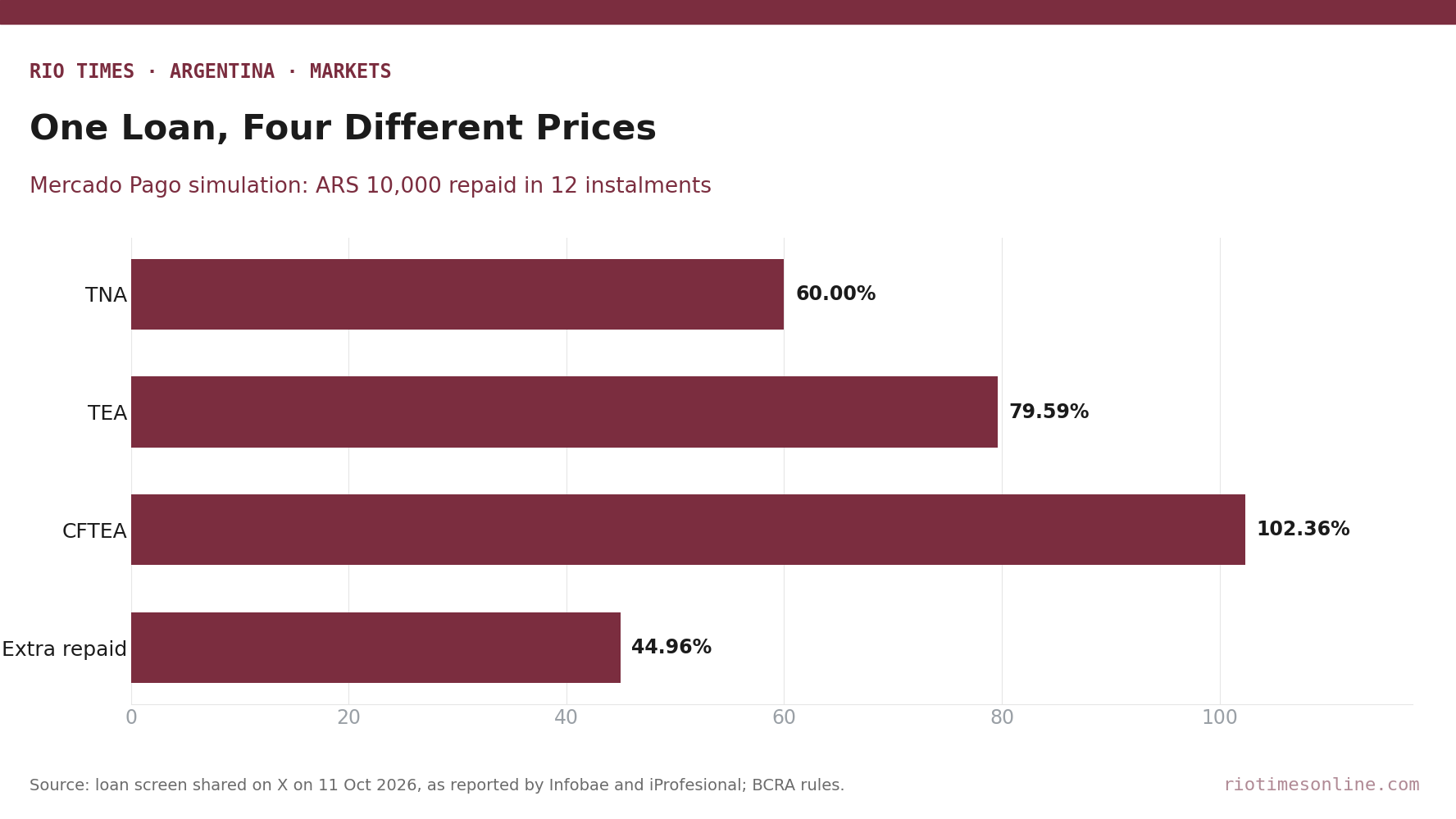
In the simulation, a borrower receives 10,000 pesos (about US$6.61) and pays 12 fixed instalments of 1,208.02 pesos (about US$0.80). The total repaid is 14,496.24 pesos (about US$9.58), at the BCRA reference rate of 1,512.50 pesos per US dollar on Tuesday 13 October.
The screen shows a nominal rate of 60%, which is 5% a month. Compounded over 12 months, that becomes the 79.59% effective annual rate, and taxes and charges lift the total annual cost to 102.36%.
Yet the borrower in this example repays about 45% more than they received, not 102%. That gap exists because each instalment repays part of the principal, so the balance shrinks through the year.
Mercado Pago made the same point in August, after reports that some of its loans showed annual costs of up to 1,375%. The company said then that only about 2% of its loans carried that top rate, according to Infobae.
Etchebarne’s reply is that an annualised figure lets borrowers compare loans of different lengths on one scale. That is the logic of the BCRA rule, and Galperin’s reported posts did not propose a replacement measure.
For background, see Mercado Libre’s Founder Faces a Criminal Usury Complaint Over Loans Costing Up to 1,375% a Year. For the company’s recent debt sale, read MercadoLibre Raises US$1 Billion in Ten-Year Notes.
What It Means for US Readers
For MELI shareholders, the Mercado Libre loan cost dispute shows that lending in Argentina is regulated and politically sensitive. A headline cost above 100% invites scrutiny from courts, consumer groups and lawmakers, even when the cash cost is far lower.
The stabiliser is that the rule has applied since at least 2018, so lenders already work within it. No BCRA communication announcing a change had been published by Tuesday.
For Americans living in Argentina or using local apps, the lesson is practical. Compare the total amount repaid in pesos as well as the annual percentage, because the two numbers answer different questions.
What Is Not Known
It is not known whether Mercado Libre will formally ask the BCRA to change the method or will challenge it in court. The company had issued no statement beyond Galperin’s posts by Tuesday evening.
It is also unclear how the government of President Javier Milei, a libertarian economist, will respond to the criticism. The BCRA had not commented publicly on Galperin’s claims at the time of writing.
Frequently Asked Questions
What did Marcos Galperin say about the BCRA rule?
On Monday 12 October he called the annual cost figure the central bank makes lenders publish false and inflated. He said it wrongly assumes compounding and repeated renewal over a year.
What is the CFTEA in Argentina?
It is the total financial cost of a loan expressed as an effective annual rate. Under BCRA rules it adds commissions, charges and certain taxes to the interest rate so borrowers can compare offers.
Is the rule new?
No. The current definition dates from a BCRA communication that took effect in July 2018. It applies to banks and registered non-bank lenders.
Does a 102% annual cost mean a borrower pays back double?
No. In the example shared on X, the borrower received 10,000 pesos (about US$6.61) and repaid about 45% more over 12 instalments.
Why does this matter to US investors?
The Mercado Libre loan cost row involves a Nasdaq-listed company, ticker MELI, that lends in Argentina through Mercado Pago. Rules on how loan prices are shown can affect demand and regulatory risk.
Sources: BCRA, Tasas de interés en las operaciones de crédito and Protección de los usuarios de servicios financieros (rules texts); BCRA reference exchange rate, Communication A 3500, 13 October 2026; Mercado Libre leadership transition release; Infobae; iProfesional; Perfil; Ámbito.
In depth
Editorial responsibility: Matthias Camenzind, Editor-in-Chief · Editorial standards · Report an error
LatAm Markets: Live Signals → — real-time movers, turnover leaders and FX across Latin America.