Argentina Markets: Merval & the Peso — September 29, 2026
Key Facts
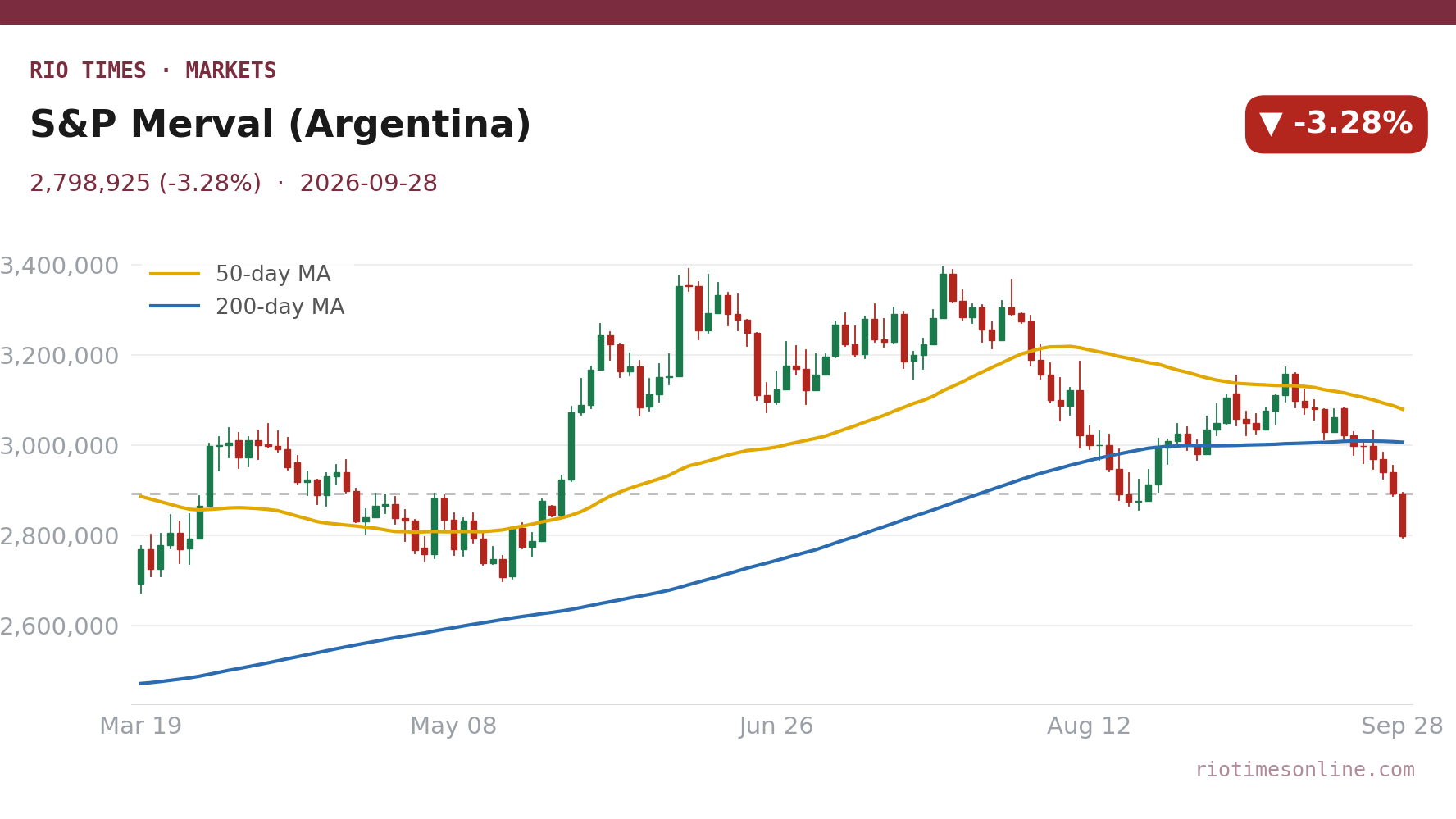
- Merval sinks: the S&P Merval, Argentina’s main stock index, closed at 2,798,925 points, a drop of 3.28% and its lowest close since 20 May.
- Country risk spikes: the JPMorgan gauge of extra yield on Argentine debt rose about 19 points to close near 628 basis points, after touching the year’s high above 640 during the day.
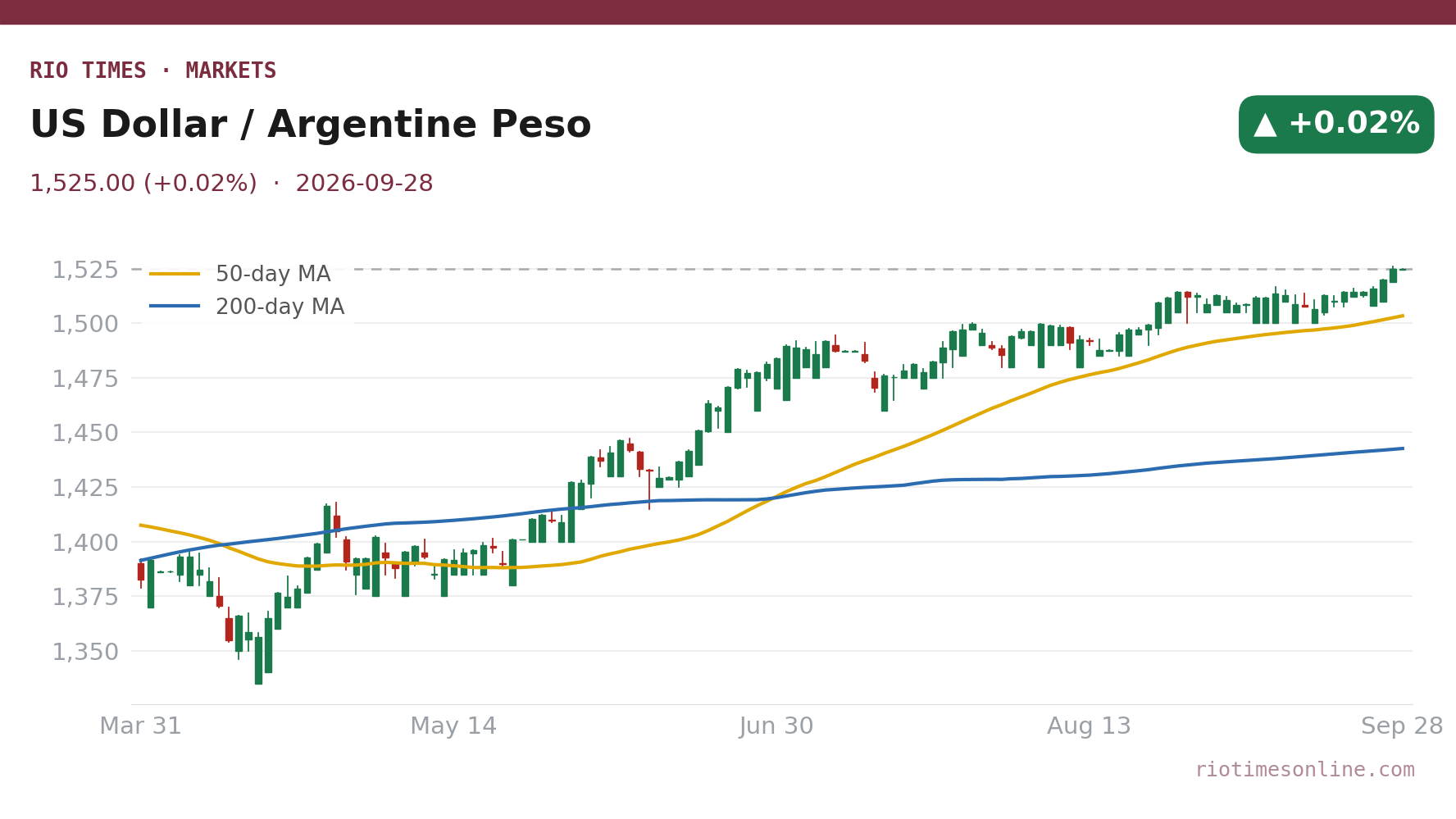
- Peso holds steady: the dollar traded at 1,525 pesos per US dollar, up just 0.02%, the weakest peso close of the past 52 weeks but far inside the official band.
- Broad sell-off: Grupo Galicia fell 4.5% and Banco Macro lost 3.8%, while gas transporter TGN dropped 7.1%.
- Wall Street weighs: US stocks fell, with the S&P 500 down 0.77%, adding to pressure on emerging-market assets.
Today’s Focus
Argentina’s stock market had a bruising session on Monday, September 28, with the S&P Merval index sliding 3.28% to close at 2,798,925 points. The sell-off came as country risk—the premium investors demand to hold Argentine government debt—rose to about 628 basis points at the close, after climbing above 640 during the day, the highest level of the year.
Banks were hit hard, with Grupo Galicia, one of the country’s largest private banks, down 4.5%, and Banco Macro losing 3.8%. Gas and energy names fell even further, led by TGN, down 7.1%. The peso, meanwhile, held steady at 1,525 per US dollar, with the dollar up just 0.02% on the day. The currency traded well inside the official exchange-rate band, whose ceiling stood near 1,917 per US dollar.
The pressure is part of a broader story: investors are increasingly nervous about the durability of President Milei’s reform agenda and the government’s ability to roll over its debts. La Nación reported that private investors now hold more than US$12 billion worth of dollar-linked bonds, a hedge against devaluation and a sign of how jittery the market has become.
What matters today. The Merval’s slide reflects a sharp rise in perceived sovereign risk, not a collapse in the peso, keeping bank stocks under intense pressure.
01 The session in one read
Argentina’s stock market fell sharply on Monday, September 28, as investors hedged against rising government debt risk. The S&P Merval, the country’s benchmark peso-denominated stock index, closed at 2,798,925 points, a drop of 3.28% on the day.
The sell-off was broad. Gas transporter TGN (−7.1%) and gas distributor Ecogas (−6.0%) were among the steepest fallers, and banks were hit hard too. Grupo Galicia, the private bank whose stock is one of the most traded on the local exchange, fell 4.5%, while Banco Macro lost 3.8%.
The trigger was a sharp rise in country risk—the extra yield investors demand to hold Argentine government bonds instead of US Treasuries. That measure, compiled by JPMorgan, rose about 19 points to close near 628 basis points, after trading above 640 during the day, the highest level of the year, according to Infobae.
Despite the equity rout, the peso barely moved. The dollar traded at 1,525 pesos per US dollar, up just 0.02% on the session. The central bank bought a small US$11 million in the market.
The evidence is clear: the Merval’s 3.28% drop coincided with a country-risk reading that climbed further above 600 basis points and closed near 628, up from 609 on Friday. Rising country risk makes it more expensive for the government to borrow, which hurts banks holding sovereign debt and clouds the outlook for the Milei reform trade. The peso’s stability at 1,525 per US dollar is reassuring, and the currency remains far from the ceiling of its official band. The variable to watch is whether country risk continues to climb toward the 700-point mark, which would signal deeper doubts about Argentina’s financing plan.
02 The day’s numbers
| Measure | Level | Change | Read |
|---|---|---|---|
| S&P Merval | 2,798,925 | −3.28% | Lowest close since 20 May |
| USD/ARS | 1,525 | +0.02% | Highest close in 52 weeks |
| 52-week range | 1,348–1,525 | — | Peso at weak end of its yearly range |
| Country risk | 628 | +19 bp | Touched year’s high above 640 intraday |
The Merval’s 3.28% drop stands out because it came on a day when the peso barely moved. That disconnect tells you the selling was about Argentina’s debt story, not a run on the currency.
The peso’s 52-week range runs from 1,348 to 1,525 per US dollar. Trading at the very top of that range means the peso is at its weakest close of the past year. The official band still leaves room, with its ceiling near 1,917 per US dollar.
Live Market IntelligenceArgentina — Live Market Board
Rio Times · Live Market Intelligence
Argentina — Live Market Board
| Instrument | Last | Change | YoY | Prev. | High | Low | Volume |
|---|---|---|---|---|---|---|---|
| MERVAL | 2,798,925 | -3.28% | +30.51% | 3,022,485 | 3,042,365 | 2,991,150 | — |
| USD/ARS | 1,493 | +0.10% | +12.96% | 1,491 | 1,494 | 1,480 | — |
| YPF | 7,810 | +0.26% | +72.84% | 7,790 | 7,850 | 7,600 | 1,763,858 |
| GGAL | 6,980 | -0.78% | +1.82% | 7,035 | 7,115 | 6,920 | 1,564,062 |
| PAMPA | 5,115 | +0.69% | +26.70% | 5,080 | 5,140 | 5,000 | 721,190 |
| TXAR | 747.50 | -2.35% | +18.67% | 765.50 | 770.00 | 742.50 | 771,892 |
| ALUAR | 938.00 | -1.21% | +29.83% | 949.50 | 951.00 | 932.50 | 135,426 |
| TGS | 8,870 | -0.17% | +15.05% | 8,885 | 9,075 | 8,720 | 143,546 |
| CEPU | 2,156 | +1.84% | +28.36% | 2,117 | 2,165 | 2,086 | 404,146 |
| MIRGOR | 1,650 | -1.20% | -92.90% | 1,670 | 1,670 | 1,635 | 20,877 |
| COME | 40.93 | -0.73% | -30.47% | 41.23 | 41.60 | 40.50 | 4,258,884 |
| LOMA NEGRA | 3,130 | +0.08% | +5.80% | 3,128 | 3,205 | 3,090 | 182,992 |
| BYMA | 275.00 | -1.70% | +35.14% | 279.75 | 282.50 | 272.00 | 1,409,575 |
| TELECOM ARG | 4,233 | -0.70% | +55.19% | 4,263 | 4,335 | 4,160 | 31,896 |
| GLOBANT | 38.10 | -2.26% | -49.65% | 38.98 | 38.70 | 36.77 | 793,552 |
| MERCADOLIBRE | 1,870 | -3.59% | -20.71% | 1,940 | 1,927 | 1,870 | 329,640 |
03 Why it moved — country risk hits the year’s high
The main driver was a spike in Argentina’s country risk, which closed near 628 basis points after touching the year’s high above 640. This measure reflects the premium investors demand to hold Argentine government bonds, and when it rises, it signals growing doubts about the government’s ability to repay its debts.
La Nación reported that private investors now hold more than US$12 billion worth of dollar-linked bonds, a form of insurance against a sudden peso devaluation. That hedging activity is a sign of how nervous the market has become about the sustainability of the Milei reform programme.
The government’s financing needs are also in focus. The Treasury rolled over 100.08% of the peso debt maturing on Monday, La Nación reported, with dollar-linked bonds taking 21% of the allocation. October still brings about 27 trillion pesos (about US$17.7 billion) of maturities. That heavy calendar is keeping investors on edge.
The Wall Street backdrop did not help. The S&P 500 fell 0.77% and the Nasdaq lost 0.92%, as US Treasury yields climbed, making riskier emerging-market assets less attractive.
04 The day’s movers
| Driver | Level / Move | Change | Note |
|---|---|---|---|
| Grupo Galicia | US$25m turnover | −4.5% | Most-traded name, hit by country-risk spike |
| YPF | US$17m turnover | −1.6% | State oil firm, relative outperformer |
| Banco Macro | US$3.5m turnover | −3.8% | Bank stock, sensitive to sovereign risk |
| Pampa Energía | US$4m turnover | −1.8% | Energy utility, defensive but still lower |
| Central Puerto | US$3m turnover | −2.5% | Power generator, tracked the broad decline |
The most-traded stock was Grupo Galicia, with US$25 million in turnover, and it fell 4.5%. That is a clear signal: when Argentina’s largest private bank is the most sold name, the market is worried about sovereign debt exposure, because banks hold large amounts of government bonds.
YPF, the state-controlled oil company, was the relative bright spot, falling only 1.6% with US$17 million in turnover. Its oil-linked revenues give it some insulation from purely domestic financial risk, but it could not escape the broad sell-off.
05 The regional scoreboard
| Index | Country | Change |
|---|---|---|
| S&P Merval | Argentina | −3.28% |
| Ibovespa | Brazil | −0.26% |
| IPC | Mexico | −0.07% |
| IPSA | Chile | −1.06% |
| COLCAP | Colombia | −0.33% |
Argentina’s Merval was the worst performer in Latin America on Monday, falling 3.28% while the other main regional indices posted smaller declines. Chile’s IPSA was the second-worst, down 1.06%, reflecting its own sensitivity to global commodity prices.
Brazil’s Ibovespa slipped just 0.26%, a relatively calm session for the region’s largest market. The live market board above carries the current closing levels for all regional indices.
06 The technical picture
The Merval closed at 2,798,925 points, near the session low and well below the day’s high of 2,894,985. It was the lowest close since 20 May and the seventh straight daily decline. The index now sits about 17% below its 22 July peak of 3,379,772.
Over a 12-month view, the Merval remained about 56% higher, so the long-term uptrend is still intact. But the short-term momentum has turned decisively negative.
On the currency side, the peso is at the weak end of its 52-week range, trading at 1,525 per US dollar. The band ceiling near 1,917 per US dollar leaves room for further weakness before the central bank must sell dollars. A further spike in country risk could add pressure.
07 What to watch
- Country risk: Whether the JPMorgan gauge holds above 600 or pushes toward 700, which would deepen pressure on bank stocks.
- Treasury auctions: October’s maturities of about 27 trillion pesos (about US$17.7 billion) will test investor appetite.
- Milei reform trade: Milei is due to address the IDEA business conference in Mar del Plata, which opens on Wednesday, by live video link from Paris; any signal of policy commitment or backsliding will matter.
- US Treasury yields: The US 10-year yield at 5.244% is a headwind for all emerging-market assets, including Argentina.
Background: Merval Falls 1.29% as Argentine ADRs Slide Across Latin America.
Frequently Asked Questions
What is the Merval?
The S&P Merval is Argentina’s main stock index, tracking the largest companies listed on the Buenos Aires exchange. It is measured in Argentine pesos.
What is country risk?
Country risk is the extra yield investors demand to hold a country’s government bonds instead of safe US debt. A reading of 628 basis points means Argentina pays 6.28 percentage points more than the US Treasury rate.
Why did the peso barely move?
Argentina’s peso floats within an official exchange-rate band, and the central bank steps in at the band’s limits. On Monday, the dollar traded at 1,525 pesos per US dollar, far below the band ceiling near 1,917.
Which stocks suffered most?
Gas and energy names fell hardest, led by gas transporter TGN (−7.1%), farmland group Cresud (−6.6%) and gas distributor Ecogas (−6.0%). Banks were also hit: Grupo Galicia fell 4.5% and Banco Macro lost 3.8%, as rising country risk hurts lenders that hold government bonds.
Merval — Source: RT live market data, close of Monday 28 September 2026 (Merval: BYMA close); exchange figures from BYMA
This article was produced by The Rio Times’ automated newsroom system. How we use AI · Report an error
LatAm Markets: Live Signals → — real-time movers, turnover leaders and FX across Latin America.
Read More from The Rio Times