Argentina Markets: Merval & the Peso — July 14, 2026
Key Facts
- The S&P Merval rallied 2.43% to close at 3,280,223.50 points, extending a break above the 3.2 million resistance band in thin, bridge-holiday volume.
- Grupo Galicia was the engine of the session, with its domestic shares and New York-listed ADRs surging 5.8% as the purest expression of the bank-led reform trade.
- Argentina’s country risk tightened to the 400-point threshold, its lowest since April 2018, after Economy Minister Luis Caputo’s 2026–2027 financing plan convinced markets the sovereign can manage its debt wall.
- YPF and Pampa Energía were the session’s notable domestic laggards, falling 1.8% and 0.5% respectively even as the broader energy and utility complex gained abroad.
- The official peso sat frozen at 1,488 per dollar, pinned near the weak edge of its managed band at a moment when local risk assets were being bid aggressively.
Today’s Focus
Argentina’s S&P Merval surged 2.43% to 3,280,223.50 on Monday, its best session in over a week, as a collapse in sovereign risk to an eight-year low powered a fierce rally in financial stocks. The move was driven almost entirely by banks, with Grupo Galicia jumping 5.8% on both the local board and in New York, as investors bet that President Javier Milei’s fiscal discipline and a credible debt roadmap from Economy Minister Luis Caputo are re-rating the entire country.
Country risk, as measured by the EMBI+ spread, closed near 400 basis points, a threshold not seen since April 2018. The compression follows Caputo’s newly unveiled 2026–2027 financing plan, which convinced bondholders that Argentina can honour its foreign-currency obligations without resorting to net new debt. That confidence flowed straight into financial equities, with Banco Macro and Central Puerto ADRs leaping between 5.8% and 9% in New York.
The rally had a narrow footprint. Volume was thin, with US markets closed for a bridge holiday on Monday, and the local board was described as near-empty. YPF and Pampa Energía were the only domestic decliners of note, shedding 1.8% and 0.5%, suggesting the session was less about energy fundamentals and more a targeted bet on the reform-sensitive financial sector.
The peso remained a non-factor. The official USD/ARS rate was flat at 1,488, sitting motionless near the weak extreme of its managed band. The contrast between a static currency and a soaring equity index underscores the nature of this trade: it is not a broad macro revaluation but a surgical bet on regulatory and fiscal liberalisation flowing through bank balance sheets and utility concessions.
What matters today. The Merval’s rally is a pure play on legislative and fiscal reform credibility, with banks acting as the high-beta vehicle for foreign and local bets on Argentina’s return to capital markets.

01 The session in one read
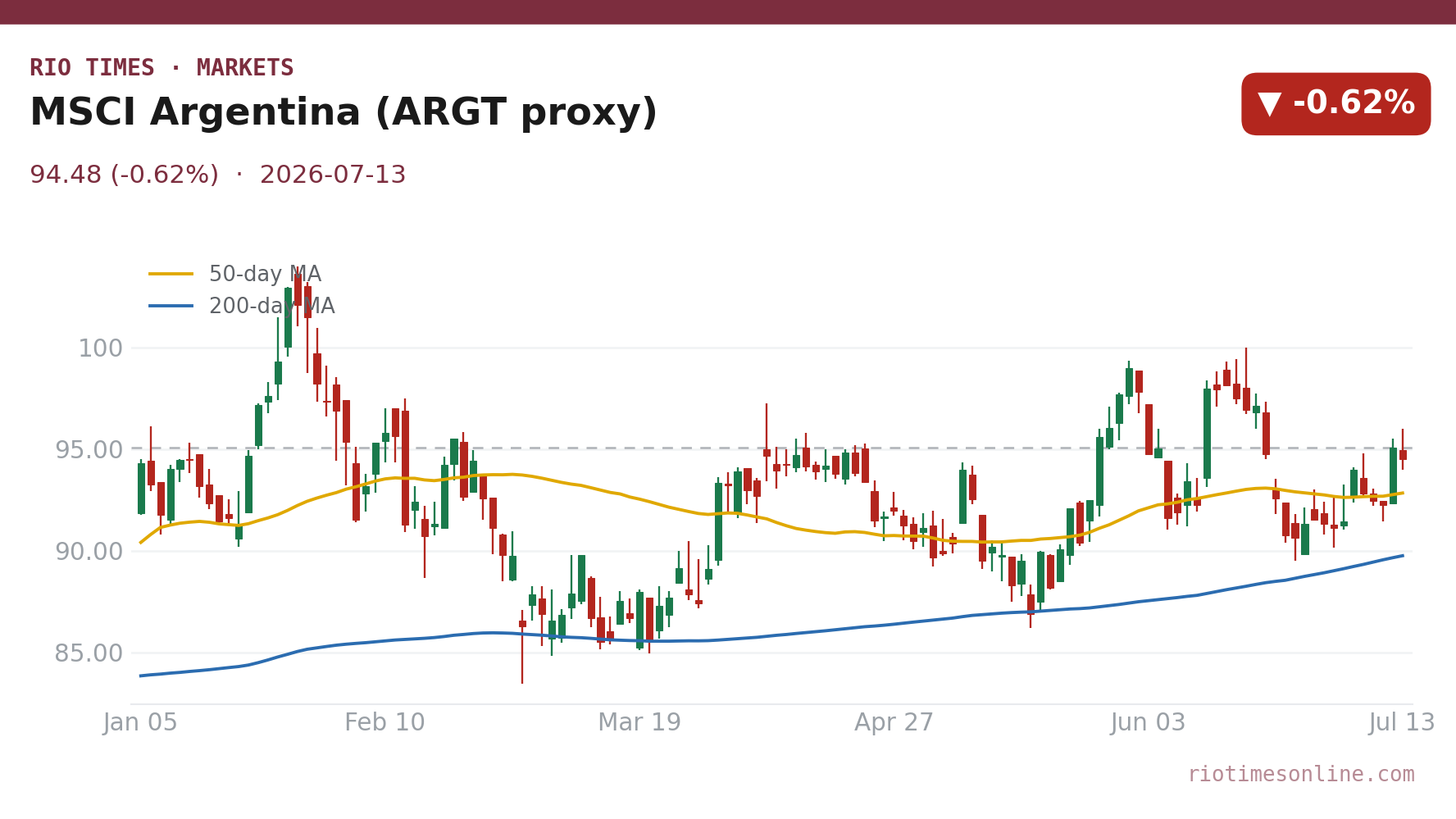
The S&P Merval climbed 2.43% to 3,280,223.50 on Monday, breaching the 3.2 million-point ceiling that had capped the index since late June. This was the benchmark’s strongest session in over a week, achieved on thin turnover as US markets observed a bridge holiday. The index opened near its session low of 3,193,070 and ground steadily higher, closing just shy of the intraday high at 3,285,580.
Grupo Galicia was the star of the session, surging 5.8% and drawing US$11 million in local-market turnover — far and away the most-traded name. The bank’s New York-listed ADR matched the 5.8% gain. Banco Macro and Central Puerto ADRs followed closely, jumping in a range of 5.8% to 9% as the reform trade broadened into utilities.
YPF and Pampa Energía bucked the trend. YPF’s domestic shares fell 1.8%, and Pampa shed 0.5%, isolating the rally to financials and select infrastructure plays. The peso was inert: the official USD/ARS rate held at 1,488, flat on the day and parked near the weak end of its 1,273–1,492 managed corridor.
The evidence for a genuine re-rating rests squarely on country-risk compression: a sub-400 EMBI spread signals bond-market conviction that Argentina’s 2027 debt wall is manageable. That is a material and verifiable shift. However, Monday’s equity rally came on exceptionally thin volume and was concentrated in a handful of financial names, with energy stocks lagging and the local board mostly empty. A durable rotation needs confirmation from higher turnover, broader sector participation, and a follow-through move when US liquidity returns. The variable to watch is whether Banco Macro and Galicia can hold these gains into a full-session New York day, and whether country risk breaks decisively below 400 basis points.
02 The day’s numbers
| Measure | Level | Change | Read |
|---|---|---|---|
| S&P Merval | 3,280,223.50 | +2.43% | Break above 3.2m resistance; close near session high |
| Merval session range | 3,193,070 – 3,285,580 | — | Rally from open to near high on thin volume |
| USD/ARS (official) | 1,488 | 0.00% | Pinned at the weak edge of 1,273–1,492 band |
| ARGT ETF proxy | 94.48 | −0.62% | −7.9% below 52-week high; global drag offset local strength |
| S&P 500 | 7,515 | −0.79% | US equities weaker on Brent spike and AI-tech pressure |
The Merval’s 2.43% gain took it decisively above the 3.15–3.20 million range that had contained the index through late June and early July. Finishing near the 3.29 million intraday high gives the breakout technical credibility, though the absence of US liquidity means conviction remains untested.
The peso’s stasis at 1,488 is notable because it decouples the equity rally from any currency tailwind. This was not a trade on a weaker peso boosting exporter profits — it was a pure re-rating of domestic financial risk. Rio Times · Live Market Intelligence
Live Market IntelligenceArgentina — Live Market Board
Argentina — Live Market Board
Instrument Last Change YoY Prev. High Low Volume
MERVAL
2,848,932
-0.35%
+30.51%
3,022,485
3,042,365
2,991,150
—
USD/ARS
1,493
+0.10%
+12.96%
1,491
1,494
1,480
—
YPF
7,810
+0.26%
+72.84%
7,790
7,850
7,600
1,763,858
GGAL
6,980
-0.78%
+1.82%
7,035
7,115
6,920
1,564,062
PAMPA
5,115
+0.69%
+26.70%
5,080
5,140
5,000
721,190
TXAR
747.50
-2.35%
+18.67%
765.50
770.00
742.50
771,892
ALUAR
938.00
-1.21%
+29.83%
949.50
951.00
932.50
135,426
TGS
8,870
-0.17%
+15.05%
8,885
9,075
8,720
143,546
CEPU
2,156
+1.84%
+28.36%
2,117
2,165
2,086
404,146
MIRGOR
1,650
-1.20%
-92.90%
1,670
1,670
1,635
20,877
COME
40.93
-0.73%
-30.47%
41.23
41.60
40.50
4,258,884
LOMA NEGRA
3,130
+0.08%
+5.80%
3,128
3,205
3,090
182,992
BYMA
275.00
-1.70%
+35.14%
279.75
282.50
272.00
1,409,575
TELECOM ARG
4,233
-0.70%
+55.19%
4,263
4,335
4,160
31,896
GLOBANT
38.10
-2.26%
-49.65%
38.98
38.70
36.77
793,552
MERCADOLIBRE
1,870
-3.59%
-20.71%
1,940
1,927
1,870
329,640
03 Why it moved — country-risk compression and the reform trade
The proximate trigger was Argentina’s country risk falling to the 400-basis-point threshold, its tightest since April 2018. Economy Minister Luis Caputo’s 2026–2027 financing plan, unveiled in recent sessions, convinced debt markets that the sovereign can navigate the 2027 foreign-currency wall without a restructuring. The EMBI+ spread has now compressed from above 2,000 basis points in late 2023 to around 400-500, a seismic shift in credit perception.
That shift flowed straight into bank stocks. Grupo Galicia and Banco Macro are the highest-beta plays on a normalising Argentine financial system, and Monday’s buying reflected conviction that Milei’s fiscal anchor — coupled with deregulation and labour reform — will allow banks to intermediate credit in a more stable environment. Central Puerto’s ADR surge extended the logic to regulated utilities, where a credible sovereign reduces the risk of tariff intervention.
The IMF’s 2026 Article IV review, published in recent weeks, endorsed the reform momentum, citing legislative progress on fiscal, trade and labour measures as well as refinements to the monetary and FX framework. That external validation matters: it reassures foreign desks that the Milei programme has institutional backing beyond Buenos Aires politics.
Critically, the rally ignored a softer US session. The S&P 500 fell 0.8% amid a near-10% spike in Brent crude and pressure on AI-linked tech stocks. Argentina decoupled, suggesting local catalysts — and the reform narrative — are currently dominating global beta.
04 The day’s movers
| Driver | Level / Move | Change | Note |
|---|---|---|---|
| Grupo Galicia (GGAL) | Local & ADR | +5.8% | Top turnover at $11m; pure reform-trade proxy |
| Banco Macro (BMA) | ADR | +5.8% to +9% | Bid with Galicia in bank-led rally; exact % unbroken |
| Central Puerto (CEPU) | ADR | +5.8% to +9% | Utility play on improved regulatory risk |
| YPF (YPFD) | Local shares | −1.8% | Session laggard despite energy-sector ADR gains |
| Pampa Energía (PAMP) | Local shares | −0.5% | Thin board; second domestic decliner |
| MELI (CEDEAR) | Cross-listed | +0.4% | MercadoLibre CEDEAR; mainly tracks US tape |
| META (CEDEAR) | Cross-listed | −1.5% | Meta CEDEAR; reflects US tech weakness |
The domestic board was dominated by Grupo Galicia, whose $11 million in turnover accounted for the bulk of local activity in a near-empty session. Its 5.8% surge was matched in New York, where Banco Macro and Central Puerto ADRs jumped in the same 5.8% to 9% range. The exact allocations within that band were not broken out, reflecting the fact that desks were buying a basket of reform-sensitive Argentine financial and utility risk rather than discriminating between tickers.
YPF and Pampa were the session’s only notable domestic decliners. YPF’s 1.8% drop is consistent with profit-taking after a strong run — its shares sit in the upper half of their 52-week range — while Pampa’s 0.5% dip likely reflects the lack of a specific catalyst in a holiday-thinned session. The Merval’s gain was entirely a financial-sector story on Monday.
05 The regional scoreboard
| Index | Country | Change |
|---|---|---|
| S&P Merval | Argentina | +2.43% |
| S&P 500 | United States | −0.79% |
| Dow Jones Industrial | United States | −0.26% |
| Nasdaq Composite | United States | −1.55% |
| Russell 2000 | United States | −0.83% |
Argentina’s Merval was the standout gainer against a broadly softer Americas equity backdrop. The S&P 500 lost 0.79% to 7,515, with the Nasdaq underperforming at −1.55% as AI-linked names sold off on the back of a near-10% spike in Brent crude and a sharp drop in SK Hynix shares in Seoul.
Verified closes for other Latin American benchmarks — Brazil’s Ibovespa, Mexico’s IPC, Chile’s IPSA, Peru’s S&P/BVL General — were not available in confirmed session data at the time of writing. The live market board above carries those closes where trading occurred.
06 The technical picture
Monday’s close at 3,280,223.50 extends a breakout above the 3.15–3.20 million resistance band that had contained the Merval since late June. The index opened at 3,193,070, held that level as a floor, and ground higher into the close, finishing within a few hundred points of the 3,285,580 intraday high. This is textbook breakout behaviour: a clean break of a well-defined range, followed by a session of follow-through that holds the gains.
The 52-week positioning reinforces the technical case. The Merval is up roughly 61% over the past 12 months, placing it in the upper quartile of its yearly range. With country risk now near 400 basis points and the index having cleared a multi-week ceiling, the next test is whether the breakout converts 3.2 million from resistance into support on any pullback.
The US-traded ARGT ETF — a proxy for Argentine equities — paints a more cautious picture, however. It fell 0.62% to 94.48 during the US session and sits 7.9% below its 52-week high of 102.57. The divergence between a soaring Merval and a softer ARGT likely reflects the ETF’s inclusion of names that did not participate in Monday’s rally, as well as the fact that ARGT prices in New York during hours when local Buenos Aires trade is closed. A clean read requires both to confirm in the same session.
07 What to watch
- Country risk threshold: Will the EMBI+ spread break decisively below 400 basis points? A sub-400 print would be the strongest signal since April 2018 that markets believe Argentina is on a durable path back to capital-market access.
- Banco Macro and Galicia follow-through: Monday’s rally was built on financials. If these names hold gains — or add to them — when US liquidity returns, the breakout gains credibility; a sharp reversal would suggest the move was holiday-thin noise.
- YPF divergence: YPF’s 1.8% drop on a day when utilities and banks surged is worth monitoring. If the energy heavyweight fails to join the rally, it raises questions about how broad-based the reform re-rating really is.
- US CPI and Fed expectations: Global rate-sensitive positioning matters for Argentine risk. Any shift in US rate-cut expectations following upcoming CPI data could either amplify or unwind the carry-trade logic underpinning the country-risk compression.
Background: Argentina’s Inflation Is Falling Monthly and Rising Annually.
Background: Argentina Paid 44% of Its Year’s Dollar Debt in a Single Day.
More: Argentina news in English, every day from The Rio Times.
Frequently Asked Questions
Why did the Merval jump 2.4% on Monday?
Argentina’s country risk fell to its lowest level since April 2018, near 400 basis points, after Economy Minister Luis Caputo’s 2026–2027 financing plan convinced markets the sovereign can manage its foreign-currency debt wall. That credit improvement flowed straight into bank stocks.
Why did Galicia and Banco Macro surge while YPF fell?
Banks are the highest-beta play on a normalising Argentine economy: lower sovereign risk means a more stable environment for credit intermediation. YPF, meanwhile, faces idiosyncratic energy-sector dynamics and may have been subject to profit-taking after a strong recent run.
What does country risk hitting an eight-year low actually mean?
The EMBI+ spread measures the premium Argentina pays to borrow relative to US Treasuries. At 400 basis points, it signals bondholders believe default risk has fallen dramatically from the 2,000+ levels seen before Milei took office, reflecting confidence in his fiscal discipline and reform programme.
Is the peso’s stasis at 1,488 a concern?
The flat peso reflects the government’s managed exchange-rate policy, not market equilibrium. For equity investors, a stable currency removes one source of volatility, but it also means the Merval rally is purely a financial-sector re-rating — not a broad macro repricing driven by a weaker peso boosting exporter earnings.
This article was produced by The Rio Times’ automated newsroom system. How we use AI · Report an error · Editorial responsibility: Matthias Camenzind, Editor-in-Chief
LatAm Markets: Live Signals → — real-time movers, turnover leaders and FX across Latin America.