IBOV 183,827.59 ▲ 0.46% IPSA 11,055.91 ▼ 0.73% IPC MEX 65,110.57 ▲ 0.26% MERVAL 2,782,561 — 0.00% COLCAP 2,558.92 ▼ 0.79% BVL PERÚ 60,220.45 ▲ 0.32% USD/BRL5.18▼ 0.52% USD/MXN18.04▼ 0.03% USD/CLP971.96▼ 0.10% USD/COP3,333▼ 1.05% USD/PEN3.44▲ 0.04% USD/ARS1,524▼ 0.05% USD/UYU40.27▲ 3.67% USD/PYG5,843▲ 2.30% USD/BOB11.96▲ 0.45% USD/DOP59.27▲ 0.12% USD/CRC452.68▲ 2.68% USD/GTQ7.64▲ 3.13% USD/HNL26.87▲ 3.23% USD/NIO36.62▲ 0.34% USD/VES856.92▲ 0.01% USD/PAB1.00— 0.00% USD/BZD2.00— 0.00% USD/JMD 157.28 — 0.00% USD/TTD6.70▲ 1.64% EUR/BRL5.88▼ 0.85% BRENT 88.88 ▼ 0.03% WTI 83.11 ▼ 0.11% IRON ORE 161.91 — — COPPER 6.61 ▲ 0.03% GOLD 4,461 ▲ 1.78% SILVER 65.59 ▲ 1.26% SOY 1,184 ▲ 3.20% CORN 480.50 ▲ 10.02% WHEAT 655.00 ▲ 3.93% COFFEE 317.25 ▼ 5.51% SUGAR 16.43 ▼ 1.79% ORANGE JUICE 138.55 ▼ 0.47% COTTON 85.03 ▲ 2.33% COCOA 5,719 ▲ 3.18% BEEF 223.60 ▼ 3.93% CATTLE 339.10 ▼ 3.16% LITHIUM 75.20 ▲ 1.47% PETR4 41.64 ▼ 0.05% VALE3 72.97 ▲ 0.83% ITUB4 38.60 ▼ 1.03% BBDC4 16.85 ▲ 0.36% ABEV3 14.89 ▼ 0.80% BBAS3 19.37 ▲ 0.47% B3SA3 14.26 ▼ 0.21% WEGE3 47.59 ▲ 0.49% PRIO3 59.14 ▼ 0.19% SUZB3 41.33 ▲ 2.35% RENT3 34.68 ▼ 0.09% AZZA3 15.89 ▼ 2.63% CSAN3 3.22 ▼ 1.83% RAIZ4 0.25 — 0.00% PCAR3 2.75 ▼ 0.36% GMAT3 3.65 ▼ 1.08% PSSA3 48.13 ▼ 0.54% CVCB3 1.33 ▼ 2.92% POSI3 3.36 ▲ 2.44% SLCE3 13.34 ▲ 0.30% NATU3 8.14 ▼ 0.73% IBOV 183,827.59 ▲ 0.46% IPSA 11,055.91 ▼ 0.73% IPC MEX 65,110.57 ▲ 0.26% MERVAL 2,782,561 — 0.00% COLCAP 2,558.92 ▼ 0.79% BVL PERÚ 60,220.45 ▲ 0.32% USD/BRL 5.16 ▲ 0.01% USD/MXN 17.06 ▼ 0.24% USD/CLP 913.98 ▲ 0.04% USD/COP 3,140 ▲ 0.03% USD/PEN 3.36 ▼ 0.66% USD/ARS 1,493 ▲ 0.10% USD/UYU 40.27 ▲ 1.24% USD/PYG 5,939 ▲ 1.68% USD/BOB 11.64 ▼ 0.76% USD/DOP 58.34 ▲ 1.25% USD/CRC 445.92 ▲ 0.89% USD/GTQ 7.62 ▲ 2.21% USD/HNL 26.79 ▲ 1.57% USD/NIO 36.62 ▲ 0.69% USD/VES 762.44 ▼ 0.13% USD/PAB 1.00 — 0.00% USD/BZD 2.00 — 0.00% USD/JMD 157.28 — 0.00% USD/TTD 6.70 ▲ 0.61% EUR/BRL 5.95 ▲ 1.01% BRENT 88.88 ▼ 0.03% WTI 83.11 ▼ 0.11% IRON ORE 161.91 — — COPPER 6.61 ▲ 0.03% GOLD 4,461 ▲ 1.78% SILVER 65.59 ▲ 1.26% SOY 1,184 ▲ 3.20% CORN 480.50 ▲ 10.02% WHEAT 655.00 ▲ 3.93% COFFEE 317.25 ▼ 5.51% SUGAR 16.43 ▼ 1.79% ORANGE JUICE 138.55 ▼ 0.47% COTTON 85.03 ▲ 2.33% COCOA 5,719 ▲ 3.18% BEEF 223.60 ▼ 3.93% CATTLE 339.10 ▼ 3.16% LITHIUM 75.20 ▲ 1.47% PETR4 41.64 ▼ 0.05% VALE3 72.97 ▲ 0.83% ITUB4 38.60 ▼ 1.03% BBDC4 16.85 ▲ 0.36% ABEV3 14.89 ▼ 0.80% BBAS3 19.37 ▲ 0.47% B3SA3 14.26 ▼ 0.21% WEGE3 47.59 ▲ 0.49% PRIO3 59.14 ▼ 0.19% SUZB3 41.33 ▲ 2.35% RENT3 34.68 ▼ 0.09% AZZA3 15.89 ▼ 2.63% CSAN3 3.22 ▼ 1.83% RAIZ4 0.25 — 0.00% PCAR3 2.75 ▼ 0.36% GMAT3 3.65 ▼ 1.08% PSSA3 48.13 ▼ 0.54% CVCB3 1.33 ▼ 2.92% POSI3 3.36 ▲ 2.44% SLCE3 13.34 ▲ 0.30% NATU3 8.14 ▼ 0.73%
since 2009
Wednesday, September 30, 2026

Argentina Ecuador

Argentina and Ecuador – LatAm’s riskiest countries after restructuring in 2020

By · May 23, 2023 · 3 min read

The LatAm Brief

One email, every weekday morning. What moved in Latin American markets, politics and expat life.

Yesterday’s subject line: “Colombia decides rates today, near its own debt ceiling”

Free. We send a confirmation link first — nothing arrives until you click it. Unsubscribe with one click in any edition. If you stop opening us for 30 days we stop sending by ourselves, as we assume the interest is no longer there. See our privacy policy. We never share your email.

By Juan Pablo Álvarez

Argentina and Ecuador restructured their debts with private creditors in 2020 within the framework of the coronavirus quarantines.

They did it in a very different way.

Free daily brief — no card needed
Get every Argentina story in one morning email
We build you a personalized brief around the topics you follow — free for 7 days. Love it? Your first month after that is US$1.

While Guillermo Lasso’s administration took three months and did it after a previous agreement with the International Monetary Fund, Alberto Fernández’s team took more than twice as long and without a previous deal with the IMF.

Ecuador’s President Guillermo Lasso and Argentina’s President Alberto Fernández
One-stop reference
Company Intelligence
Every listed company in Latin America — financials, ownership and structure for 1,450+ companies across 26 exchanges, in one place.
Browse the directory →
RT
Ask Rio Times
17 years of Latin America reporting, on demand.
Open the full Ask Rio Times →

This difference caused both restructurings to have divergent paths: as an example, while Argentina closed 2022 with a country risk of 2,162 units, Ecuador did the same at 1,255 basis points.

However, the political crisis faced by President Lasso in Ecuador – he has just dissolved the Assembly and called for elections for executive and legislative positions, anticipating his impeachment – severely damaged sovereign bonds and, at this moment, Ecuador’s country risk stands at 1,857 points (against 2,596 of Argentina).
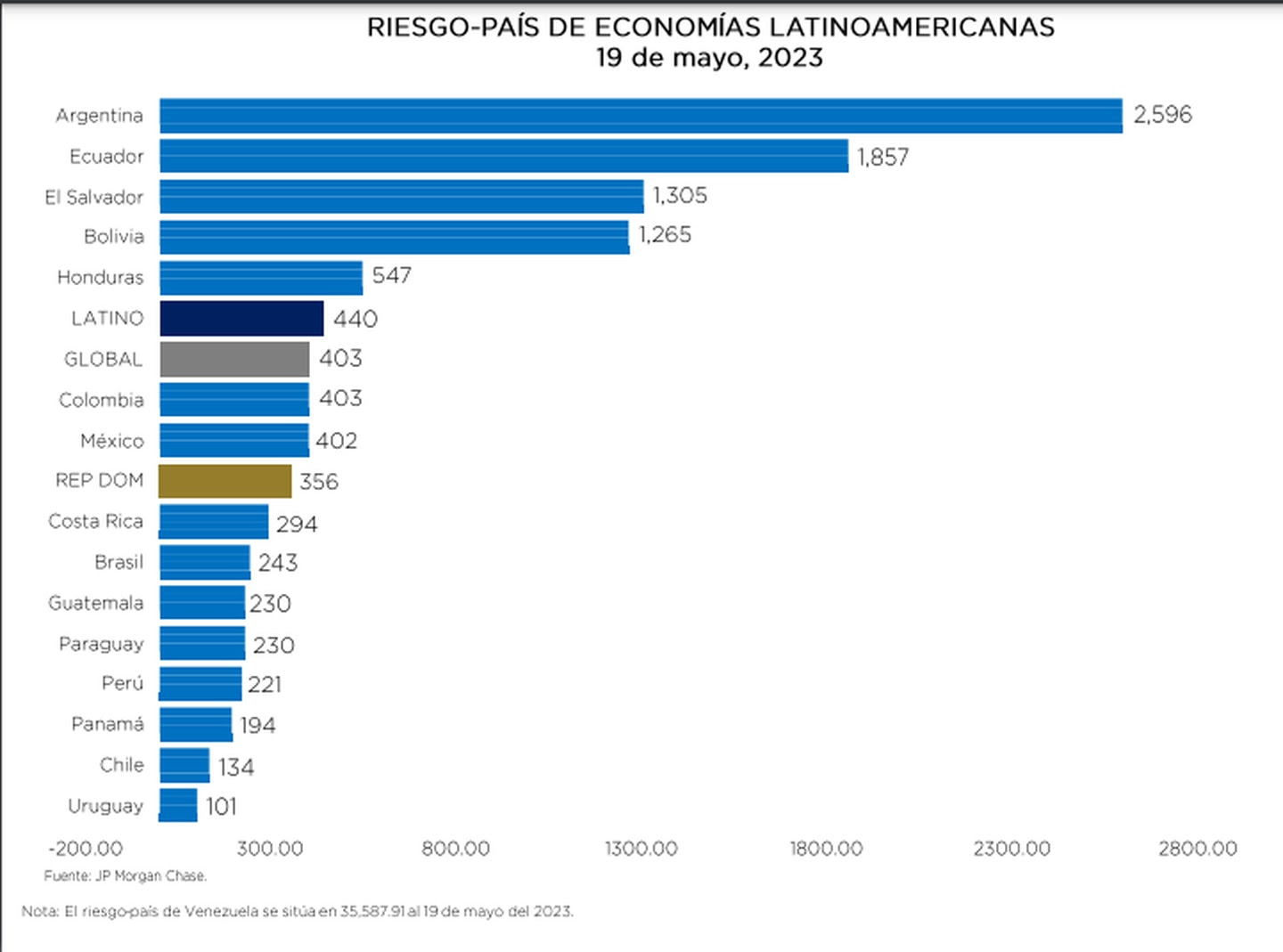
Country risk in Latin America. Source: Central Bank of the Dominican Republic, based on JP Morgan

Both states currently have the second and third worst country risk in Latin America since the first place is occupied by Nicolás Maduro’s Venezuela (35,587.91 units).

In this context, the Argentine consulting firm Quantum Finanzas prepared a study on the evolution of both debt restructurings.

THIS IS HOW ARGENTINA’S AND ECUADOR’S DEBTS EVOLVED

The average price of Ecuador’s sovereign debt in dollars is 40/100, while Argentina’s is 26.5/100 (Global bonds).

“The recent sharp correction in the price of Ecuador’s (from almost 60/100 in January) can, in part, be associated with general asset price movements in the region following last year’s Q4 rally, but also with political tensions,” the Quantum paper notes.
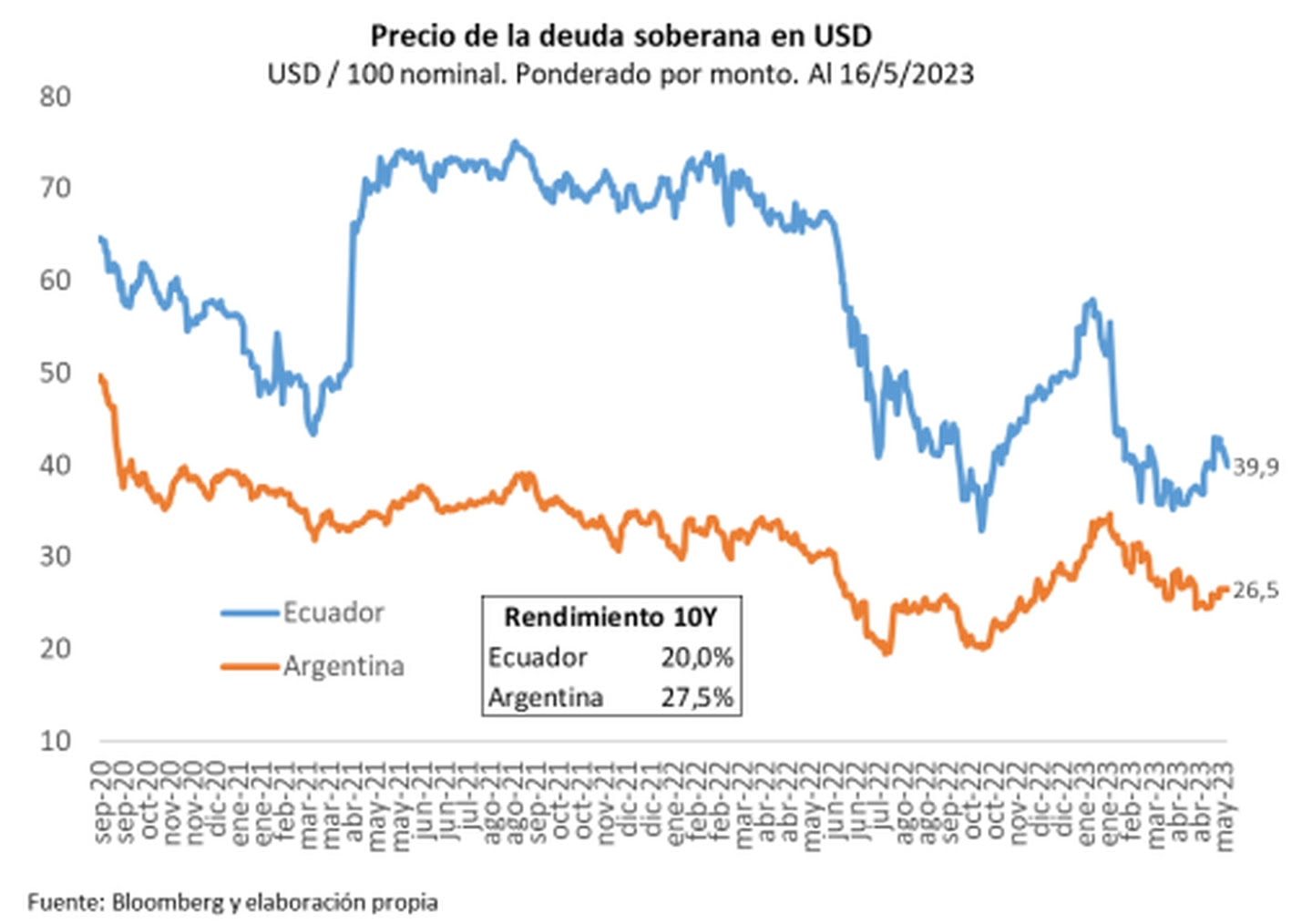
Price of sovereign debt in US dollars

According to Quantum, the upside of Argentina’s debt prices in a scenario of relative normalization is higher -even considering a future restructuring, entry prices would more than offset it- than that of Ecuadorian bonds”.

DIFFERENCES BETWEEN THE TWO COUNTRIES

The Quantum report notes that Ecuador’s economy is “stable” and has been dollarized since 2000.

It also notes that the country has maintained positive growth rates in recent years, but the political crisis has escalated.

“The outcome of the political crisis anticipates greater strength and dominance of the line of former President Rafael Correa.”

“In Argentina, on the other hand, the economic crisis has been manifesting itself in one form or another for some time and was practically constant in the period we are considering.”

“This derives in political tensions, which, however, are contained within a general institutional framework that maintains republican forms and practices, without interruptions,” Quantum compares.

Quantum Finanzas maintains that Ecuador’s economic indicators are “substantially better” than those of Argentina in terms of inflation, external sector, fiscal balance, and public debt, although it clarifies:

“The question is whether dollarization and its rigidity in terms of economic policy decisions, beyond the fact that it allowed sustaining stability for many years in Ecuador and that, in general, the economy shows better indicators than Argentina, is more advantageous to achieve a sustained growth that allows reducing the costs of indebtedness”.

This doubt raised by Quantum Finanzas is because the Ecuadorian economy is dollarized and is usually the model used as an example by those who want to dollarize in Argentina.

“Both countries face political difficulties that impact their economies (crack). In Ecuador, even with a history of tensions and greater fragility”, summarizes the report.

With information from Bloomberg

News Latin America, English news Latin America, Argentine economy, Ecuadoran economy

Read More from The Rio Times

The Rio Times · Power Map
See who really holds power in Latin America
Click to open the Power Map →

Rotate for Best Experience

This report is optimized for landscape viewing. Rotate your phone for the full experience.