World Bank ranks Paraguay among the countries with the best fight against inflation and economic recovery
After the inflationary shocks resulting from events such as Russia’s invasion of Ukraine and the Covid-19 pandemic, the economies of Latin America and the Caribbean are still facing challenges.
In this context, according to a World Bank (WB) report, Paraguay is positioned as one of the countries with the highest economic projection for the following years and with favorable signs in terms of inflation containment.
The World Bank (WB) study indicates that although inflationary tensions are still in force in 2023, expectations remain in low ranges in the region, oscillating between 2% and 4.5%.

In this context, it points out that the relative success of Latin America and the Caribbean (LAC) in its fight against inflation is mainly due to the early response of central banks, which reacted up to a year before the US Federal Reserve (FED).
In the case of Brazil, by raising rates much more aggressively than during previous episodes.
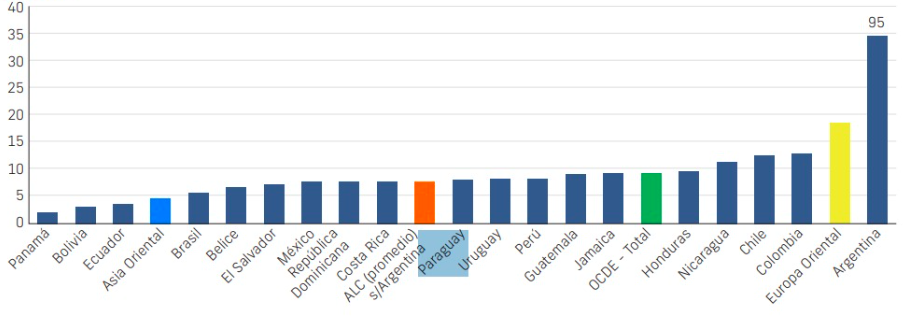
Against this backdrop, inflation expectations for the region, excluding Argentina and Venezuela, closed in 2022 with an average of 7.9%, below those observed in the Organization for Economic Cooperation and Development (OECD) and Eastern Europe, although above East Asia.
Monthly inflation peaked in April 2022 at 1%, then fell to 0.4% in January 2023, and annual inflation is forecast to decline to 5% in 2023.
“However, in no case is a large Latin American economy expected to meet the official inflation target before 2024; thus, even if they do not rise, interest rates will remain elevated,” the report states.
According to the World Bank, this situation places economies in the usual dilemma of choosing between lower growth or runaway inflation.
In some parts of the region, heated discussions occur around this trade-off.
In this case, World Bank data place Paraguay as the fourth country with the lowest inflation in 2022, within South America, even though it closed above 5%.
According to World Bank data, Paraguay’s inflation is on par with the weighted average for Latin America – excluding Argentina – which is 7.9%.
It is important to add that, as of March of this year, local inflation already stands at 6.4% year-on-year, close to the range of 2% to 6% in which it is considered that it can fluctuate in a controllable manner and already far from the peak of 11.8% reached in April of last year, according to BCP data.
The Central Bank of Paraguay (BCP) also estimates that inflation will reach 4.1% by the end of 2023, which places this indicator practically in the middle of the target set in the inflation targeting scheme of 4%.
With these projections, the WB also highlights that Paraguay would be practically the only country to meet its inflation target as early as this year.
REGIONAL CHARACTERISTICS
On the other hand, the World Bank report points out that Latin American central banks have concrete experience in inflation management.
“The so-called monetary policy dilemma of developing countries has long called for pro-cyclical monetary policies, in contrast to advanced countries. In other words, as the economy weakens, interest rates generally rise”, the WB states.
In this sense, they explain that a fall in terms of trade would not only slow down growth but would also force an additional contractionary (pro-cyclical) increase in interest rates to defend the exchange rate.
“This is necessary to avoid the pass-through effect of inflation, minimize the growing pressure of servicing largely foreign currency denominated debt, and reinforce confidence that the situation is being stabilized and exchange rates will not depreciate further,” the multilateral agency’s report adds.
As a result, while monetary policy moves countercyclically in developed countries, dampening excessive exuberance and mitigating slowdowns, the opposite is true in LAC.
In developed countries, inflation falls as growth decreases, consistent with authorities raising interest rates to reduce excessive demand.
In contrast, the panel shows that in Latin America, as inflation rises, interest rates rise, and growth declines.
This pattern is evident in all countries in the region.
EFFECTS OF GEOPOLITICAL EVENTS
The Russian invasion of Ukraine caused a slowdown in the recovery of poverty levels in LAC by increasing food and energy prices and reducing household purchasing power.
Domestic fertilizer prices for LAC farmers remain about 2.5 times higher than before the pandemic, warns the WB.
Higher prices for such inputs, in addition to droughts in some countries, adversely impact the livelihoods of these producers and reduce planted area and yields.
By 2023, the food crisis could shift from affordability (access to food) to availability (food production) in some countries and sub-regions with below-average yields.
In absolute terms, the World Bank estimates that some 5.5 million people fell into poverty, with the countries with the largest populations, such as Mexico, Brazil, and Colombia, experiencing the largest increases.
Paraguay recorded a 1.3% increase in food inflation due to geopolitical events.
ECONOMIC GROWTH OUTLOOK
Regarding economic growth projections for the region, Paraguay is among the countries that will maintain a rate of over 4% for the next two years, behind only Panama and the Dominican Republic.
By 2024, Paraguay’s gross domestic product (GDP) will grow 4.3% by 2025, according to World Bank estimates.
Thus, Paraguay would have the highest economic expansion in LAC since Brazil, Chile, and Argentina would not grow more than 2% in this period.
With information from Marketdata
Key Facts
— Deep Dive
— For the complete picture, read our in-depth guide: Paraguay: Washington's Most Valued Ally in Latin America
More: Paraguay news in English, every day from The Rio Times.
Editorial responsibility: Matthias Camenzind, Editor-in-Chief · Editorial standards · Report an error