Paraguay: Washington’s Most Valued Ally in Latin America
Key Facts
— Key Points
RioTimes Deep Analysis | Series: Paraguay Guide
Most Americans cannot find Paraguay on a map. And yet this landlocked country of seven million people — no coastline, no oil, smaller than California — now sits at the center of one of the hemisphere’s most consequential strategic contests. This is how the Paraguay Washington ally story became the defining case study of what reliability is worth in the US-China contest for Latin America.
The Economic Foundation: 6% Growth and Dual Investment Grade
Paraguay’s Central Bank revised its 2025 GDP growth estimate upward to 6% — nearly triple the Latin American average and the country’s strongest performance since 2013. BCP President Carlos Carvallo acknowledged the institution had underestimated the economy’s capacity, noting that growth exceeded 5% across all three major sectors: agriculture, industry, and services. The expansion created 146,000 new jobs and, combined with the 4.2% forecast for 2026, would give Paraguay an unprecedented four consecutive years of growth above 4%.
The credit agencies have responded accordingly: Moody’s upgraded Paraguay to investment grade in July 2024, and S&P followed in late 2025, citing the government’s track record of institutional reforms, sound monetary policy, and fiscal discipline. S&P projects investment will reach 27% of GDP during 2026-2028, while inflation held at 3.5% near the central bank’s target and the fiscal deficit converges to the legal ceiling of 1.5% of GDP. That level of fiscal credibility is something most of Paraguay’s neighbors cannot match.
The profile is distinctive: a 10% flat corporate tax rate, free capital repatriation, 100% renewable electricity from the Itaipu and Yacyreta hydroelectric dams, and public debt at a sustainable 38.5% of GDP. President Santiago Pena, an economist who took office with the Colorado Party, is pursuing OECD accession by 2028 — a signal to investors that the institutional upgrade is intended to be permanent. Even Javier Milei highlighted Paraguay before Argentina’s parliament as a country that embraced economic freedom, defeated inflation, and attracted investment from around the world.
- 6% GDP growth in 2025 — triple the regional average
- 10% Flat corporate tax rate with free capital repatriation
- 146,000 New jobs created in 2025
- 38.5% Public debt to GDP — among region’s lowest
The Taiwan Factor: Why China Made the Paraguay Washington Ally Story Possible
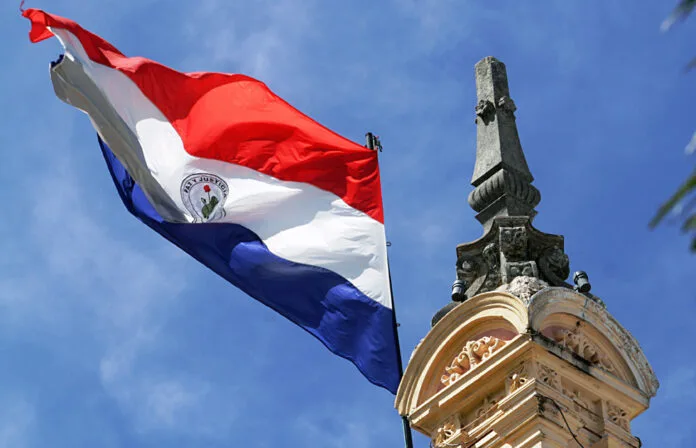
The geopolitical dimension is what transforms Paraguay from an interesting growth story into a strategic asset. Since 2016, Beijing has persuaded 10 countries in Latin America and the Caribbean to drop recognition of Taiwan, signed nearly 1,000 bilateral agreements, and financed approximately 2,500 development projects. Its satellite ground stations now operate in Argentina, Bolivia, Brazil, Chile, and Venezuela — facilities the US military views as potential intelligence platforms.
Paraguay has held firm. It remains one of only four Latin American countries recognizing Taipei, has not allowed Chinese state-owned enterprises to control critical infrastructure, and has kept Huawei and ZTE out of its telecommunications networks. In Washington’s current geopolitical vocabulary, that makes Paraguay not just a friendly government but an anchor — a country where Chinese influence never gained a foothold in the first place.
The Washington Post analysis frames this as a new form of commodity: reliability itself. In a hemisphere where external powers scan for openings, the countries that appear hardest to influence can suddenly look more attractive than those with louder rhetoric or flashier scale. Paraguay’s value to Washington is not that it needs rescuing — it is that it never needed rescuing in the first place.
The Security Architecture: Shield of the Americas and the SOFA
The strategic relationship has already taken institutional form. Paraguay attended the inaugural Shield of the Americas summit at Trump National Doral in March 2026, where a multinational coalition was formalized to combat organized crime, narco-terrorist cartels, illegal migration, and foreign interference. President Pena stood in the front row alongside Milei, Bukele, and Noboa in the summit photo — a visual statement of Paraguay’s place in Washington’s preferred regional architecture.
Days later, Paraguay’s government ratified a Status of Forces Agreement creating a legal framework for US military presence — training, joint exercises, and humanitarian assistance — with $11 million in funding and Green Beret trainers embedded inside Paraguay’s special forces through 2029. A May 2025 memorandum had already enabled Paraguayan arms purchases through the US Foreign Military Sales program. Deputy Secretary of State Christopher Landau summarized the current state of affairs: the relationship has “honestly never been better.”
The security rationale is grounded in Paraguay’s role as a transit corridor for cocaine produced in Bolivia and Colombia, with shipments moving toward Brazil and global markets. Brazil’s PCC maintains approximately 699 members inside Paraguay, operating across the border and within Paraguayan prisons. The Paraguayan People’s Army (EPP), a rural insurgent group, adds a domestic terrorism dimension that justifies the deepening cooperation.
The Soft Power Play: Tourism, Sport, and Clean Energy
Paraguay’s international profile is being amplified through a deliberate soft-power strategy: the country recorded 3.66 million international visitors in 2025 — a 91% increase confirmed by the UN World Tourism Organization, making it the world’s fastest-growing tourist destination. Tourism receipts reached an estimated $1.42 billion, with the WRC Rally Paraguay and Pan American Junior Games anchoring a strategy to use international sporting events as economic catalysts.
The 2026 WRC Rally, the championship’s longest round, expanded to include a night stage on Asuncion’s Costanera waterfront and routes through Jesuit heritage towns — designed to convert sporting attention into sustained tourism infrastructure. The 2025 debut attracted 210,000 spectators and reached an estimated 800 million television viewers globally.
The clean energy story adds another layer: Paraguay generates 100% of its electricity from hydroelectric sources, and X8 Cloud Infrastructure has signed an agreement with the national electricity administration (ANDE) to build what it describes as Latin America’s largest AI infrastructure, powered entirely by the Itaipu dam. Commercial operations began in early 2026 at 50MW, with expansion to 500MW planned for 2027. The pitch to Brazilian and international tech companies is compelling: world-class AI computing at up to 70% lower cost, running on renewable energy under US-friendly jurisdiction.
The Limits: Growth That Has Not Reached Everyone
The narrative has real constraints: poverty fell to a historic low of 16% in 2025, and extreme poverty nearly halved to 2.4%, but GDP per capita remains well below Uruguay and other higher-income regional peers. Without cash transfer programs like Tekopora, the poverty rate would have been 20%, indicating that growth benefits are not fully reaching the bottom of the income distribution. The economy minister who trumpeted the 6.6% growth figure lost his job weeks later amid construction-sector arrears estimated at $1.5 billion and accusations of mismanagement.
The Colorado Party’s clientelistic power structure — which has dominated Paraguayan politics for seven decades — creates tensions with the institutional modernization Pena is pursuing. Americas Quarterly noted that Paraguay’s growth model remains fragile, one shock away from turbulence, whether from exchange-rate fluctuations, a spike in oil prices, or a reversal in soy markets. The Heritage Foundation ranking Paraguay as the hemisphere’s fourth-freest economy captures the direction of travel, but the destination is not yet guaranteed.
What to Watch
OECD accession timeline: Pena targets membership by 2028. Progress on governance, transparency, and tax-information exchange will determine whether Paraguay graduates from emerging-market curiosity to institutional-grade partner. The accession process itself forces reforms that outlast any single administration.
AI and data center buildout: If X8’s Itaipu-powered facility scales to 500MW as planned, Paraguay could become a regional hub for AI computing — a proposition that would attract a different class of foreign investment entirely. Watch whether Brazilian tech companies, restricted from US-based cloud infrastructure by data-sovereignty concerns, route through Paraguay instead.
Paraguay-Parana waterway: The 2,050-mile commercial artery connecting Paraguay to global markets is undergoing dredging and modernization, with US engineering firms already positioning for contracts. This infrastructure play could transform Paraguay’s export logistics and reduce its landlocked disadvantage.
China pressure on Taiwan recognition: Beijing has not stopped courting Paraguay’s remaining diplomatic allegiance. Any shift would demolish the geopolitical premium that currently makes Paraguay uniquely valuable to Washington. Pena has shown no inclination to switch, but the economic incentives China can offer grow each year.
In this new hemispheric contest, countries do not become important only by being big, loud, or resource-rich. Sometimes they do it by standing still long enough for everyone else to finally recognize what standing still is worth.
Related Coverage on Rio Times Online
- Paraguay’s Quiet Upgrade: How a Small Country Became a Big-Credibility Story
- No Beaches, No Problem: Paraguay’s Record-Breaking Tourism Boom
- Paraguay: The In-Between Country That Turned Transit Into a Tourism Boom
- Paraguay Opens Door to US Military Cooperation, Testing Regional Trust
- Paraguay Rises to Fourth Freest Economy in South America
- Rally Paraguay 2026: WRC’s Longest Round
This article is part of The Rio Times’ guide series, offering in-depth analysis for investors, expats, and analysts tracking Latin America. This article does not constitute investment advice.
More: Latin America news in English, every day from The Rio Times.
This article was produced by The Rio Times’ automated newsroom system. How we use AI · Report an error · Editorial responsibility: Matthias Camenzind, Editor-in-Chief