Humpback Whales Return to Rio, and the Boats Follow
Nature
Key Facts
—The recovery. Brazil’s humpback population has grown from about 1,000 animals in 1988 to more than 30,000 today.
—The season. Whales pass the Rio coast between June and November, with the Cagarras Islands the city’s main viewing ground.
—The journey. They swim nearly 9,000km a year between Antarctic feeding grounds and Brazilian breeding waters.
—The rules. Boats must idle beyond 100m, never chase for more than 30 minutes, and nobody may swim with them.
—The size. A humpback reaches 16m and roughly 40 tonnes, which is why a light collision is not a light matter.
—The free option. Binoculars from Arpoador or any high headland cost nothing and disturb nothing.
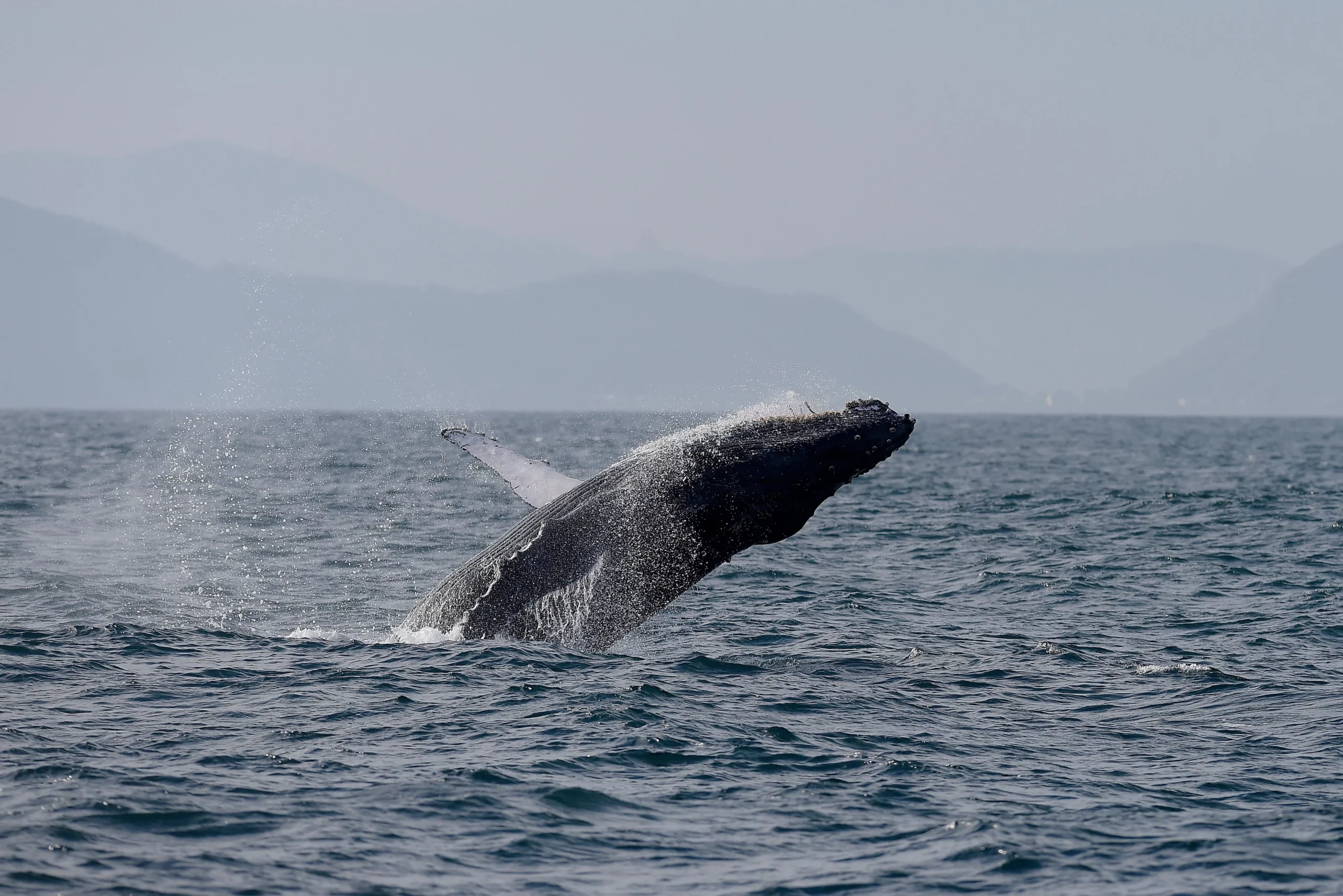
Something rare is happening off Rio de Janeiro, and it is not the whales. It is the sight of a conservation success creating a fresh problem, which is why whale watching in Rio now comes with a rulebook.
Humpbacks pass the city every winter on their way north, and this year they arrived early. A team from an urban-waters research expedition spotted the first one off Ipanema, moments after freeing a stingray from a net.
They heard the blow before they saw the animal. That blow, incidentally, is not seawater but hot breath and vapour, expelled at speed.
These are the whales the scientific name calls great wings of New England, for the pectoral fins that run to a third of the body’s length. A humpback can hold its breath for half an hour and dive beyond six hundred metres, though off Brazil it usually stays shallow and surfaces often.
The underside of each tail carries a black-and-white pattern unique to the individual, which is how researchers count them at all. That method has produced one of the strangest findings in the archive.
Some of Brazil’s humpbacks have been photographed off Ecuador in the Pacific, and others between Mozambique and Madagascar. Whatever route they take, it is far wider than anyone assumed.
The number behind whale watching in Rio
Brazil banned the hunting of humpbacks in 1987. A year later, researchers counted roughly a thousand of them left in the country’s waters.
Today, according to the aerial censuses run by Projeto Baleia Jubarte, there are more than thirty thousand. The species left Brazil’s endangered list in 2014.
Do the arithmetic that nobody bothers with. Thirty-fold growth across thirty-eight years is a compound rate close to ten percent a year, sustained by a wild animal for nearly four decades.
There is a further point the coverage misses. These whales are not colonising new water off Rio, they are reoccupying old water.
Their original breeding range ran from Rio Grande do Norte all the way down to São Paulo. Whaling compressed it into a single refuge, the Abrolhos Bank off southern Bahia, and recovery is now pushing the animals back out along the coast they once held.
Rio is a corridor, not a nursery
Hold that distinction, because it changes what you are looking at. The calving happens up at Abrolhos, so the whales crossing Rio are commuters, mid-journey and moving.
That is precisely why the rules forbid altering a whale’s course or splitting a group. A boat that turns a humpback around off Ipanema has not spoiled a photograph, it has taxed an animal halfway through a nine-thousand-kilometre year.
Researchers at a marine mammal laboratory in Rio note the sightings are creeping earlier each season. They are honest that nobody yet knows why.
A quiet irony sits alongside all this. The project that counted the recovery has been funded since 1996 by Petrobras, and the whales now turn up regularly in the Campos Basin, the oil province that made the company.
What the boom is doing, and what the rules say
Demand for trips has surged, pushed along by social media, and vessels have been seen working areas they should not. Rio’s tourism body has responded with a code of practice drawn from the environmental regulator’s rules and the whale institute’s protocols.
The essentials are worth carrying in your head before you book. No engine engaged within a hundred metres of the nearest whale, and no re-engaging until the animals are clearly visible at the surface fifty metres away.
No pursuit beyond half an hour, even at a legal distance. No third boat joining two that are already approaching, no interrupting the group, and no swimming or diving with them at all.
Aircraft, drones included, must stay a hundred metres above the sea. One operator put the physics plainly: “It is not a barbecue trip or an ordinary outing.”
He is right, and the reason is arithmetic rather than sentiment. Forty tonnes meeting a hull with a propeller and a rudder ends badly for everyone involved.
So choose a licensed operator, not the cheapest boat on the quay, and understand you are heading into open ocean rather than pottering round the bay. Or take the option that costs nothing.
Stand on the rock at Arpoador with a pair of binoculars and watch for the blow. The researcher who found this season’s first whale saw one from exactly there.
When is the best time for whale watching in Rio?
The migration runs from June to November, with the strongest sightings around the Cagarras Islands. Animals have been arriving progressively earlier in recent years.
Can I see them without a boat?
Yes, from any high point along the coast on a clear day. Arpoador is a reliable spot, and binoculars help more than a camera.
Is swimming with the whales allowed?
No, it is prohibited outright. Boats must also idle beyond a hundred metres and may never pursue an animal for more than thirty minutes.
Connected Coverage
São Paulo’s North Coast: A Whale Watching Sanctuary
Brazil’s Digital Nomad Visa in 2026: What’s Real, What’s Myth
Frequently Asked Questions
When is the best time to see humpback whales off Rio de Janeiro?
The whales pass Rio between June and November, with the Cagarras Islands being the main viewing spot. Sightings have been arriving progressively earlier each season in recent years.
Can I watch the whales without paying for a boat trip?
Yes, you can watch for free from Arpoador or any high headland along the coast using binoculars. A researcher even spotted this season's first whale from Arpoador.
What are the basic rules boats must follow around the whales?
Boats must stay beyond 100 metres from the nearest whale, cannot chase them for more than 30 minutes, and no one is allowed to swim or dive with them. A third boat is also not permitted to join two that are already approaching a whale.
This article was produced by The Rio Times’ automated newsroom system. How we use AI · Report an error · Editorial responsibility: Matthias Camenzind, Editor-in-Chief
The Rio de Janeiro Guide
What The Rio Times publishes for foreigners in Rio de Janeiro, Brazil.
This month
Coming up in Rio de Janeiro
- Whindersson Nunes Plays Rio's Qualistage on 18 October, Tickets From US$13.50 18 Oct
- Black Pantera Opens Brazil Tour at Rio's Circo Voador on 24 October 24 Oct
- Mondial de la Bière in Rio de Janeiro, Brazil: 1,500 Beers at Pier Mauá, October 29–November 1 29 Oct
- Maro Plays Circo Voador in Rio de Janeiro on 3 November 3 Nov
Living in Rio de Janeiro
- Réveillon Copacabana 2027: New Year's Eve in Rio — Fireworks, Traditions and Guide
- Rio vs São Paulo Safety for Expats, District by District
- Rio's Armed Group Map Put 1.6 Million People Under One Faction
- Rock in Rio 2026: What Travelers and Expats Need to Know
Nightlife
Understand Brazil