“We Have the Best Honey in the World,” Says Brazilian Beekeeper
By Ricardo Wegrzynovski, Contributing Reporter
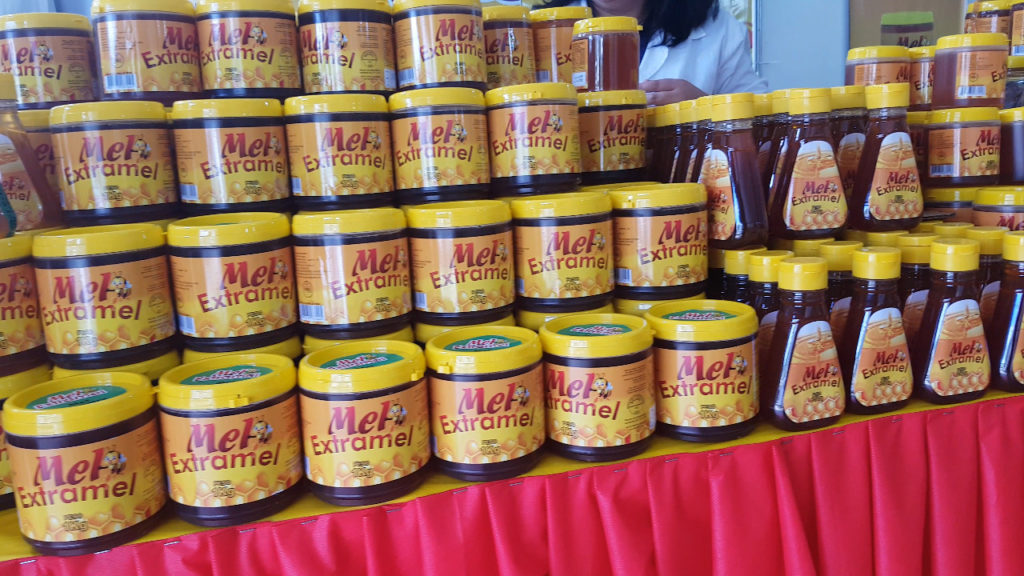
FLORIANÓPOLIS, BRAZIL – Awarding several medals and displaying the best of numerous varieties of honey, the Honey Show in Florianópolis, Santa Catarina, will be held until Saurday, June 8th. The state produces an average of 6,000 tonnes of honey a year, regarded as the best quality honey in the world.
“We produce 68 kilos per square kilometer here, while the national average is 5 kilos per kilometer”, highlights agro-engineer Rodrigo Durieux da Cunha. According to beekeepers, bees in Santa Catarina produce more than 100 varieties of honey with different colors, scents, flavors, and consistency.
The show includes the sale of honey from a variety of flowers, propolis, composite honey, royal jelly, beeswax, candies, cookies, cosmetics from bee products, honey bread, honey cake, teas, cachaça, vodka with honey, honeycombs, and pollen.
According to the Federation of Associations of Beekeepers and Honey Producers of Santa Catarina (FAASC), the couple Ideraldo and Leodete Pfleger, from Santo Amaro, harvest an average of 50 to 60 kilos of honey in each of their 240 beehives.

During extraordinary harvests, they have harvested up to 70 kilos of honey in a single hive. In 2017, Santa Catarina’s production averaged 25 kilos per hive. In Brazil as a whole, the average is ten kilos per hive.
International market
The president of the FAASC, Ênio Frederico Cesconeto says that “the international market is very important for Brazil. Around 90 percent of the honey produced in Santa Catarina is exported to markets in the European Union, the United States, and Middle Eastern countries”.
The honey is usually exported in bulk–bottling occurs directly in buying countries. One of the main differentials is that honey from Santa Catarina is 90 percent organic, pesticide-free. “We are accredited by international organizations,” says the president. In 2017, association members had more than 320 hives in Santa Catarina.
In 2017, honey produced in Santa Catarina was elected the best in the world for the fifth time, during the 45th Congress of the International Association of Beekeepers’s Federations (Apimondia), held in Turkey.
There were approximately 1,000 competitors from over 60 countries. In addition to Turkey, the company Prodapys from Santa Catarina has already won gold medals at the Apimondia Congress in Australia in 2007, Ukraine in 2013, and South Korea in 2015.
However, in terms of technology, the prize was awarded to the Chinese, who developed equipment for the transfer of larvae and collection of royal jelly. Other countries standing out in the technology sector are Germany, France, and Denmark. The next “Apimondia International Apicultural Congress” will be held in Montreal, Canada, from September 8th to 12th.
Technology
Beekeepers from Santa Catarina take part in cooperative data collection. The Beekeeping Monitoring System, or “Apis online” is a state government website gathering information such as internal and external temperature and humidity of the hive, weight, rainfall, and dew, are some of the data, classifying it into maximum, average and minimum levels.
This produces a report that provides a framework for agricultural technicians to do their work, thus permitting better management practices and mapping of the floral calendar.
“External factors are climate and blooming, internal factors are the queen and box,” says agronomist Lourenço F. Xavier Dias, from Chapecó, in Santa Catarina’s west. According to him, it is necessary to pay special attention to two types of flowers, those from cultivated plants as well as from the native forests and fields of each region.
History
The first bees of the Apis species that arrived in Brazil were brought by Frenchman Sigismond Victor Vigneron from La Jousselandière, in 1820.

In 1839, nine more hives were brought by the Portuguese, Manoel Joseph Pereira de Sequeiras.
In 1853, German beekeeper Friderich August Hannemann arrived with two beehives, settling in Taquari (RS). For years, he corresponded with the German beekeeping newspaper “Bienenzeitung”.
More: Brazil news in English, every day from The Rio Times.
Editorial responsibility: Matthias Camenzind, Editor-in-Chief · Editorial standards · Report an error