Versace, Pininfarina, Lamborghini & Co: Buildings signed by luxury brands arrive in Brazil
RIO DE JANEIRO, BRAZIL – Buildings signed by brands are already a reality in the Brazilian luxury real estate market. In São Paulo, Gafisa pre-launched in October the Tonino Lamborghini Apartments São Paulo, in the upscale Jardins neighborhood, with the lifestyle brand of the family famous for sports cars.
The brand is present in the façade lines, with an angular trace, and in the decoration of the common areas, which will have furniture and decoration items imported from Italy, with the company’s signature.
This project will have 17 units of 250 m² and 96 studios of 21 – 34 m². The apartments can also be decorated with items from the brand – the studios will already be delivered with Tonino Lamborghini cabinets.

Despite sharing the same tower, studios and larger apartments will have a separate life in the development: the former will be located up to the seventh floor and will have an entrance on Marília Street, while the larger apartments will be on the upper floors, with a reception on Jaú Lane.
Guilherme Benevides, executive director of Gafisa, says that having an associated brand helps to attract attention to the project. “We can have a much higher valuation and product exposure than if we didn’t have the partnership”, he says. The square meter of Tonino Lamborghini Apartments San Paolo, which is in pre-sale, costs about R$40,000.
Gafisa has the right to exclusively launch buildings with the Tonino Lamborghini brand for five years in São Paulo and two years in Rio but has not yet disclosed what will be built in Rio de Janeiro.
Cyrela launched in September, in the Jardim Europa neighborhood of Porto Alegre, the Tree House and Garden House Porsche Consulting, with the business consulting of the automobile manufacturer. The same developer is building in São Paulo the ‘Milano Lifestyle by Versace Home’ in partnership with the real estate developer Lavvi, which brings the fashion brand to Moema.
Meanwhile, in December the apartments of the Yachthouse by Pininfarina, by Pasqualotto>, in Balneário Camboriú (SC), will be delivered. The construction company has two other projects with the same brand in the city under construction, the Vitra and La Città by Pininfarina.
The office also signed the Cyrela by Pininfarina, delivered in 2018, and the Heritage, of 2020, in Itaim Bibi, in São Paulo.
This connection between international brands from other sectors and the real estate market has been happening for a few years outside the country. In Miami, besides Porsche, there are also Aston Martin and Fendi buildings, for example.
For Suzane Strehlau, a professor in the master’s program in consumer behavior at ESPM, living in a building that bears the name of a brand should not be considered something strange by those who are already used to using logos of these companies in their daily lives, on clothes and other objects. “If they feel good about it, they will find it interesting in the building as well,” she says.
However, for the relationship between the building and the brand to make sense, there needs to be more than just a sign with the brand’s logo at the entrance. The consumer and resident need to capture the essence of the company in the project. “The idea is that the brand’s image is transmitted in the building, the consumer will perceive this in the decoration, in the service, in addition to the style [of the development],” Strehlau says.
Strehlau reminds us that the name of a building is rarely mentioned in everyday life, and it is the address that serves as a reference point.
A partnership of this type means double work for the developer, says Alcino Pasqualotto Neto, president of the Santa Catarina construction company, making the project more expensive.
In the Yachthouse, which has 6% of the 264 units for sale, with values between R$6 million and R$8 million and a floor area of 265 m², it was necessary to produce concrete pumps and specific piping for the project.
The building’s façade, composed of two towers, was entirely covered with a double layer of glass for thermal and acoustic comfort.
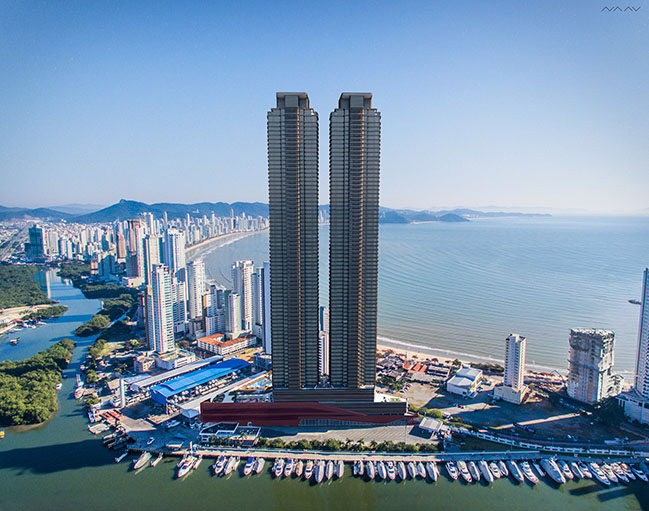
The red, angular structure at the base of the towers is coated with the fiberglass used to build boats, and was ordered from a ship manufacturer, while the usual would be to use aluminum plates, says Neto. “It makes the project very expensive because the difference in the materials used is huge,” he says.
The towers have 81 floors – the development will be the tallest residential building in Brazil when inaugurated.
For Neto, the partnership with the Italian office managed to add automobile design to civil construction, transmitting desire and a sense of speed to work. The differentiation and the attempt to surprise the buyer are what the developers that venture into these partnerships seek.
Paulo Sevilla, director of development and business at Cyrela, says that they began to make this kind of approach with international brands back in 2012 when they noticed the trend outside the country.
Besides Pininfarina, Versace, and Porsche Consulting, they have a line of buildings with Yoo, the office of French designer Philippe Starck. “This partnership involved locking a Cyrela team in their London office for four months to pass on the dynamics of Brazil,” he says.
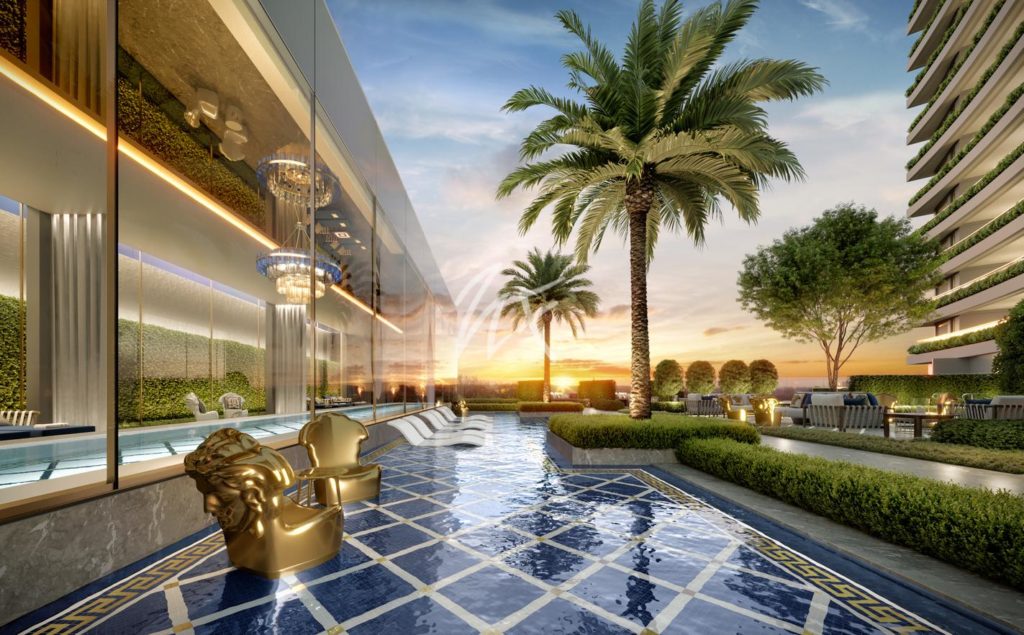
The touch of the partner brand appears in different ways in each project and varies according to the image of each company. In Milano Lifestyle by Versace Home, for example, it is apparent in the decoration of the common areas, with lots of gold, marble, and use of the image of Medusa, the symbol of the Italian brand.
Strehlau explains that the proximity between the building and a well-known brand can attract two types of consumers: those who already consume the brand and identify with its values and those who aspire to belong to the universe it represents.
For the project to be successful, the brand must have low rejection and an established image in the luxury market. “In any society, we usually eat a kilo of salt together to understand the relationship; we have the criterion of being a brand that has no risk of misalignment with our values,” says Sevilla. After all, the building will exist for decades.
Such a development may also require extra care by the residents to preserve the original features of the decoration and facade. “It doesn’t make sense for a guy who paid for a specific design later to want to change the hall, there is a brand desire for the buildings to be preserved as they were designed,” says Cyrela’s development director.
The company is closing a partnership with two more brands, which should be disclosed in 2022.
There must be an advantage in this partnership with the real estate market on the brand’s side. Besides being paid for their participation in the project, the brand can approximate its target audience. For this, many already have divisions specialized in prospecting this type of business and coordinating partnerships.
“Luxury brands have for some years now been showing a tendency to extend the brand, to collaborate with other products, such as spas and hotels,” says Strehlau. The professor points out that these brands are also cautious when choosing partners because problems in the project can damage their image.
Unlike what happens in a store, in the real estate market, the brand’s relationship with the consumer is not restricted to the moments of purchase. “The brands realized that by being in a real estate project they can penetrate the client’s life, they will talk to this person throughout his or her life,” says Benevides.
With information from Folha
More: Brazil news in English, every day from The Rio Times.
This article was produced by The Rio Times’ automated newsroom system. How we use AI · Report an error · Editorial responsibility: Matthias Camenzind, Editor-in-Chief