Brazil Markets: Ibovespa & the Real — July 11, 2026
Key Facts
- The Ibovespa surged 2.97% to close at 177,866.37 points, its best finish since May 14 and 10.5% below its 52-week high of 198,657.
- The real firmed to 5.1098 per dollar down 0.12% on the day, extending a third straight session of gains for Brazil’s currency.
- June’s IPCA inflation print came in at just 0.16% far below the 0.31% consensus and May’s 0.58%, the softest monthly reading since October.
- Banks led the board with Banco Pan (BPAC11) up 5.5%, Bradesco (BBDC4) up 4.8% and Itaú (ITUB4) up 4.0%, all among the day’s most-traded names.
- Turnover reached R$25.17 billion as Vale (VALE3) traded $321m while adding 1.4% and Petrobras (PETR4) added 1.1% on $211m of volume.
Today’s Focus
Brazil’s stock market had its best session since March on Friday, with the Ibovespa surging 2.97% to 177,866.37 points — its highest close since May 14 — after June inflation undershot every forecast on the street.
The real strengthened too, closing at 5.1098 per dollar for a third consecutive day of gains, as traders raced to price in an August rate cut from the central bank.
Financials did the heavy lifting — Banco Pan, Bradesco and Itaú all up more than 4% — while Vale and Petrobras, the index’s most-traded names, posted milder gains as commodity markets stayed calmer.
Only one Ibovespa constituent, oil producer Prio, closed lower, underscoring how broad-based the rate-cut trade was across the local board.
What matters today. A much-weaker-than-expected inflation print handed Brazil’s central bank room to keep cutting, and equity and currency markets moved together to price that in.
01 The session in one read
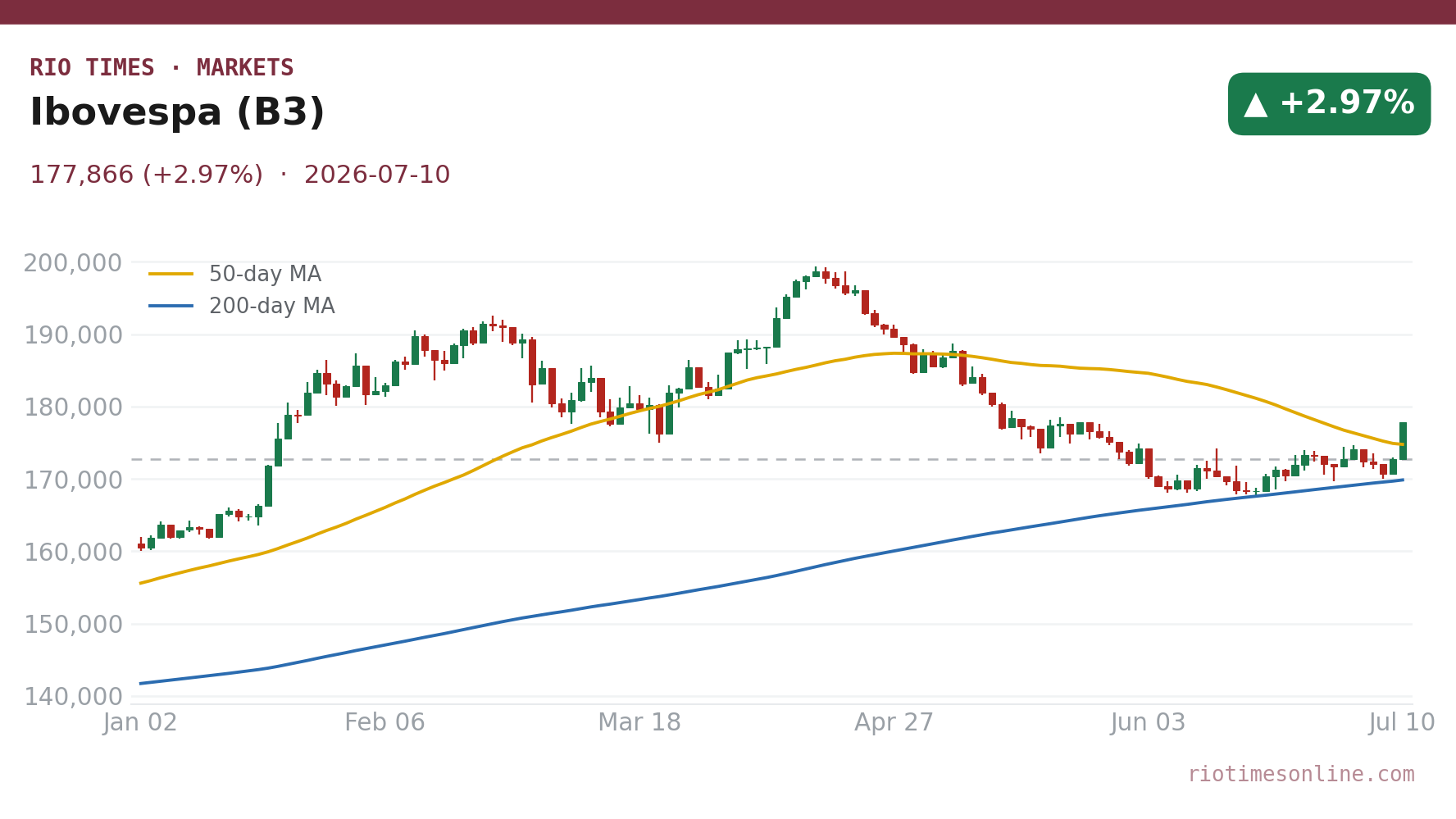
The Ibovespa needed just 60 seconds after the inflation data landed to add 3,400 points, before closing the day at 177,866.37, up 2.97%, its best level since May 14. The index advanced 2.97% to 177,866.37 points, terminating at the day’s high, with practically every stock in positive territory.
The session’s low was 172,760.66 points, meaning the Ibovespa closed roughly 5,100 points above its intraday trough — a genuine trend day, not a drift.
The index completed a third consecutive week of gains, up 2.18% on the week, 3.40% in July and 10.39% year-to-date, and turnover for the session totalled R$25.17 billion.
Only Prio (PRIO3) closed lower among Ibovespa names, down 0.38% — a reminder of how narrowly the rally’s exceptions were confined to oil-linked names caught by a specific tax headline rather than the broader macro story.
The breadth of the move — virtually every Ibovespa constituent higher, the real firming in tandem, and futures curves reportedly pricing a roughly three-in-four chance of an August cut — points to a real repricing of the rate path rather than a technical squeeze. The variable to watch is whether July’s mid-month IPCA preview confirms the disinflation trend, since a reversal would quickly puncture both the rally and the case for 180,000 on the Ibovespa.
02 The day’s numbers
| Measure | Level | Change | Read |
|---|---|---|---|
| Ibovespa | 177,866.37 | +2.97% | Best close since May 14; 10.5% below the 52-week high of 198,657, roughly 34.6% above the 52-week low |
| USD/BRL (real) | 5.1098 | −0.12% | Third straight decline; 8.6% off the 52-week high, near the strong end of its 52-week range |
| Session range (Ibov.) | 172,760.66 – 177,866.37 | — | Closed at the day’s high after a roughly 5,100-point intraday swing |
| S&P 500 (global tape) | 7,575.39 | +0.42% | Near-record close on Wall Street, a supportive backdrop for EM flows |
The headline number is the close, but the range tells the real story: the Ibovespa opened near its low and never looked back once the inflation data hit the tape. The dollar itself fell to R$5.108, its lowest closing level since June 16, a level the scan captures at 5.1098.
With the index still 10.5% shy of its 52-week high, there is no records narrative here — this is a market clawing back toward a level it last saw in mid-May, not breaking new ground. The real’s positioning is the mirror image: far closer to its strongest levels of the past year than its weakest, which matters for anyone pricing dollar-denominated Brazilian risk. Rio Times · Live Market Intelligence
Live Market IntelligenceBrazil — Live Market Board
Brazil — Live Market Board
Instrument Last Change YoY Prev. High Low Volume
IBOV
209,066.90
+1.38%
+21.85%
206,220.24
168,310
167,142
—
USD/BRL
5.16
+0.01%
-5.13%
5.16
5.18
5.14
—
SELIC
14.00%
—
—
—
—
—
PETR4
41.64
-0.05%
+35.19%
41.66
41.97
41.15
41,499,400
VALE3
72.97
+0.83%
+30.75%
72.37
73.54
72.66
17,658,000
ITUB4
38.60
-1.03%
+4.57%
39.00
39.34
38.39
29,487,800
BBDC4
16.85
+0.36%
+3.50%
16.79
16.90
16.67
19,416,900
BBAS3
19.37
+0.47%
+0.73%
19.28
19.44
19.16
11,069,200
B3SA3
14.26
-0.21%
+12.73%
14.29
14.47
14.11
33,037,800
ABEV3
14.89
-0.80%
+21.91%
15.01
15.07
14.81
16,453,100
WEGE3
47.59
+0.49%
+29.99%
47.36
48.08
47.36
3,364,600
PRIO3
59.14
-0.19%
+50.67%
59.25
59.81
58.74
3,325,600
SUZB3
41.33
+2.35%
-23.55%
40.38
41.48
40.35
3,914,900
RENT3
34.68
-0.09%
+0.84%
34.71
34.96
34.35
7,979,100
AZZA3
15.89
-2.63%
-53.76%
16.32
16.42
15.82
1,330,300
CSNA3
4.30
+0.47%
-42.65%
4.28
4.41
4.26
10,076,100
GGBR4
24.69
+2.19%
+51.38%
24.16
24.85
24.18
7,047,600
ENEV3
24.21
-1.38%
+70.49%
24.55
24.64
23.99
9,297,000
03 Why it moved — a cooler inflation print revives the rate-cut trade
June’s IPCA came in at 0.16%, well below the 0.31% consensus and down sharply from May’s 0.58% reading. The 12-month rate fell to 4.64%, moving the data further from the top of the central bank’s tolerance band and giving the Copom cover to keep easing.
Food at home was the main driver of the downside surprise, falling 0.39% in June, a detail several desks flagged as the crux of the beat. The Selic currently sits at 14.25% a year, and B3-traded Copom options were already pricing roughly 75.5% odds of a further 25-basis-point cut in August against 21% for a hold, a wager the inflation data only reinforced.
Lower rates mechanically favour equities by cutting corporate funding costs and lifting the present value of future earnings, which is precisely why the rally concentrated in rate-sensitive banks and consumer names rather than commodity exporters. Citi separately flagged that an extension of the oil export tax is negative for names like Prio but could actually benefit Petrobras given the subsidies it receives — a nuance that helps explain why the two energy names diverged even within a single-sector rally.
The session’s single biggest Ibovespa gainer was CSN (CSNA3), up 7.92%, on news of progress in talks to sell CSN Cimentos — a reminder that idiosyncratic M&A headlines can still outrun the macro trade on any given day.
04 The day’s movers
| Driver | Level / Move | Change | Note |
|---|---|---|---|
| VALE3 | $321m turnover | +1.4% | Most-traded name of the session, a comparatively muted gain versus the banks |
| ITUB4 | $249m turnover | +4.0% | Itaú led the big banks higher on the rate-cut repricing |
| PETR4 | $211m turnover | +1.1% | Petrobras trails the rally as crude stays range-bound |
| BBDC4 | $176m turnover | +4.8% | Bradesco among the best-traded rate-sensitive gainers |
| BPAC11 | $173m turnover | +5.5% | Banco Pan tops the most-traded board’s percentage gains |
| MGLU3 | — | +7.4% | Magazine Luiza leads the broader gainers list, the clearest rate-cut read |
| AURA33 | — | −4.3% | Aura Minerals the session’s sharpest domestic decliner |
| M1TA34 | — | +6.1% | Meta Platforms BDR — a cross-listed tracker moving on Wall Street and FX, not a domestic result |
The most-traded list tells you where the money actually moved: banks and the B3 exchange operator itself (B3SA3, up 4.3% on $125m) dominated turnover alongside the usual Vale and Petrobras flow. The percentage gainers list is where retail shows up hardest, with Magazine Luiza’s 7.4% advance the clearest single read on the rate-cut trade.
Note that M1TA34 is a Brazilian Depositary Receipt tracking Meta Platforms, not a domestic operating company — its move mainly reflects Friday’s Wall Street tape and the currency, and should not be read as a signal about Brazilian retail or consumer demand.
05 The regional scoreboard
| Index | Country | Change |
|---|---|---|
| Ibovespa | Brazil | +2.97% |
| Merval | Argentina | — |
| S&P/BMV IPC | Mexico | +0.82% |
| IPSA | Chile | — |
| COLCAP | Colombia | — |
Mexico’s IPC was up 0.82% at midday Friday, rebounding on a bounce in the financial sector after three consecutive days of losses — a figure captured mid-session rather than at the close. The live market board above carries the confirmed closes for all five names; where a close could not be independently verified in time for this file, we have marked it with a dash rather than guess.
Brazil’s outsized gain stands apart from a Mexican market still digesting a rough week of Middle East-driven risk aversion, underscoring that Friday’s rally was a domestically-driven Brazil story rather than a regional risk-on wave.
06 The technical picture
The Ibovespa’s close at its intraday high, on top of an already-positive week, is a textbook bullish signal for chartists — the index has now recovered to levels last seen on May 14 and sits roughly 34.6% above its 52-week low of 132,129. Resistance from here builds toward the 180,000 level that several strategists have flagged as achievable if disinflation persists.
One São Paulo-based strategist, Villela, argues an Ibovespa in the 180,000-point range is a plausible scenario provided inflation keeps surprising to the downside and the market maintains its expectation that the rate-cutting cycle continues. The ultimate technical ceiling remains the 52-week high of 198,657 — still a substantial 10.5% above Friday’s close.
On the currency side, USD/BRL at 5.1098 sits only 4.5% above its 52-week low of 4.8909, putting the real in the strongest quartile of its own 52-week range. That positioning gives foreign investors a currency tailwind on top of the equity rally, though strategists caution that a rising political risk premium tied to the approaching 2026 election could cap the pace of further gains in the short term.
07 What to watch
- Selic path: The August 5 Copom decision is now the focal point after the inflation undershoot, with B3-priced options showing strong odds of another quarter-point cut.
- Real’s technical zone: USD/BRL is testing toward its 52-week low near 4.89; a break below 5.10 on a closing basis would extend the currency’s strongest run of the year.
- Ibovespa resistance: Strategists have floated 180,000 as a plausible near-term target if July’s inflation data confirms June’s downside surprise.
- Election risk premium: Analysts flag a rising political risk premium into Brazil’s late-2026 election cycle that could cap the rally’s pace even if the rate story stays supportive.
Background: São Paulo Launched 26,700 Homes Nobody Bought. Rates Explain Why..
Background: Brazil’s Banks Kept 82% of the Bonds They Were Meant to Sell.
More: Brazil news in English, every day from The Rio Times.
Frequently Asked Questions
Why did the Ibovespa jump nearly 3% on July 10?
A much weaker-than-expected June inflation reading, IPCA at 0.16% against a 0.31% consensus, revived bets that Brazil’s central bank will cut the Selic again in August.
What happened to the Brazilian real that day?
USD/BRL closed at 5.1098, down 0.12% on the scan’s reading, marking a third consecutive session of gains for the currency.
Which stocks led the Ibovespa rally?
Rate-sensitive banks led on volume, with Banco Pan up 5.5%, Bradesco up 4.8% and Itaú up 4.0%, while retailer Magazine Luiza gained 7.4%.
Is the Ibovespa at a record high?
No — despite the jump, the index remains 10.5% below its 52-week high of 198,657, and Friday’s close was merely its best level since May 14.
This article was produced by The Rio Times’ automated newsroom system. How we use AI · Report an error · Editorial responsibility: Matthias Camenzind, Editor-in-Chief
LatAm Markets: Live Signals → — real-time movers, turnover leaders and FX across Latin America.