U.S. Secures Access to Brazilian Rare Earths in $565 Million Deal That Cuts China Out

Key Facts
— — The US International Development Finance Corporation (DFC) finalized a $565 million financing package for Serra Verde, Brazil’s only producing rare earths mine — including an option for the US government to acquire a minority equity stake
— — The deal includes offtake clauses that give Washington priority access to Serra Verde’s production of heavy rare earths — dysprosium and terbium — critical for EVs, wind turbines, and defense systems
— — Serra Verde terminated its long-term Chinese offtake agreements in December 2025, pivoting to Western buyers — the deal represents the most significant decoupling of a non-Chinese rare earths producer from Beijing’s supply chain
The global competition for critical minerals has arrived on Brazilian soil — and Washington just wrote a $565 million check to make sure it wins this round.
The United States secured access to Brazil rare earths through a landmark $565 million financing deal with Serra Verde, the only large-scale rare earths producer operating outside Asia. The agreement, structured by the US International Development Finance Corporation (DFC), includes offtake clauses that give American companies priority access to production — and an unprecedented option for the US government to take a minority equity stake in the Brazilian mining company.
What the Deal Includes
The $565 million package — 22% larger than the $465 million originally approved by the DFC board in late 2025 — will fund upgrades and expansion at Serra Verde’s Pela Ema mine in the state of Goiás. The company targets annual production of 6,500 metric tonnes of total rare earth oxides by the end of 2027, up from roughly 5,000 tonnes currently. It is also evaluating options to double capacity to over 10,000 tonnes within four years.
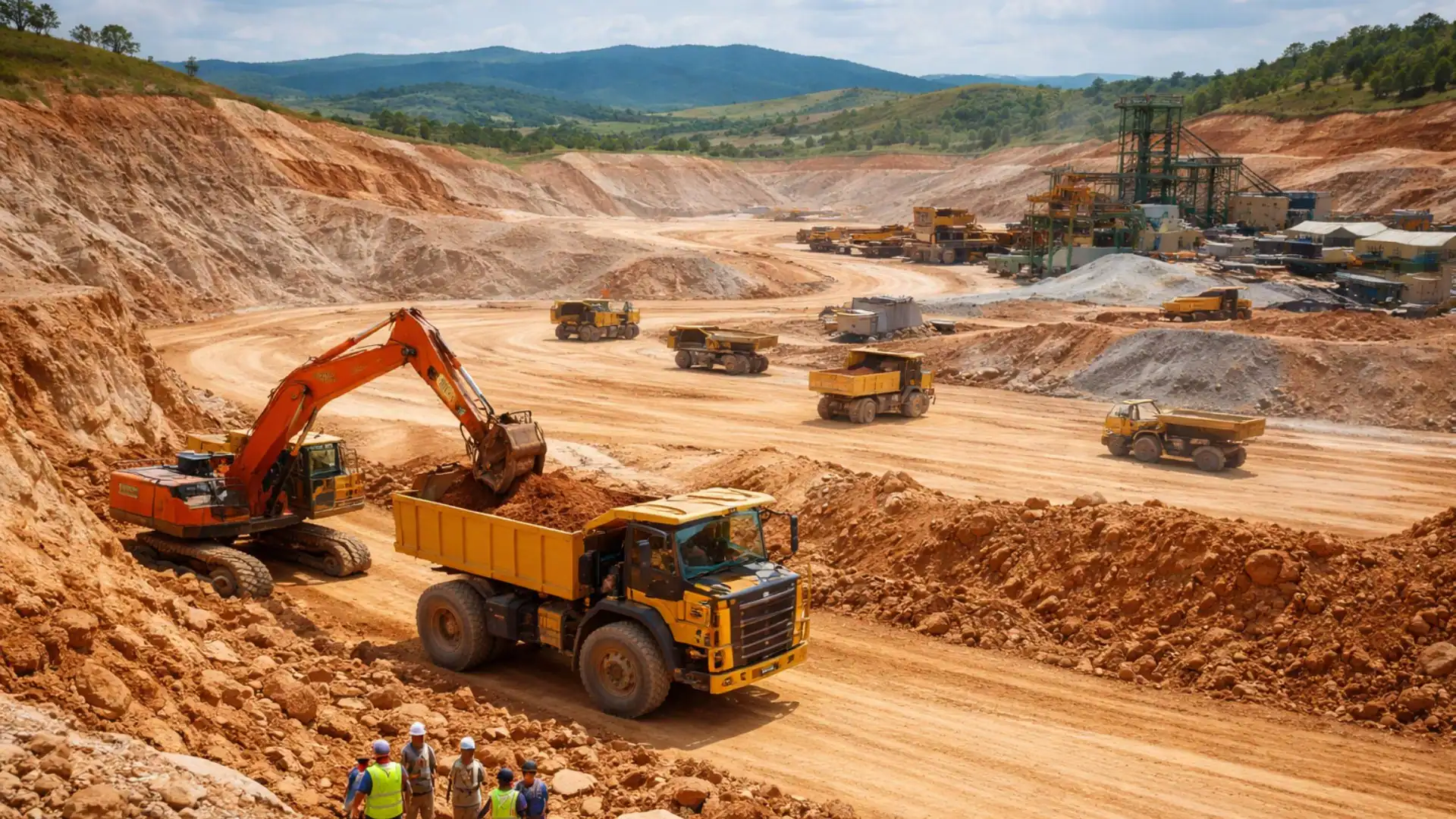
The critical detail is the offtake structure. According to DFC executives, the financing is tied to clauses guaranteeing supply priority to American companies or entities aligned with US strategic interests. Serra Verde CEO Thras Moraitis confirmed the company expects to have new offtake contracts in place by the end of 2026 — after terminating its long-term Chinese agreements in December 2025, deals that had been expected to run nearly a decade.
Why Heavy Rare Earths Matter
Serra Verde’s Pela Ema deposit is one of the few sources in the world — outside China — of heavy rare earths, particularly dysprosium and terbium. These elements are essential for manufacturing the permanent magnets used in EV motors, wind turbines, guided munitions, fighter jet components, and advanced electronics. China currently controls over 90% of global rare earths processing and has repeatedly used export restrictions as a geopolitical weapon — most recently restricting shipments to the US during trade tensions.
Brazil holds the world’s second-largest rare earth reserves after China but has historically produced almost nothing. Serra Verde, backed by private equity groups Denham Capital, Energy and Minerals Group, and Vision Blue (led by former Xstrata chief Mick Davis), began commercial production in early 2024. The Pela Ema deposit uses ionic clay extraction — a low-energy, environmentally benign process powered by renewable electricity — giving it a sustainability advantage over conventional rare earth mining.
The China Decoupling
The most consequential element may be the break with Chinese buyers. Serra Verde renegotiated and shortened its Chinese offtake agreements — originally expected to last roughly a decade — so they expire at the end of 2026. This places Serra Verde alongside Australia’s MP Materials in stepping away from dependence on Shenghe Resources, China’s dominant rare earths processor. New contracts are expected with Western processors or manufacturers in the US, Australia, Estonia, France, or Malaysia — countries with existing rare earth separation capacity.
The DFC is pursuing a broader strategy along the same lines. The agency is also negotiating a potential equity conversion in Australia’s Syrah Resources, a graphite producer, and US export banks are evaluating financing for antimony projects — another defense-critical mineral. Washington’s approach has shifted from trade policy (tariffs) to industrial policy (direct investment and offtake control) in its effort to break Chinese dominance of critical mineral supply chains.
What It Means for Brazil
For Brazil, the deal brings investment into a sector with enormous but underdeveloped potential — at least half a dozen additional rare earth projects are in various stages of development. But it also raises sovereignty questions: the offtake clauses effectively give Washington influence over where Brazilian minerals go, and the equity option would make the US government a part-owner of a Brazilian mine. The government in Brasília has maintained dialogue with the US on critical minerals cooperation while seeking to balance economic benefits against resource sovereignty. For investors watching Latin America’s critical minerals boom — from Argentina’s lithium triangle to Chile’s copper and lithium — the Serra Verde deal is the clearest signal yet that the US-China competition for mineral supply chains is no longer a future risk. It is happening now, on Brazilian soil.
This article was produced by The Rio Times’ automated newsroom system. How we use AI · Report an error · Editorial responsibility: Matthias Camenzind, Editor-in-Chief
Read More from The Rio Times