The Monroe Doctrine: Occasionally Pronounced Dead, It Lingers On
RIO DE JANEIRO, BRAZIL – On December 2nd, 1823, US President James Monroe delivered a speech to Congress on the State of the Union. Two years earlier, Mexico had declared its independence from Spain and in South America, the military defeat of the Iberian colonial power was looming on the horizon.

Monroe warned the European states against trying to regain the lost colonies or interfere in the affairs of the new states south of the US border. The principles he formulated and later supplemented, have been known as the Monroe Doctrine since 1853.
For almost 200 years they have been a cornerstone of United States foreign policy. In Latin America, on the other hand, they are considered to be the symbol of US imperialism.
This burden led John Kerry, in his capacity as Secretary of State under Barack Obama, to officially declare the Monroe Doctrine dead in November 2013. President Donald Trump, on the other hand, emphasized in his speech to the UN General Assembly in 2018, making an explicit reference to James Monroe, that the USA will reject any intrusion of “expansionist foreign powers” into the Western hemisphere.
This was confirmed six months later by his then security adviser John Bolton with the words “The Monroe Doctrine is alive”. Why it was able to survive for so long will be discussed below.
Principles and features
First, the Monroe Doctrine is a set of principles unilaterally defined and implemented by the United States, and therefore not a part of international law.
Second, Monroe drafted his declaration in such a way that it ties in with the anti-colonial origins of the USA on the one hand, without denying its own claim to hegemony on the other.
Third, there is the flexible nature of the Monroe Doctrine. By 1993 alone, the original 1823 version had been amended more than thirty times.
Fourth, this flexibility was particularly required because the initial doctrine differed widely from measures implementing the doctrine.
Fifth, there is a close connection of the Monroe Doctrine with the missionary self-image of the United States, reflected in the interaction of domestic and foreign policy in the drafting and implementation of the Monroe Doctrine.
The claim to power that the USA asserts in two directions, which was articulated at an early stage, deserves special mention. First, the young republic clearly set itself apart from the European system, and denied its representatives free access to the Western hemisphere.
In return, the USA was prepared to stay out of the power struggle in Europe, which included the recognition of the remaining European colonial possessions in the Caribbean.
On the other hand, Monroe’s message was addressed to its southern neighbors in Latin America. But behind the demand “America for Americans!” there are two different conceptions of power.
The USA was in a competitive relationship with Europe, initially having a weaker, but this was reversed in favor of Washington with the transition to the 20th century. Compared to Latin America, on the other hand, the United States feels superior from the outset.
As it caught up with its European rivals and later overtook them, the power gap widened to the detriment of Latin America.
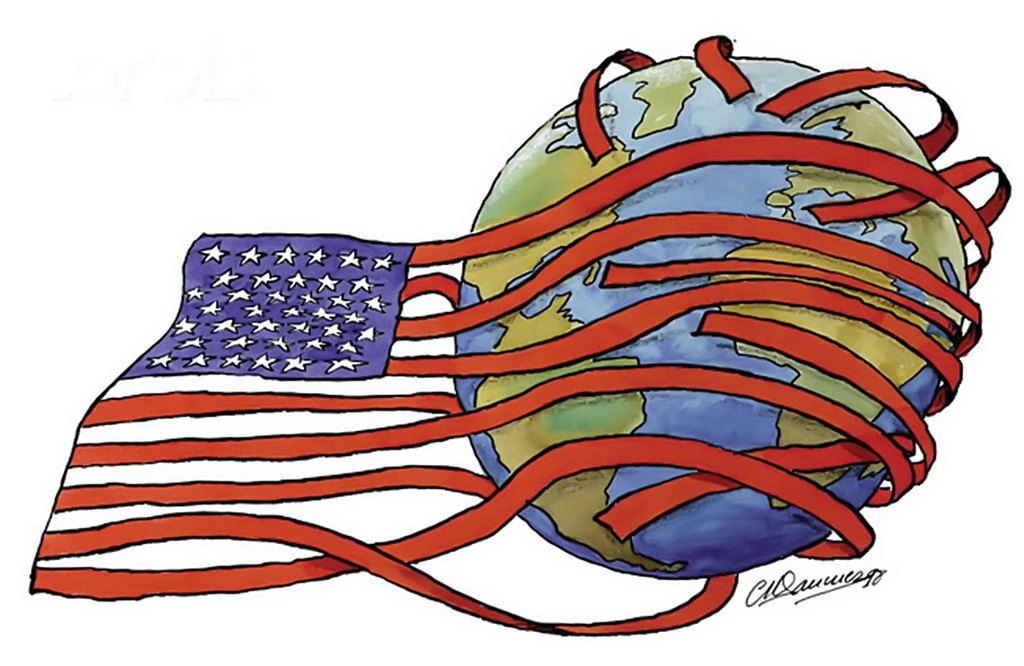
The double-edged and contradictory nature of the Monroe Doctrine is clearly and irrevocably changing into the imperialist dictate of the new hegemonic power, with the rise of the USA as a global superpower.
The clarity with which the USA claims the Western hemisphere as its “natural habitat” even aroused the envy of Germany and Japan, the other two competitors for 20th century world dominance, who fought for their own “greater order” during the Second World War.
Principles
Like US foreign policy in general, the Monroe Doctrine in particular rests on two foundations – one ideological and one geopolitical – which are closely intertwined.
The ideological foundation is formed by American Exceptionalism, which is at the core of US identity.
According to one theorist, “the Americans” feel themselves to be a superior people, whose values and institutions are on the one hand superior to all others, but on the other hand should be extended globally for the benefit of all mankind (mission), but this is dependent on the respective power resources (power).
From the interplay of mission and power, both an exclusive and a universal reading of American Exceptionalism can be derived.
In the 19th century, Washington initially focused its foreign policy on the Western hemisphere (isolationism), while in the 20th century it devoted itself to building a liberal world order (internationalism). However, the different variants of Washington’s foreign and security policy have the same goal: world domination (primacy) by the USA.
The missionary spirit of American Exceptionalism finds its geopolitical counterpart in the uniquely favorable position of the USA. Guided by their civil religion, the early settlers, under the banner of Manifest Destiny, created an empire in the 19th century that stretches from the Atlantic Ocean in the east to the Pacific Ocean in the west, bordering on sparsely populated Canada to the north and Mexico to the south, which by 1848 had lost half of its territory (Texas, New Mexico, California) to its overpowering Northern neighbor.
Time and again, Washington was able to exploit the crises and wars, in which its European rivals were involved, to its own advantage. In 1803, Napoleon, who had just failed in Haiti and saw his priorities in Europe, had to sell the French colony of Louisiana (more than two million square kilometers) to the United States, which doubled its territory as a result.
Spain, which had a hard time in Mexico and South America against the independence movements there, had to give up Florida in 1819 and grant the USA access to the Pacific Ocean north of the 42nd parallel. Great Britain made similar concessions to the United States in the 1814 Peace Treaty, resulting in the border with Canada running along the 49th parallel.
In the years following 1850, the “Indian border” (Frontier) – interrupted by the 1861-1865 civil war – was violently shifted further and further west, until it was virtually eliminated in 1890.
The USA had by that time not only completed its continental westward expansion, but had also developed into a modern economic power with a huge market.
However, the three severe depressions that rocked the country in 1873-1879, 1882-1885 and 1893-1897, made it clear that the further ascent of a “hemisphere of its own” was required, as Thomas Jefferson had called for in 1808 and 1813. To achieve this, the Monroe Doctrine was the first choice, but it had to be revamped and realigned.
The Roosevelt Corollary
The United States took the decisive step from domestic to foreign expansion in 1898, and as a result of its victory in the Spanish-American War, it not only gained strategically important colonies in the Caribbean (Puerto Rico) and Pacific (Guam, Philippines), but also emerged as an imperialist world power.
Although Cuba became formally independent in 1902, it remained a semi-colony under Washington control. Hawaii was annexed in 1898 and became the 50th state to join the Union 60 years later. The expansions to the south and west plunged the USA into conflict with Great Britain and Germany.
In these conflicts, which culminated in the crises of 1895/1896 and 1902/1903, Venezuela was at the center of each.
In the first case, a border dispute with the British colony of Guyana was the trigger, while in the second case it was a classic act of imperialist gunboat diplomacy: Great Britain and Germany, supported by Italy, wanted to use the military blockade of Venezuela to force payment of outstanding debts.
In both cases, Washington was challenged to insist on compliance with the Monroe Doctrine.
In the test of strength with its imperialist rivals, Washington was able to assert itself, but still had to take the new situation into account. In order to be able to stand up to Germany’s advance, a new version of the Monroe Doctrine was required.
On December 6th, 1904, President Theodore Roosevelt announced a Corollary before the US Congress, in which Washington appointed itself as the police of the western hemisphere and threatened its southern neighbors with intervention if order and stability were endangered in that region. This was intended to remove the ground from under the advance of Germany and other European powers.
Unlike the Empire, Great Britain accepted the Monroe Doctrine including its amendment, and gradually withdrew from the western hemisphere. The peaceful settlement of the Alaskan border dispute in 1903 marked the end of the power-sharing that had developed in the region after the 1814 peace treaty; on the other hand, a special and close relationship developed between the retiring and the rising empires, which later had its baptism of fire in two world wars.
It was the states of the Caribbean Basin that first and foremost felt Washington’s new power.
Under the symbol of Roosevelt’s famous “big stick”, Panama was separated from Colombia in 1903 and a US colony was established along the canal, completed in 1914. The US intervention policy reached its peak with the occupation of Nicaragua (1912-1933), Haiti (1915-1934), and the Dominican Republic (1916-1924).
Further transformations
Following 1898, 1941 marked the second leap in the rise of the USA, with far-reaching consequences for the Monroe Doctrine. After Hitler seized power in 1933, the “German menace” gained a new dimension. In addition to the conflicts in Europe, the growing political costs of intervention policy in the Caribbean were the most important reasons for a new direction under the banner of “Good Neighbourliness”.
In view of the changing situation, the Monroe Doctrine was revised under President Franklin D. Roosevelt’s “multilateralization” policy, with Washington binding the Western hemisphere countries more closely into its security policy by means of treaties. The Pan-American Conferences in Montevideo (1933), Lima (1936), and Havana (1940), were milestones on the way to the creation of a common safety zone.
With reference to the Monroe Doctrine, the conference topics in Havana declared that the defense of the Western hemisphere against the Axis powers was of vital interest to the United States. At the conference in Rio in 1942, this became a pan-American war coalition under Washington’s leadership.
The closer the war in Europe came, the more pressing was the question of how the USA should react to a potential German invasion of the Western Hemisphere.
The Japanese attack on Pearl Harbor on December 7th, 1941, and Germany’s declaration of war on the United States that same month, radically changed the status of the Western Hemisphere in Washington’s security policy.
From the course of the two-front war in the Atlantic and Pacific, Washington concluded that the further rise of the United States could only be secured if Eurasia was squeezed from its edges. The Western Hemisphere thus acquired a new function for Washington: it became a springboard and then a hinterland in the enforcement of US global hegemony.
With the onset of the Cold War against the Soviet Union, the inter-American system took on an anti-Communist thrust, as evidenced by the founding of the OAS in 1948 and particularly its Caracas Resolution of March 1954.
The “democratic spring” in Guatemala (1944-1954) was the first to fall victim to this realignment of the Monroe Doctrine: using a covert operation, the CIA ousted President Jacobo Arbenz from office in June 1954. After 1959, John F. Kennedy and Lyndon B. Johnson invoked the Monroe Doctrine to fight the Cuban Revolution and prevent a communist Cuba at all costs.
The landing in the Bay of Pigs in 1961 and the US intervention in the Dominican Republic in 1965, were the military highlights of Washington’s counterrevolutionary attack. Ronald Reagan also saw himself as an executor of the Monroe Doctrine in his crusade against Central American revolutionaries during the 1980s.
Dead or alive?
With the implosion of the Soviet Union in 1991, the globalization of the Monroe Doctrine seemed to have finally been achieved. The illusion of the “unipolar moment” was reflected in the general loss of significance of Latin America.
When Hugo Chávez came to power in Venezuela in 1999 and began to challenge US hegemony, it became clear that history had by no means reached its end. Today, the revived Monroe Doctrine is once again at the service of US hegemony against “opposition” powers.
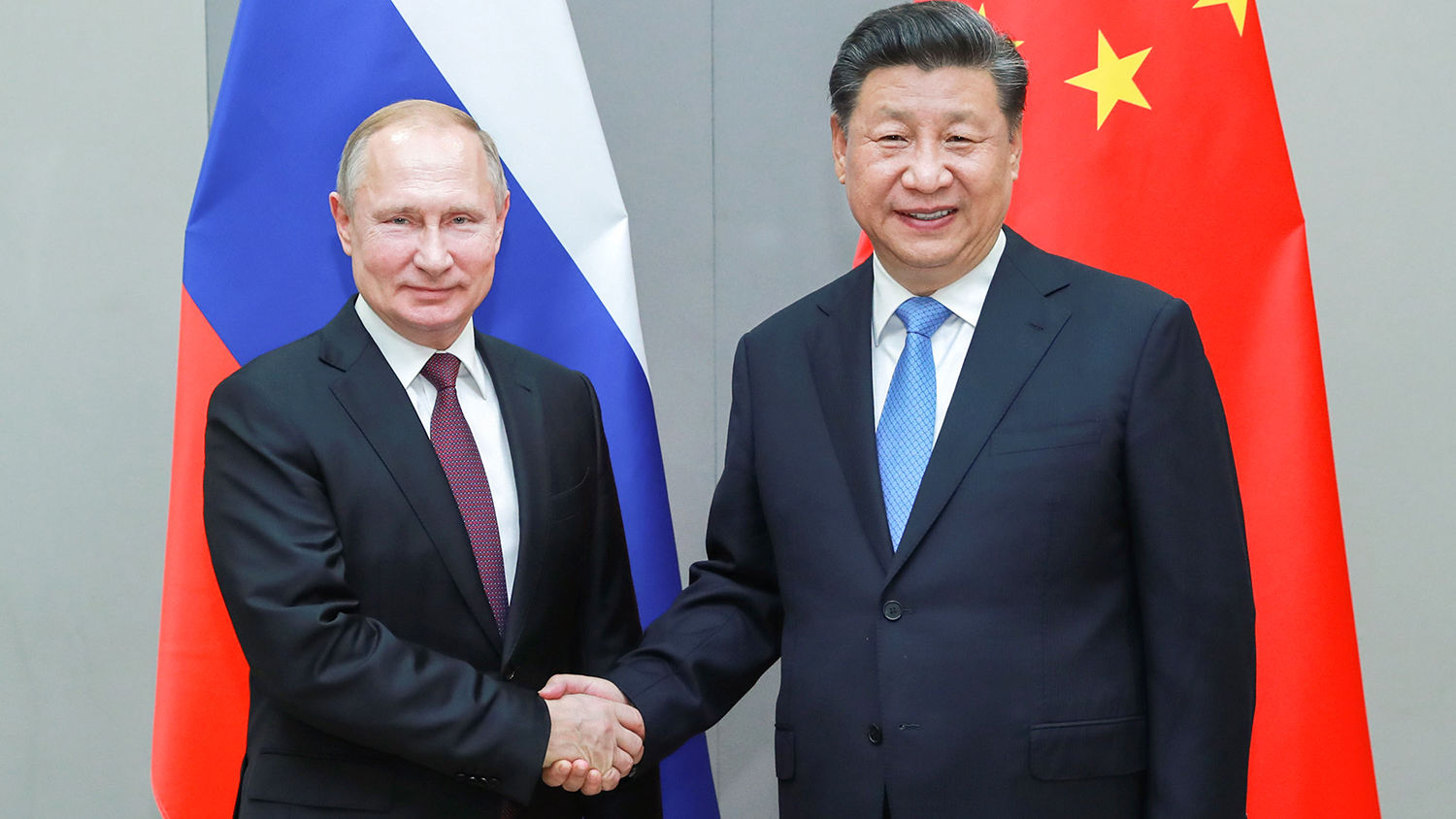
This time it is China and Russia, which the US has named as global rivals in the 2017 National Security Strategy. The rapid economic rise of China has led to the People’s Republic gaining greater influence in Latin America as well.
The recent conflict over Venezuela shows that the geopolitical power struggle with the USA is becoming increasingly explosive in the Western hemisphere. After all, this is the world region which Washington first claimed, and for the longest time has maintained, as its sole area of influence.
Under Trump, the Monroe Doctrine is celebrating its historical origins, but the decisive difference compared to the past is that the USA’s influence in Latin America is now on the decline, as Russia and China use both hard and soft power to gain footholds.
More: Latin America news in English, every day from The Rio Times.
This article was produced by The Rio Times’ automated newsroom system. How we use AI · Report an error · Editorial responsibility: Matthias Camenzind, Editor-in-Chief