The global rise of Venezuelan arepas: unpacking the recipe’s popularity
From Caracas to Tokyo, traversing through New York, Paris, and Hong Kong, on street corners or in high-end restaurants, the arepas—a cornmeal dish from Venezuela—is making a worldwide mark.
The expanding “gluten-free” market and Venezuelan diaspora have fueled the global popularity of arepas.
Arepas start with a mix of pre-cooked cornmeal, salt, and water. This dough is then hand-shaped into a circular form and cooked for a few minutes on a griddle or in a skillet.
The fillings offer a canvas for creativity, ranging from leftovers to more intricate concoctions like “reina pepiada”—a mix of chicken, avocado, and mayonnaise—that many Venezuelans favor.
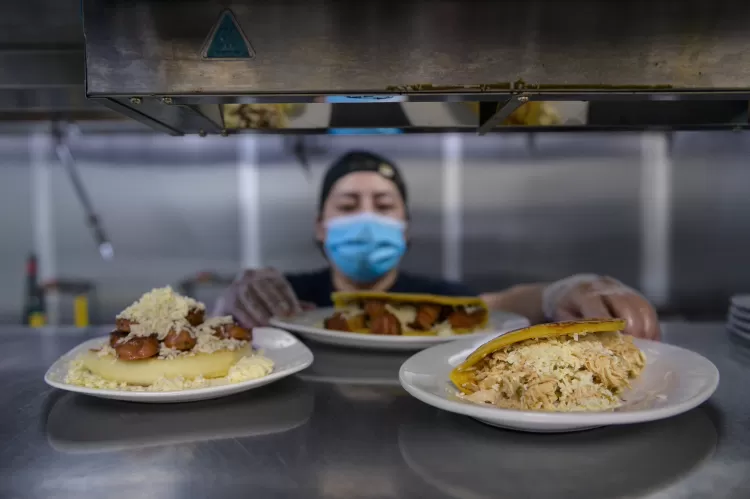
“Wherever a Venezuelan goes, an arepa goes too,” quips Venezuelan food critic Ricardo Estrada Cuevas, author of “Arepólogo: Our Daily Bread.”
“Venezuelans eat it daily, night and day,” notes Patrick Ribas, the book’s translator. Arepas can be filled “with a host of delightful ingredients at any time… but it can also be eaten plain when money is tight.”
Out of an estimated 30 million inhabitants in Venezuela, over 7 million have left the country amid a crisis that began in 2014, impacting 80% of the economy. Arepas found a place in their luggage.
“A Taste of the Caribbean”
Attorney Marlyn Quiroga, 47, immigrated to New York five years ago. Starting as many immigrants do, doing a bit of everything, she now dedicates her time to cooking.
She assures New Yorkers prefer arepas to bread at parties as they are “gluten-free.”
In Paris, Jean-François Lamaison considers the arepa a refreshing change from ubiquitous hamburgers.
As a digital designer for the restaurant “Ajidulce – The Taste of Venezuela,” he champions the “Arepa Power” campaign.
“It’s a corn pancake filled with excellent ingredients… I appreciate the diverse flavors,” he remarks.
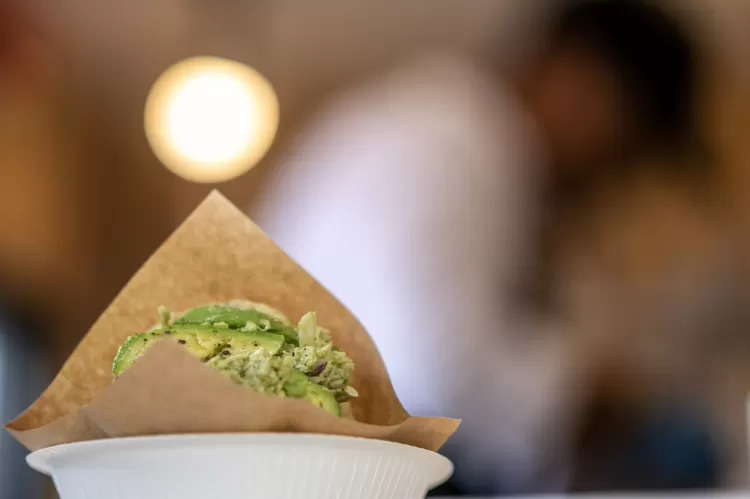
The restaurant’s owner, Luis Fernando Machado, a Venezuelan oil engineer from Punto Fijo (in northwest Venezuela), emphasizes they offer “home-cooked fillings with fresh ingredients.”
Luis Fernando left Venezuela in 2011 and set up a Venezuelan cuisine food truck in 2014.
Owing to its success, he now runs a small restaurant in Paris’ 9th District that employs around ten people.
A Story of Passion and Love
Machado acknowledges that the increasing demand for gluten-free options has boosted his business.
“Customers are interested in a complete gluten-free meal. We attract many tourists as we’re well-known among gluten-free restaurants.”
Along with his wife Miho, 42-year-old Venezuelan Raúl Márquez lures customers by promoting arepa as a “healthy, gluten-free street food” from their food truck.
“Venezuela has endured a tough time… with significant emigration. We carry with us what’s ours. Arepas are part of that. To me, an arepa is reminiscent of my mother.”
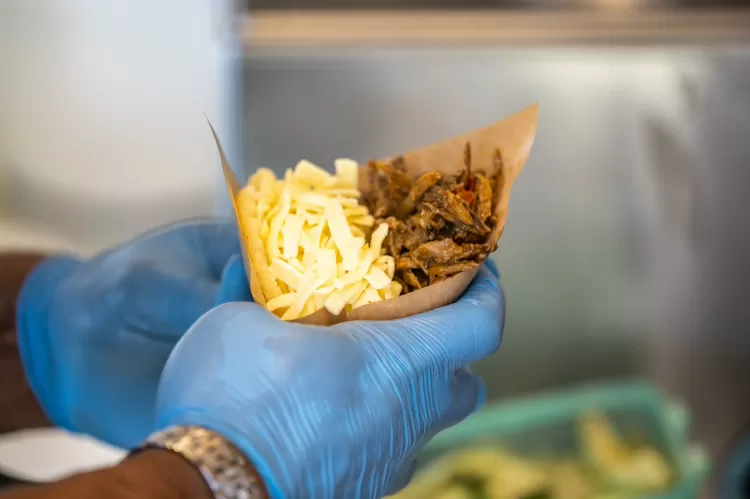
“It’s what I ate before going to school… it’s the passion, the love from home that I put into selling arepas,” he shares.
Lisbeth Márquez’s street stand in Caracas serves 1,300 meals a day. Her usual breakfast is a hearty arepa pabellón: black beans, shredded meat, an egg, grated cheese, and melted butter atop a hot tortilla.
“I never grow tired of eating arepas. The best one is the homemade arepa,” Márquez adds.
With information from AFP
Arepas, Latin American food, Venezuelan food specialities, news Venezuela, English news Venezuela
Editorial responsibility: Matthias Camenzind, Editor-in-Chief · Editorial standards · Report an error
Read More from The Rio Times