Latin American Steel Rebounds as CSN Recovers; Ternium Ends Losing Run
Key Facts
- CSN bounced back in São Paulo, rising 6.85% to R$5.77 (about US$1.12) after Tuesday’s 9.85% slump; its New York shares gained 3.92% to US$1.06.
- CSN Mineração gained 5.25% to R$5.01 (about US$0.97), a day after cutting its 2026 output guidance.
- Ternium rose 1.59% to US$54.30, ending an eight-session losing streak.
- Gerdau’s US-traded shares gained 1.72% to US$4.72, and its São Paulo shares added 0.29% to R$24.27 (about US$4.69).
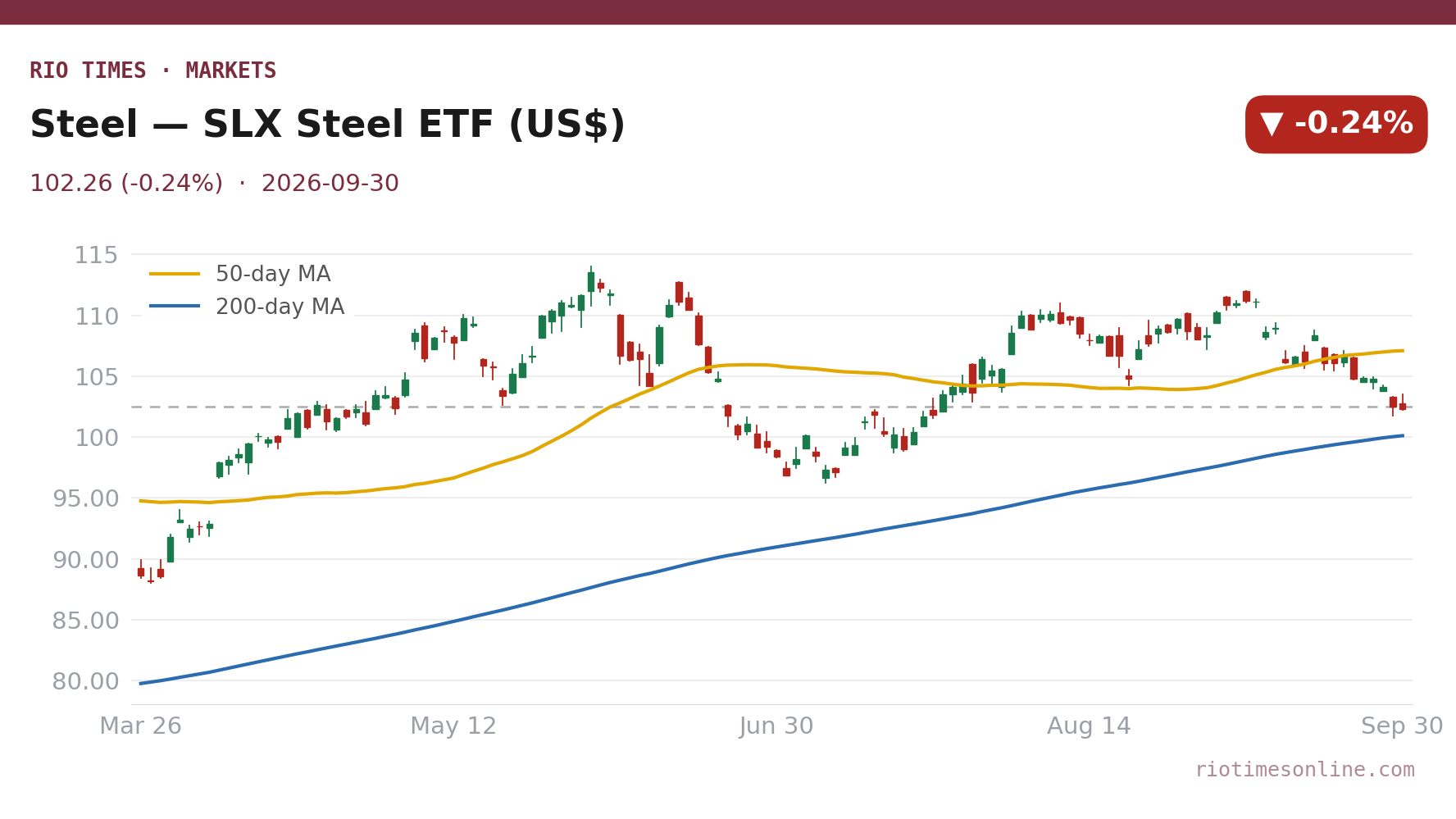
- The SLX steel ETF slipped 0.24% to US$102.26, its fourth straight loss and its lowest close since 23 July.
- At the G20 trade meeting in Milwaukee, a 28-country steel forum agreed a “Milwaukee Framework” against global excess steel capacity, US Trade Representative Jamieson Greer said, and Brazil and the US agreed to form a working group on tariffs.
Today’s Focus
Latin American steel shares bounced on Wednesday, 30 September 2026, after Tuesday’s sell-off. CSN led the recovery: its São Paulo shares jumped 6.85% to R$5.77 (about US$1.12), and its mining arm CSN Mineração gained 5.25%.
The rebound came on a strong day for Brazil. The Ibovespa rose 1.37% to 186,340 points and the real firmed 0.53% to 5.1743 per US dollar, as softer-than-expected US inflation data lifted risk appetite.
Ternium rose 1.59% to US$54.30, ending eight straight daily losses. The SLX steel-producers ETF still slipped 0.24% to US$102.26, its fourth loss in a row.
Trade policy moved at the G20 trade ministers’ meeting in Milwaukee. A 28-country steel forum agreed a “Milwaukee Framework” to coordinate action against global excess steel capacity, and US Trade Representative Jamieson Greer said it would likely encourage countries to raise trade barriers to steel from China and other overproducers. Brazil and the United States agreed to set up a working group on tariffs.
What matters today. Wednesday’s bounce was relief after a company-specific sell-off, not a change in the story. The G20 push against overcapacity and Brazil’s new tariff channel with Washington are the threads to follow.
01 The session in one read
Latin American steel equities recovered part of Tuesday’s losses on Wednesday, 30 September 2026. Every Latin American name on our board rose, while the US-listed SLX ETF, which holds global steel producers, fell for a fourth day.
CSN’s New York shares rose 3.92% to US$1.06 after Tuesday’s 8.11% crash. There was no new company statement. The move came on a broadly positive day for Brazilian stocks, while brokers stayed cautious on the mining guidance cut.
Wednesday’s gains recovered only part of Tuesday’s damage: CSN’s São Paulo shares are still below Monday’s R$5.99 close (about US$1.16), and CSN Mineração’s lower-volume, higher-cost outlook is unchanged. The bigger shift is in policy. A coordinated G20 push against excess steel capacity and Brazil’s working group with Washington could matter more for Gerdau, Usiminas and CSN over the coming months than any single session. Watch for the framework’s text and the US proposal on the scope of the Brazil talks.
02 The board
Ternium, the Mexican flat-steel producer, rose 1.59% to US$54.30, ending an eight-session losing streak. Nothing changed on the 50% US Section 232 duty on Mexican steel.
Gerdau’s US-traded shares gained 1.72% to US$4.72. The long-steel maker’s São Paulo shares added 0.29% to R$24.27 (about US$4.69), and holding company Metalúrgica Gerdau rose 1.11% to R$10.94 (about US$2.11). Usiminas gained 0.86% to R$7.01 (about US$1.35).
| Asset | Level | Change |
|---|---|---|
| Steel (SLX ETF) | US$102.26 | -0.24% |
| Gerdau | US$4.72 | +1.72% |
| CSN (ADR) | US$1.06 | +3.92% |
| Ternium | US$54.30 | +1.59% |
Source: RT close, 2026-09-30. Where a commodity has no spot feed, an exchange-traded tracker or leading producer is shown as a labelled proxy.
Live Market IntelligenceThe live market board
Rio Times · Live Market Intelligence
Latin America — Cross-Market Board
| Instrument | Last | Change | YoY | Prev. | High | Low | Volume |
|---|---|---|---|---|---|---|---|
| IBOV | 186,340.46 | +1.37% | +21.85% | 183,827.59 | 168,310 | 167,142 | — |
| IPSA | 10,969.49 | -0.78% | — | 11,055.94 | 11,210 | 10,984 | 1,513,213,483 |
| IPC MEX | 64,214.36 | -1.38% | +12.17% | 65,110.57 | 66,121 | 65,405 | 108,886,187 |
| MERVAL | 2,819,323 | +1.32% | +30.51% | 3,022,485 | 3,042,365 | 2,991,150 | — |
| COLCAP | 2,549.16 | -0.38% | — | 9.04 | 9.05 | 9.02 | 4,133 |
| BVL PERÚ | 60,410.88 | -0.96% | — | — | — | — | — |
| USD/BRL | 5.16 | +0.01% | -5.13% | 5.16 | 5.18 | 5.14 | — |
| EUR/BRL | 5.95 | +1.01% | -5.83% | 5.89 | 5.98 | 5.94 | — |
| USD/MXN | 17.06 | -0.24% | -8.58% | 17.10 | 17.08 | 17.01 | — |
| USD/CLP | 913.98 | +0.04% | -5.67% | 913.65 | 915.11 | 906.68 | — |
| USD/COP | 3,140 | +0.03% | -22.04% | 3,139 | 3,141 | 3,105 | — |
| USD/PEN | 3.36 | -0.66% | -4.82% | 3.38 | 3.38 | 3.35 | — |
| USD/ARS | 1,493 | +0.10% | +12.96% | 1,491 | 1,494 | 1,480 | — |
| USD/UYU | 40.27 | +1.24% | +1.80% | 39.77 | 40.27 | 40.23 | — |
| USD/PYG | 5,939 | +1.68% | -19.54% | 5,841 | 5,939 | 5,925 | — |
| USD/BOB | 11.64 | -0.76% | +72.04% | 11.73 | 11.72 | 11.64 | — |
| USD/DOP | 58.34 | +1.25% | -3.44% | 57.62 | 58.34 | 58.04 | — |
| USD/CRC | 445.92 | +0.89% | -9.71% | 441.97 | 448.50 | 445.92 | — |
03 What moved it
The main move was the rebound at CSN. A day earlier, CSN Mineração had cut its 2026 production and third-party purchase guidance to 39–41 million tonnes, from 45–47 million tonnes, and raised its cash-cost forecast to US$25–26 a tonne. Brokers did not turn positive. Itaú BBA estimated the cut could reduce CSN Mineração’s 2026 EBITDA by R$0.7–1.0 billion (about US$135–193 million), or 13–20% of its previous estimate.
Brazil’s broad rally helped. The Ibovespa gained 1.37% and the real firmed after US inflation came in below forecasts.
Policy was the second theme. On the sidelines of the G20 trade ministers’ meeting in Milwaukee, the OECD-led Global Forum on Steel Excess Capacity, whose 28 members exclude China and India, agreed a “Milwaukee Framework”, Reuters and AFP reported. It calls on members to avoid subsidies that keep loss-making mills alive, to cut market-distorting subsidies, to share data on suspicious steel trade and, if needed, to take trade measures, which could include tariffs, against overproducers. Greer said it would likely encourage countries to raise barriers to steel from countries such as China.
Brazil and the United States also agreed on Wednesday to set up a working group to discuss a possible trade agreement, Brazil’s trade ministry said, after Foreign Minister Mauro Vieira and Development Minister Márcio Elias Rosa met Greer. Brazil wants US tariffs removed, including the Section 232 duties on its steel and aluminium. Washington is expected to send a proposal on the scope of the talks in the coming weeks.
04 Wednesday’s data, one by one
Tuesday’s edition promised five steel markers for Wednesday. Here is what happened.
G20 trade ministers, Milwaukee: a framework on overcapacity. A 28-country steel forum agreed the “Milwaukee Framework” against excess steel capacity, and Brazil and the US agreed to form a working group on tariffs. Mexico’s Economy Secretary Marcelo Ebrard attended, but no date was announced for the fourth round of US-Mexico talks, and the 50% US duty on Mexican steel stayed in place. Ternium still rose 1.59%.
Brazil fiscal data (August): a wider deficit. The consolidated public sector ran a primary deficit of R$10.0 billion (about US$1.93 billion) in August, the central bank said, after a R$1.4 billion (about US$0.27 billion) surplus in July. Including interest, the nominal deficit was R$115.9 billion (about US$22.4 billion). Gross government debt rose to 82.9% of GDP from 82.5%, just below the 83.1% forecast. The real still firmed 0.53%.
Brazil producer prices (August): back up. The IBGE producer price index rose 0.36% in the month after a 0.83% fall in July. Over 12 months it is up 2.53%, above the 2.0% forecast. The index includes metals, but it did not move steel shares.
US data: stronger jobs and factories, softer inflation. ADP private payrolls rose by 90,000 in September, above the 70,000 forecast. The Chicago PMI jumped to 58.8 from 47.1, far above the 51.2 forecast, a sign of firmer US factory activity. Core PCE inflation held at 3.0% a year in August, below the 3.3% forecast. The softer inflation reading helped risk assets in Brazil.
CSN and CSN Mineração: brokers cautious, shares higher. There was no new company comment. Itaú BBA put the hit to CSN Mineração’s 2026 EBITDA at R$0.7–1.0 billion (about US$135–193 million). In a note on Tuesday, Citi kept neutral ratings, with price targets of R$5 (about US$0.97) for CSN and R$6 (about US$1.16) for CSN Mineração. Both stocks still rose.
Chile industrial data (August): weaker than expected. Industrial production fell 5.7% from a year earlier, the INE statistics office said, against a forecast 3.0% drop, as mining output slumped 11.7%. Manufacturing fell 2.6%, worse than the 1.7% decline expected. It is a soft signal for regional steel demand.
China: PMIs above 50, then a holiday. The official manufacturing PMI rose to 50.1 in September, released early on Wednesday. Mainland Chinese markets, including steel and iron ore futures, are now closed for the Golden Week holiday from 1 to 7 October.
05 The Latin American read
Brazil now works on two fronts. Abroad, it has a new working group with Washington that covers the Section 232 steel duties. At home, mills say they run at only 60–65% of capacity despite tariffs and anti-dumping measures on imports. Brazilians vote in the first round of the general election on Sunday, 4 October, which adds a political layer to every Brazilian stock this week.
Mexico’s problem is still the 50% US duty on its steel. Ebrard was in Milwaukee, but there was no new date or tariff text. The peso eased 0.12% to 18.0687 per US dollar, and Mexico’s IPC index fell 1.38% to 64,214.36.
06 The names to watch
CSN: the rebound does not change the guidance. The next test is whether freight costs ease enough for CSN Mineração to restore lower-grade output, which it says it can do if market conditions improve.
Gerdau: the long-steel maker, which also runs mills in the United States, is the bellwether for Brazilian construction steel. Rebar and structural steel track housing and infrastructure spending.
Ternium: the purest play on the US-Mexico talks. Ending its losing streak does not change the 50% duty; a date for the fourth negotiating round would be the first real signal.
07 The outlook
The G20 trade meeting closes on Thursday. Whether members turn the Milwaukee Framework into new tariffs will show if it brings real trade action against cheap steel. For Brazil, the first test is the US proposal on the scope of tariff talks, expected in the coming weeks.
With mainland China closed for Golden Week until 7 October, Chinese steel and iron ore futures will be quiet. US factory data and trade headlines are likely to drive the sector in the meantime.
08 What to watch
- G20 trade ministers, final day (Milwaukee): any G20 statement on steel overcapacity after the Milwaukee Framework, and any date for the fourth US-Mexico round.
- Brazil manufacturing PMI, 10 am BRT (13.00 UTC): S&P Global’s September reading, forecast 46.5 after 46.3.
- US ISM manufacturing, 11 am BRT (14.00 UTC): forecast 55.0 after 54.6, with the prices index forecast at 72.3.
- Mexico manufacturing PMI, 12 pm BRT (15.00 UTC): forecast 50.0 after 49.8, a read on demand for Ternium’s flat steel.
- China Golden Week: mainland markets, including steel and iron ore futures, are closed from 1 to 7 October.
- Brazil industrial production, Friday 2 October, 9 am BRT (12.00 UTC): August output, forecast up 0.1% on the month.
Frequently Asked Questions
Why did CSN shares rebound on Wednesday?
They recovered part of Tuesday’s sell-off on a strong day for Brazilian stocks. CSN rose 6.85% in São Paulo to R$5.77 (about US$1.12) and CSN Mineração gained 5.25%, but the mining arm’s cut to its 2026 guidance still stands.
What is the Milwaukee Framework?
It is a plan agreed on 30 September by the 28-member Global Forum on Steel Excess Capacity, which excludes China and India, on the sidelines of the G20 trade ministers’ meeting in Milwaukee. Members agreed to cut market-distorting subsidies, share data on suspicious steel trade and, if needed, take trade measures such as tariffs against countries that overproduce.
What did Brazil and the United States agree?
On 30 September they agreed to set up a working group to discuss a possible trade agreement. Brazil wants US tariffs removed, including the Section 232 duties on its steel and aluminium.
Did Ternium recover?
Yes. Ternium rose 1.59% to US$54.30 on Wednesday, ending an eight-session losing streak. The 50% US duty on Mexican steel remains in force.
Source: RT live market data, close of Wednesday 30 September 2026.
This article was produced by The Rio Times’ automated newsroom system. How we use AI · Report an error
LatAm Markets: Live Signals → — real-time movers, turnover leaders and FX across Latin America.
Read More from The Rio Times