Six Figures Reflect Dramatic Economic Impact of Coravirus in Brazil
RIO DE JANEIRO, BRAZIL – In only two months, the covid-19 pandemic wiped out Brazilians’ hopes for a speedy economic rebound. Before the coronavirus, the country was gradually pulling out of the recession and taking on a positive economic trajectory, but this changed with impressive speed.
Investments were canceled, jobs were lost and companies threatened to close their doors, generating more unemployment. For many organizations and people, growth plans have become a struggle for survival. Below are six figures that illustrate the magnitude of the crisis triggered by the coronavirus.

Brazilian GDP may drop 7.7 percent in 2020
Poor health systems, little scope for fiscal incentives, and a high degree of informality make Latin America particularly vulnerable to the devastating economic impacts of the coronavirus pandemic. The Bank of America (BofA) has said so in a report published this week.
The bank projects Brazil’s GDP to drop 7.7 percent this year as a result of the pandemic. If that figure proves to be true, it will be the worst recession in Brazil’s history.
The dollar soars above R$6
The Brazilian real has now depreciated 45 percent against the dollar this year and there are indications that this downward trajectory will persist. In the financial market, the question is not “if” the dollar will exceed the R$6 mark, but rather “when” this will happen.
The currency has actually peaked at this figure over the past week but retreated because of Central Bank interventions in the foreign exchange market. Last Friday, May 15th, the dollar closed the day trading at R$5.84. The tourism dollar stood at R$6.15.
Other emerging country currencies have also depreciated. In addition to the covid-19 pandemic, the trade war between the United States and China has contributed to this effect. A weak real helps exporters, but increases the price of many imported products, relies on imported supplies, or has its prices tied to international markets.
Unemployment benefit claims have increased by 39 percent
IBGE (Brazilian Institute of Geography and Statistics) data show that unemployment increased somewhat in the first quarter. The unemployment rate in the country was 12.2 percent, against 11.0 percent in the fourth quarter of 2019. It increased in 12 of the 27 states. This is not a dramatic change, but a greater increase is sure to be seen when figures for the second quarter are released, as the country is being hurt the hardest by the coronavirus pandemic.
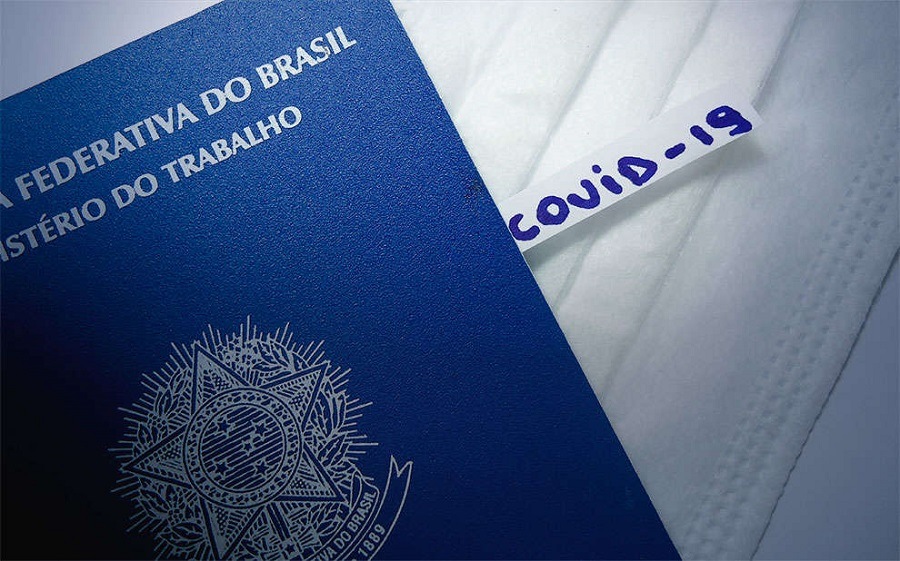
Evidence of this lies in the number of people who applied for unemployment benefits in April, which increased 39 percent compared to March, according to the Ministry of Economy. The Ministry also reported that 6.2 million people signed up for the temporary measure that allows for the reduction of wages and the suspension of the employment contract – a means to prevent more jobs from being lost.
A further sign that unemployment is on the rise is in the FGV’s Past Employment Indicator (IAEmp), which monitors the direction of the labor market in Brazil. It dropped from 82.6 points in March to 39.7 points in April. It is its lowest level since 2008 when the FGV (Getúlio Vargas Foundation) initiated the survey’s historical series.
Industrial production contracted 9.1 percent in March
For the first time since IBGE began monitoring industrial production in the country in 2012, it has shrunk in the 15 locations where this survey is conducted. In São Paulo, the country’s largest industrial park, the reduction was 5.4 percent. The most intense drops occurred in Ceará (-21.8 percent), Rio Grande do Sul (-20.1 percent) and Santa Catarina (-17.9 percent).
Considering the whole country, production contracted 9.1 percent, according to IBGE in its Monthly Industrial Survey – Regional Physical Production (Regional PIM). This is yet another indicator signaling that Brazil is entering a recession.
The country risk rose from 95 to over 400 points
In the eyes of international investors, Brazil has become a riskier country to invest in this year. The country’s Credit Default Swap (CDS) has already increased 255 percent this year, showing that international investors perceive a growing risk that Brazil will default on its foreign debt.
The country’s situation is worse than that of other emerging countries. Mexico’s CDS, for instance, grew 175 percent, Chile’s 140 percent, and South Africa’s 137 percent (Argentina and Venezuela are not considered as they are currently in default).
Before the coronavirus crisis and the worsening of the political environment, investors viewed Brazil as having a chance to regain its investment grade, the seal of good payer granted by risk assessment agencies. In early January, the Brazilian CDS stood at 95 points, its lowest level in ten years.
In April, rates exceeded 400 points, the same level Brazil had in early 2016, just before Dilma Rousseff’s impeachment. As a result, the dream of returning to investment grade, which would bring more foreign investments to Brazil, became much more distant.
The global cost of the pandemic may reach US$8.8 trillion
A study released last week by the Asian Development Bank (ADB) estimates that the cost of the coronavirus pandemic could reach US$8.8 trillion, depending on the evolution of the outbreak and the scope of government interventions.

This figure is equivalent to almost ten percent of global GDP. The ADB also estimates that between 158 million and 242 million jobs could be lost globally, 70 percent of them in Asia and the Pacific. In China, up to 95 million jobs could be lost, says the bank.
This is the bank’s worst-case scenario. The impact of covid-19 may be milder if governments take effective action to mitigate it. But there is no doubt that the world is becoming poorer because of the pandemic.
Source: Exame
More: Brazil news in English, every day from The Rio Times.
This article was produced by The Rio Times’ automated newsroom system. How we use AI · Report an error
Read More from The Rio Times