Portuguese Prime Minister apologizes to Mozambique for Wiriyamu massacre
Portuguese PM António Costa apologized yesterday to the President of the Republic of Mozambique, Filipe Nyusi, for the Wiriyamu massacre, which he described as an “inexcusable act that dishonors the history of Portugal.”
“In this year 2022, almost 50 years after that terrible day on December 16, 1972, I cannot but remember and bow to the victims of the Wiriyamu massacre, an inexcusable act that dishonors our history,” he said in Maputo.
Speaking at the dinner to which the Prime Minister had invited the President of the Republic of Mozambique, Filipe Nyusi, António Costa pointed out that “a relationship as intense and lasting” as the one between the two countries “is inevitably marked by diversity.”

“Diversity of encounters and maladjustments, slavery and liberation, of progress and poverty, war and peace, for moments that we certainly want to remember, but also for moments and events that we must never forget,” explained the Portuguese Prime Minister.
‘IT MUST NEVER BE FORGOTTEN’
“The relationship between friends is created in this way; it is created by the kindness of those who are victims and do not want to remember, but also by those who have the duty never to let forget what they did and who must repent before history,” he said.
The Prime Minister considered that this must be done because Portugal has known how to reinvent its history with the fall of the dictatorship, “which opened the doors to peace so that the independence Mozambique has achieved has definitively consecrated our relations as friendly relations between sovereign, free and equal countries.”
“Based on this awareness, we look to the future with an open heart and a will be renewed every day to build a common future,” António Costa stressed.
Prime Minister António Costa concluded yesterday a two-day official visit to Mozambique.
THE WIRIYAMU MASSACRE
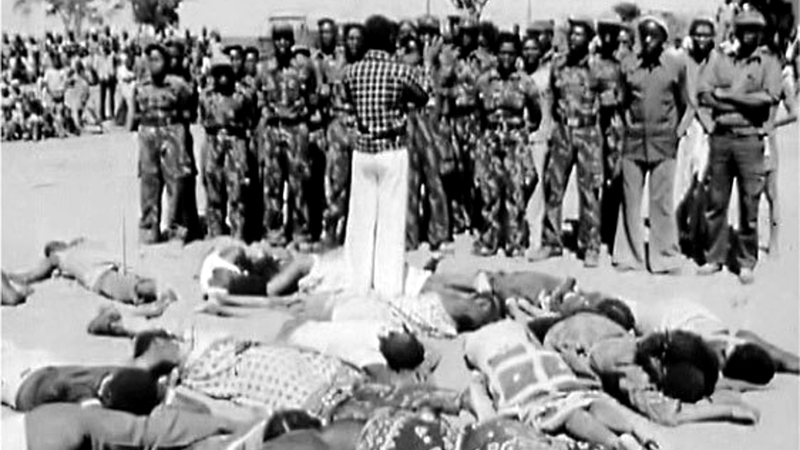
The Wiriyamu Massacre or Operation Marosca was a massacre of the civilian population of the village of Wiriyamu in Mozambique by Portuguese soldiers in December 1972.
The Portuguese Colonial War broke out in 1961 in response to challenges to Portuguese colonial rule by African independence movements following the success of the Democratic Republic of the Congo obtaining independence from Belgium a year earlier.
In 1970, FRELIMO guerillas began operating along the Mozambican section of the Zambezi River. The presence of FRELIMO and other anti-colonial revolutionary guerilla organizations sparked intense and widespread panic among settlers.
In response, the Portuguese Army initiated 1971 a series of “cleanup” operations along the Zambezi, from Mucanha to Mucumbura to Inhambinga.
These operations involved widespread atrocities and the depopulating of the area to block the advance of guerillas, who relied on support from the local African populace.
By 1972, the Portuguese government deployed large amounts of Army units and PIDE/DGS corps to the area, with their behavior and that of the settler militias becoming increasingly harsh.
On 16 December 1972, the Portuguese 6th company of Mozambique Commandos killed the inhabitants of the village of Wiriyamu, in the district of Tete.
Referred to as the ‘Wiriyamu Massacre’, the soldiers killed between 150 (according to the Red Cross) and 300 (according to a much later investigation by the Portuguese newspaper Expresso based on testimonies from soldiers) villagers accused of sheltering FRELIMO guerrillas.
The action, named “Operation Marosca”, was planned at the instigation of PIDE/DGS agents and guided by agent Chico Kachavi, who was later assassinated while an inquiry into the events was being carried out.
The soldiers were told by this agent that “the orders were to kill them all”, never mind that only civilians, women, and children included, were found.
All of the victims were civilians.
This article was produced by The Rio Times’ automated newsroom system. How we use AI · Report an error · Editorial responsibility: Matthias Camenzind, Editor-in-Chief