Piñera Bets Chile’s Future on New Constitution, Assures Punishment for Police Violence
RIO DE JANEIRO, BRAZIL – President Sebastián Piñera made an official statement at La Moneda Palace on Sunday evening, November 17th, to assess Friday morning’s political agreement, involving virtually all of the country’s political forces, to hold a plebiscite in April 2020 that will define the future of the 1980 Constitution.

“If the population so decides, we will move towards a Constitution, the first drafted in full democracy and accepted and respected by all,” said the president on the joint effort of both the government and much of the parliamentary opposition to restore public order and control the social outbreak, which completed one month on Monday.
“It will be the great milestone that will provide unity, legitimacy, and stability to our democracy and social coexistence and will allow us to process and settle the legitimate differences emerging in our society,” said Piñera, who allowed almost three days to elapse before mentioning the most important fact in Chile’s recent political history.
President Piñera also made reference to the charges of human rights violations against the Armed Forces and the law enforcement in this month of protests, where massive peaceful demonstrations were coupled with the actions of violent groups that caused more than US$4.5 billion in damages to infrastructures alone.
This is one of the greatest complexities his government has faced for weeks. “In some cases, the protocols were not respected, there was excessive use of force, abuse or crimes were committed and the rights of all were not respected,” the president said of the police action.
“I want to express my solidarity and condolences to the victims of this violence, to those who have suffered injuries, and in particular to the families of those who have lost their lives,” he added, in reference to the 23 people who have died since the crisis broke out on October 18th – initially as a protest against the increase in subway fares in the capital.
“There will be no impunity and our government will do its utmost to assist the victims in their recovery and for the Prosecutor’s Office and courts to carry out their mission of investigating and doing justice,” Piñera said.
The ‘Carabineros’ (Chilean national police force), the institution in charge of controlling public order and security in Chile, are facing a delicate scenario: in this crisis, the deficiencies in their protocols and the need for modernization have become evident. The National Human Rights Institute (NHRI) reported that 217 people have suffered eye injuries due to the use of rubber bullets.
As neither the protest nor the violence was extinguished even with the political agreement for a new constitution, on Friday night there was a new incident in Baquedano Square, the epicenter of the demonstrations in Santiago. A young man died of a heart attack during the demonstration, an incident still under investigation.
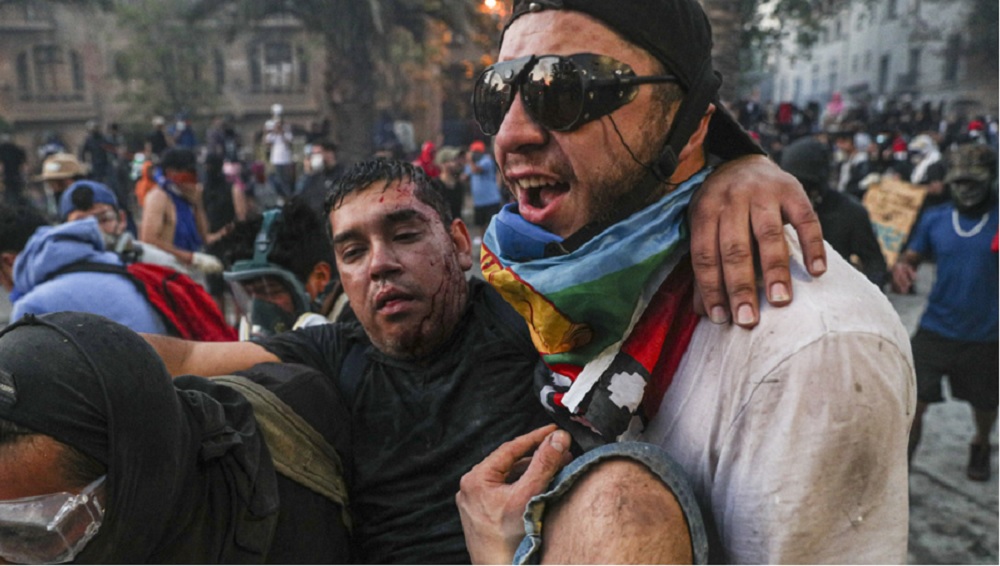
According to the Emergency Medical Service (SAMU), the medical team that was assisting the young man was shot by rubber bullets and tear gas bombs from the Carabineros while they were trying to save his life.
But in addition to anticipating that his government’s next agreement will be focused on social welfare, the president summarized the difficult days that Chile’s democracy is facing.
“The final outcome of these four weeks is not yet written,” he said. “It is up to us to build and follow the paths that will lead our country to a successful conclusion”.
Last Tuesday, Chile experienced delicate hours. Immediately after a day-long national strike promoted by the Bureau of Social Unity – made up of 200 trade union, human rights, environmental and native peoples’ organizations, among others -, the gatherings resulted in one of the most severe violent outbreaks since the protests began a month ago.
In addition to lootings and attacks on residential buildings, political party committees and even diplomatic headquarters – there were at least 30 fires ignited throughout the country – there were attempts to raid at least 20 police barracks, most of which located in the capital, according to official information from the Ministry of the Interior.
Against this backdrop, the president considered returning the military to the streets in an attempt to restore public order, which would have interrupted the political talks between the government and the opposition in Parliament, that even during the crisis enabled agreements on fundamental issues such as the tax reform.
However, in the most complex hours since the return to democracy in 1990, the president finally decided to make a common call for peace.
In the following hours, his appeal was accepted by the majority of the political spectrum and, after 48 hours of intense negotiations in Congress, a historic agreement was reached to convene the April plebiscite, which will determine whether citizens wish to replace the 1980 Constitution.
It seems clear that this will be the case – eight out of ten Chileans wish to do so, according to surveys – and Chileans would decide on the tools for its replacement in parallel: whether by means of a “constitutional convention” with entirely new members, operating concurrently with the Congress with constituent functions, or a “mixed convention” made up of 50 percent of legislators and another 50 percent of delegates.
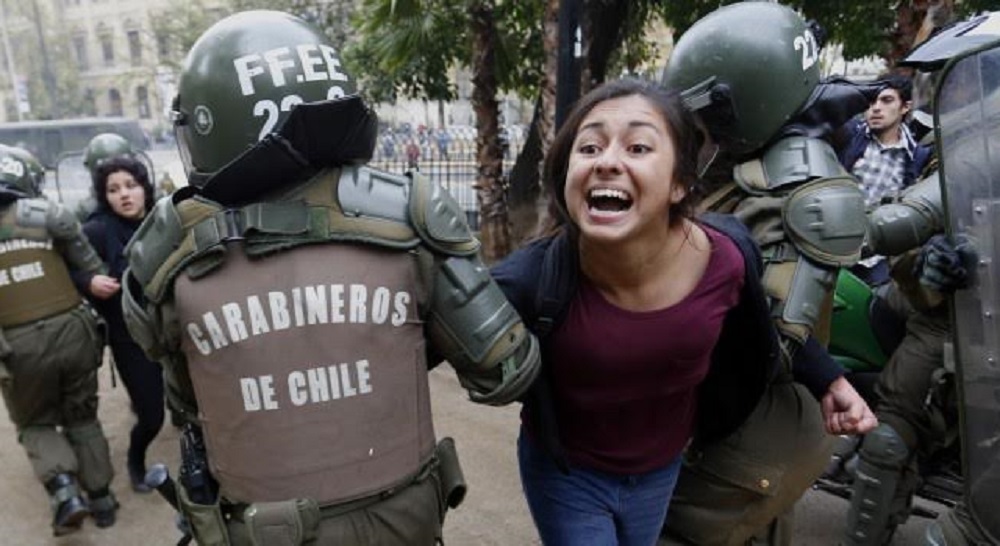
The political agreement to amend the Chilean constitution by means of a referendum fails to appease the radical sectors. On Monday, a new sit-in has been called to celebrate a month of the uprising, and the Bureau of Social Unity – which rejects the terms on which the new constitutional path was negotiated – has scheduled further days of protests and a new general strike.
On Sunday, one of the main leaders of the left-wing ‘Frente Ampla’ (“Broad Front”), Beatriz Sánchez, was insulted in downtown Santiago by groups of demonstrators who reprimanded the support of most of her political group for a new constitution, which they regard as insufficient.
Source: El Pais
More: Latin America news in English, every day from The Rio Times.
This article was produced by The Rio Times’ automated newsroom system. How we use AI · Report an error · Editorial responsibility: Matthias Camenzind, Editor-in-Chief