Panama Petroterminal Buyout: Key US Oil Pipeline Shifts Control
Panama · Economy
Key Facts
—Announcement date. July 17, 2026, by Panama's Ministry of Economy and Finance.
—Current ownership split. The Panamanian state holds 59%, while US-based NIC Holding Corp owns 41%.
—Purchase price. Undisclosed; will be calculated using a pre-agreed formula based on audited financial statements.
—Financing method. The buyout will be funded by the company's own cash flow, not through expropriation.
—Strategic asset. The pipeline allows large oil tankers to bypass the Panama Canal, connecting the Caribbean to the US West Coast.
Panama’s government announced on Friday it has begun the process to buy the remaining private stake in the Panama Petroterminal, a strategic trans-isthmus oil pipeline, aiming for full state ownership. The exact purchase price for the 41% share held by US company NIC Holding Corp has not been publicly disclosed.
A Contractual, Not Expropriation, Purchase
The Ministry of Economy and Finance confirmed the move is a contractual purchase under the 1977 Association Agreement, specifically Clause 10. It is not an act of expropriation, officials stressed, a crucial distinction for foreign investors watching the process.
The price will be determined by a pre-agreed formula based on the Panama Petroterminal’s audited financial statements. The government will use the company’s own cash flow and generated income to finance the deal, meaning no new public debt or extraordinary budget allocations are required.
Why Panama Wants Full Control of the Panama Petroterminal
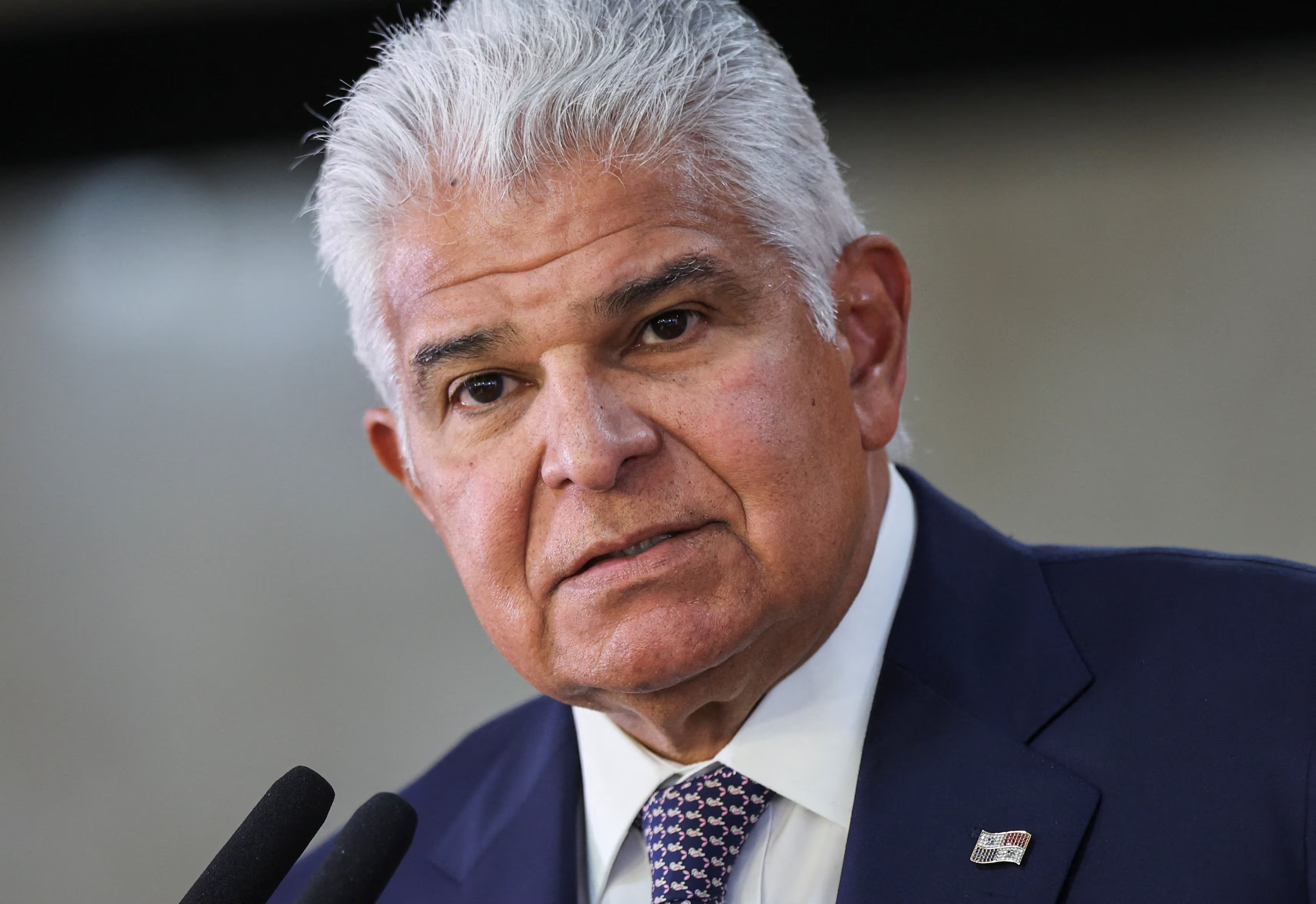
President José Raúl Mulino’s administration cited three main reasons for the buyout. First, the state will capture all future dividends and economic value from the pipeline’s operations, rather than sharing profits with the private minority shareholder.
Second, full ownership tightens national control over a critical energy and logistics asset, reinforcing sovereignty. Third, the captured funds will support future investments in Panama’s energy, maritime, and logistics sectors, potentially strengthening the country’s position as a regional transport hub.
Strategic Role of the Trans-Isthmus Pipeline
The Panama Petroterminal was created in 1977 as a joint venture to handle oversized oil tankers that could not navigate the Panama Canal. It remains a key platform for the country’s logistics development and energy infrastructure.
The pipeline transports hydrocarbons from the Caribbean to the US West Coast, bypassing the canal entirely. This function gives it critical strategic value for regional energy supply chains, as it offers a reliable alternative route for crude and petroleum products regardless of canal congestion or transit restrictions. The buyout is the latest in a series of moves by Panama to consolidate state control over its energy and logistics corridors, following the Panama Canal Authority’s decisions to build its own port terminals and a gas pipeline alongside the canal—part of what our reporting has shown is a deliberate strategy to place critical infrastructure in Panamanian hands rather than relying on foreign operators.
Background: A 50-Year Partnership Nears Its End
The Panama Petroterminal has operated for nearly five decades under a unique public-private structure established by the 1977 Association Agreement. NIC Holding Corp, the US-based private partner, has been involved since the project’s inception, helping finance and operate the trans-isthmus system during a period when Panama was still consolidating its control over the Canal Zone.
The original agreement always contemplated a mechanism for the state to eventually acquire full ownership, which is why Clause 10 provides a contractual pathway rather than requiring hostile negotiations. For context, this model differs sharply from outright nationalizations seen elsewhere in the region, as it follows a pre-established legal roadmap that both parties signed decades ago.
What It Means for Expats, Investors, and Energy Markets
For foreign investors and expats living in Panama, the government’s emphasis on a contractual—not expropriation—process is a reassuring signal about respect for private property rights. The use of the company’s own cash flow to fund the purchase also suggests the state is not straining public finances to complete the deal.
From an energy market perspective, full state ownership of the Panama Petroterminal could lead to more predictable long-term operations, as the government will have undivided authority over maintenance and expansion decisions. However, international oil shippers will be watching closely to ensure that service continuity and competitive pricing remain in place after the transition.
Next Steps and Operational Continuity
The government guaranteed job stability for all current employees and continuity of supplier contracts. Uninterrupted service to customers will be maintained throughout the transition, a key concern for US West Coast refineries that depend on the pipeline’s steady flow.
A final completion date for the transaction remains pending. The deal will close once the price is finalized through the agreed financial formula, moving state ownership from 59% to 100% and ending the nearly 50-year public-private partnership.
More: Panama news in English, every day from The Rio Times.
Frequently Asked Questions
What is the Panama Petroterminal?
It is a trans-isthmus oil pipeline and terminal system created in 1977 as a joint venture between the Panamanian state and US-based NIC Holding Corp. The facility allows large tankers to move crude oil and petroleum products from the Caribbean to the US East Coast, bypassing the Panama Canal entirely—a critical function for vessels too large to transit the waterway.
How is Panama paying for the private stake?
The government will use the Panama Petroterminal's own cash flow and generated income to finance the buyout, meaning no new taxes or public borrowing are required. The purchase is a contractual process under Clause 10 of the 1977 Association Agreement and is explicitly not an expropriation of the US owner's shares.
Why hasn't the purchase price been disclosed?
The exact transaction value will be calculated using a pre-agreed formula based on the company's audited financial statements. Until those audits are completed and the formula is applied, the final dollar figure remains confiden
tial. This method was designed decades ago to ensure a fair, transparent valuation rather than a politically negotiated number.
Connected Coverage
This article was produced by The Rio Times’ automated newsroom system. How we use AI · Report an error
Read More from The Rio Times