Analysis: How Brazil Became a Huge Farm with Cities in Its Center
RIO DE JANEIRO, BRAZIL – When Cornelius Vanderbilt died in 1877, the world was able to have a notion of his fortune, valued at US$100 million, making him the wealthiest man in the world at the time. Vanderbilt created an empire in the railway sector, becoming the first American tycoon.
Some 7700 km away, on that same date, another entrepreneur in the sector was fighting to prevent the bankruptcy of his empire: Brazilian Irineu Evangelista, whose fortune had reached US$60 million a decade earlier.

The Baron of Mauá, as Irineu became known, is the greatest entrepreneur in the country’s history. He founded the Brazilian naval industry, the railway industry, the financial sector, the telecommunications industry, the food industry, as well as promoting lighting and sanitation in Rio de Janeiro.
Born in the countryside of Rio Grande do Sul, Irineu moved to the capital of the empire, where he began working early in a trading house. Using his skill with numbers, he moved up to take control of Scottish Richard Carruthers’ company.
From this small trading house, Mauá would build an empire, which would make him the first Brazilian global capitalist, with offices from Europe to the United States, and countless companies here in Brazil and the rest of South America. All controlled by, of course, the crude communication of the time.
However, it was his anti-slavery position that cost him countless disaffections throughout his life. As a deputy for his home state, Mauá spoke in parliament in favor of ending the slave trade. In his plants, no worker was enslaved.
His opposition transcended moral issues and also dealt with economic issues. Slavery, as Adam Smith wrote a century earlier, is not only immoral but also economic foolishness.
The country’s fortune, as Mauá proclaimed, was drained into trafficking, preventing Brazil from developing. After the adoption of the Eusébio de Queiroz Law, which would put an end to the slave trade, the country saw its first capitalist boom, just as its greatest representative, Mauá, had foreseen.
Decades later, countless industries, businesses and other ventures emerged in the country. However, the issue is a subtle detail approved at that time, designed to guarantee benefits to farmers who would be adversely affected.
The land law guaranteed physical ownership of the land, but among its articles it provided for a ban on the purchase of land by foreigners. In practice, the law paved the way for slave trafficking to be replaced by importation of immigrants.
Large waves of emigrants left Europe at this time and headed for the American continent. In the United States, where many Germans, Scots and Irish went, the government encouraged land occupation.
In the early 1860s, Abraham Lincoln signed the Homestead Act, an American land reform that in practice privatized and guaranteed new settlers public land ownership. The impact of this law over time is what one might call colossal.
Not only did Brazil never compensate its former slaves, but it also ensured that farmers would have benefits and accumulate land. As Mauá found out in the worst possible way, Brazilian institutions failed to create an environment in which private enterprises would flourish.
Even at that time, large farms ruled the country’s economy. However, two exceptions are worth noting. Santa Catarina, today a not very unequal and abundantly industrial state, and the Serra Gaúcha (Gaucho Highlands).
Due to the relief of the land, the large properties that accumulated in the Rio Grande do Sul pampas became unfeasible, thereby populating the regions with countless rural micro-properties.
Unable to create an export culture, as in the area that would extend from the north of Paraná to the south of Minas Gerais, teeming with coffee trees, the two regions turned into small industry locations. Through such industry they could generate the resources to import what they were unable to produce.
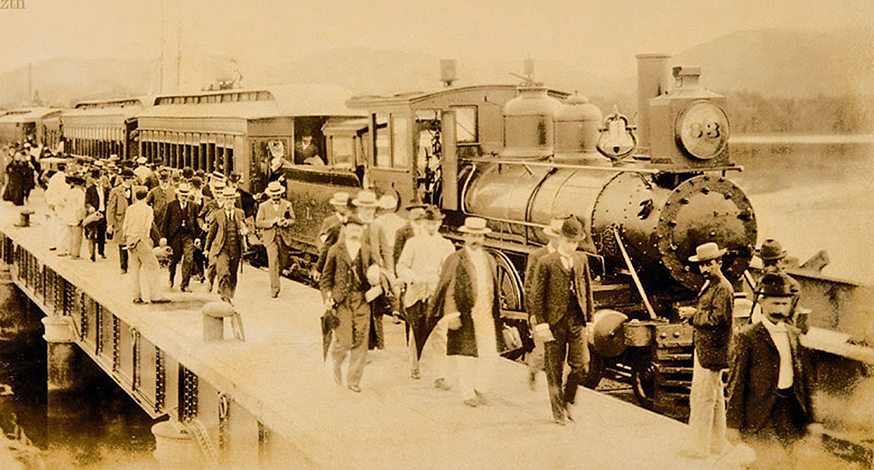
The Brazilian economy continued to be centered on coffee for decades, dominating the other sectors. São Paulo’s infrastructure developed along the railroads built to flow coffee, and the Port of Santos, the largest in Latin America, grew around this export.
Little known, the 1906-1913 boom, which would result in more than 130 companies going public on the São Paulo Stock Exchange and another 100 on the Rio de Janeiro Stock Exchange, would again bring hope for industrialization. By this time, the capital accumulated by coffee laid down infrastructure and flowed into industrial ventures such as the Matarazzo industries.
As Aldo Musachio, a Cambridge professor, comments in his book Experiments in Financial Democracy, this boom would end with World War I in 1914, placing coffee back as the economy’s flagship, at least until the 1929 crisis.
From then on, Brazilian industry became the focus of its rulers’ agenda. The trouble lies in the way it was built.
Getúlio Vargas, the dictator responsible for its initial process, would promote not only the lack of state autonomy that persists until today, but also a concept of induced industrialization.
Under the leadership of Eduardo Guinle, the wealthy entrepreneur whose family had controlled the Port of Santos for decades, the first steel mill was introduced in Brazil.
Unlike the US, where the son of Scottish immigrants Andrew Carnegie would promote this industry, which in turn would give rise to a growth boom in the cities and foster the automobile industry, our immigrants lacked an environment capable of promoting this type of enterprise.
Also with Vargas the country nationalized iron mining, creating Vale do Rio Doce, nationalized bankrupt railroads and promoted economic dirigism. The state centralization of industrial assets was a constant guideline of the war effort. But in Brazil it became permanent, reaching its peak during the military regime.
Our industry once accounted for 25 percent of GDP, more than double what it is today.
However, its downfall is not limited to the success of agriculture, which in the 1970s would take over the Midwest through technological innovations by EMBRAPA (Brazilian agricultural research corporation) in partnership with the Japanese.

The Brazilian industry was, and still is, pampered when it comes to competition. We made a huge effort to prevent our industry from having to compete with the outside world (as did the South Koreans, who also promoted a government-supported industrialization).
We created laws that prevent foreign products from entering, leading to obscene cases such as our import tax being higher than that of the former Soviet Union.
This, however, is only part of the problem. Our tax legislation penalizes long chain sectors and benefits those with a short chain, such as agriculture. The more stages of production a product requires, the more taxes it will pay. The logic, which should support added value products, does not apply here.
Along this decade, we had a very good illustration of how the solution to these problems is quite difficult. Never before in this country’s history was a president so aligned with the yearnings of the industrial sector as Dilma Rousseff.
Long before the FIESP (Federation of Industries of the State of São Paulo), the organization that represents most of the country’s industry in São Paulo, complained about being the whipping boy, Roussef helped create the current picture.
To benefit industry, Dilma passed a Provisional Measure (MP) that provided for renewals of hydroelectric contracts, which resulted in a temporary reduction in the electricity bill. It led to a domestic content law that forced Petrobras to pay more for equipment made here.
She also enacted payroll tax relief which, as we know today, did not create jobs. She also promoted the PSI, the program to sustain investment, which provided R$1.2 trillion in subsidized credit. In short, everything that the industry asked for, it got.
It turns out that none of this was enough. As a genie of the lamp, the government delivered only what was desired, not what could be truly relevant.
Our industry did not acquire the means to compete, it was not exposed to competition, it did not have a tax reform (like the reform we are discussing now) that would ensure less investment taxes. Instead, industry only asked for its costs to be reduced, not for its productivity to increase.
The result is a pampered sector, not very innovative, and unable to compete with the rest of the world.
At the other end of the spectrum, the agricultural sector is growing in productivity by two percent per yearm more than four times the country’s average. With a tax burden that favors exports, not paying as many taxes and with plenty of credit, the Brazilian agricultural sector could also be classified as “benefited”, just as industry was 70 years ago.
The difference is that, unlike industry, our agriculture competes globally. The prices of products produced here are quoted in Chicago or London and, in order to produce, adapting to the rest of the world is required.
With greater competition and a better defined tax burden, this could be the fate of our industrial sector. Until this happens, we will continue to be the whipping boy.
Source: InfoMoney
More: Brazil news in English, every day from The Rio Times.
This article was produced by The Rio Times’ automated newsroom system. How we use AI · Report an error · Editorial responsibility: Matthias Camenzind, Editor-in-Chief