Online Classes in Southern Brazil, While Northeastern Brazil Lacks Food
BRASÍLIA – While a number of southern Brazilian cities like Blumenau, Joinville, and Curitiba are providing online classes for the public broadcasting network, in Teresina, Piauí, children “have nowhere to live nor what to eat”.
The City of Blumenau, Santa Catarina, last week started distance learning activities for ‘all’ children and adolescents enrolled in the municipal school system. The measure aims to complete the 2020 school calendar, hampered by the coronavirus pandemic. The same happens with cities regarded as wealthy in Southern Brazil, such as Joinville (Santa Catarina) and Curitiba, capital of Paraná.
But this reality is not applicable in the whole of Brazil. Teacher and educational director Ruthneia Lima, from Teresina, capital of Piauí, laments the Brazilian social inequality. The ‘Casa Meio Norte’ School, where she works, on the outskirts of the city, is an example of education, with the highest grade (8.2) in the city’s Basic Education Development Index (IDEB), albeit located in a huge poverty cluster.
The Brazilian average is 5.8 in the same school range. But many children at the ‘Meio Norte’ School have nothing to eat, and a considerable portion of the group live in wattle and daub houses. In other words, far from access to technology.
“We have a motto that says, ‘a day without lessons is a day without learning’. And because of the pandemic, our children have been out of school for more than 45 days, despite the rapid progress of technology on the planet. If our children had at least one computer at home, we could be working with them,” says teacher Ruthneia. The dream seems distant, because the big companies, be it Google, Microsoft, Apple or any of the technology giants, may not even know that this school exists. Even if they knew about the revolutionary educational methods applied on site, the students would not be able to afford any electronic equipment.”
“As the school is in a highly vulnerable social community, if two or three of the 300 children we serve in a full-time school have a computer at home, that’s a lot,” Ruthneia says at a sad time watching the school closed and the students with no activities due to poverty.
The local education department is at least trying to post the subjects online. But in a message to educators, it says, “Although we know that not everyone will make use of it, for a variety of reasons, please share the link with the parents’ groups,” reads the text sent by WhatsApp to teachers.
“We will be feeding the platform weekly with new activities that are being selected in alignment with the proposal developed in each school year,” states the text.

Meanwhile, in the wealthiest cities…
In the wealthiest cities, such as Blumenau (Santa Catarina), activities are carried out on the Internet, on the Google for Education platform, and were thought of collectively with the whole network, based on the Basic Education Curriculum of the Municipal Education System of Blumenau.
The Municipal Secretary of Education conducted an initial registration that was filled out by 82 percent of those enrolled in the municipal school system. Of these, 94 percent declared that they have internet access.
For students without internet access, the City government will also provide educational activities, which should be collected in schools with personal attendance, in “an open location and keeping a safe distance between rows”.
Another positive aspect in Blumenau are the WhatsApp channels, whose base provides answers to questions about digital access almost immediately.
The ‘Paradesporto’ Program will also use the Google for Education platform to relay activities to disabled athletes, not only performance athletes, but all those at school level. “Our goal is to serve 100 percent of the network, so that no student feels unattended,” emphasizes the Secretary of Education, Patricia Lueders.
According to the government of the State of Santa Catarina, classes should be suspended until May 31st.
New and old technologies
If, on the one hand, the city of Blumenau chose the internet, its neighboring city Joinville uses local FM radio as an alternative. At pre-set times, students can tune into the radio station, and listen to the lessons.
The lesson contents were produced by teachers from the municipal school system, who also host the program together with journalists. Each school stage has been adapted accordingly. For nursery schools, the content is directed to the parents. At the elementary school level, the program addresses the child and the family. The “Educa Joinville” program covers all educational levels, from early childhood education, elementary school, and youth and adult education (EJA).
In addition, the city of Joinville has launched an App that can be downloaded on cell phones or accessed by computers.
The mayoralty of Curitiba, a city considered a model in ‘sustainable development’, is starting e-classes this week. However, as the city’s periphery also includes poverty clusters, the solution was to broadcast lessons through an open TV channel.
“Children and students in the municipal educational system who are in isolation at home, due to the coronavirus pandemic, will have contents displayed in video lessons on the Paraná Turismo TV channel. An aerial is required to access the channel. Anyone who chooses to do so, can also watch the lessons on YouTube,” reads a text published by the city government, which announced the extension of quarantine until May 2nd.
São Paulo plans remain on paper
Brazil’s financial capital has not found a digital solution to keep public network students active. The solution presented so far is for students to receive educational materials for study by mail.
Students must update their home address on the municipal home website. “Families with greater difficulty in accessing the internet or dealing with online forms can call the schools in which the student is enrolled and ask to fill them out,” reads a document published by the city office on the internet.
Universities
The Ministry of Education (MEC), the highest body of the education sector in Brazil, has published a measure that authorizes the replacement of in-person teaching by lessons using digital information and communication media and technologies.
However, the measure covers only “higher education institutions that are part of the federal education system”.
According to the text, the authorization period is valid for 30 days and may be extended, depending on the Ministry of Health and state, municipal and district health bodies’ guidelines.
The new recommendation cannot be applied to medical courses and professional practices of internships and laboratories of the remaining courses.
Practical example
The University Center – Catholic of Santa Catarina follows the MEC guidelines, as stressed by Professor José Tavares de Borba. A post-doctoral graduate, Borba is the coordinator of the Lato Sensu Post-Graduation course at the Catholic University.
According to him, the most used platforms vary among each professor. Many use the “Microsoft Teams“, others the Google “hangout”, but there are also those who prefer the WhatsApp groups and Zoom. Online lessons have taken place during the same schedule as the in-person classes.
New paradigms for the job market
The digital teaching that the pandemic has brought on may change the paradigms of various sectors. As José de Borba points out: “In my opinion, the pandemic has forced everyone to change their perspectives, to make themselves more flexible, to leave the comfort zone, to have other views, other attitudes”.
The professor stresses that it is not only in relation to classes, but to the job market as a whole. “It changes working relationships, because we see the home office system working very well, all we have to do is set goals. People will have to be logged on during those working hours, and of course, submit the assignments”.
In his analysis, with the home office system “we will improve urban mobility and even the quality of the children’s education, as well as companies saving on transport and food. This will reduce costs”, says José de Borba from the top of the economics professorship.
“It’s an improvement in the quality of life. And why not do something combined? Or in alternation? In some cases, instead of increasing the physical structure of a company, why not allocate some sectors working from home?”.
Online does not allow for the same social interaction
Retired professor Elmar Joenck taught at several universities and schools for 54 years. Joenck was a seminarian alongside great names of Brazilian philosophy, such as Leonardo Boff among others, and has a critical reflection on the subject. At the age of 84, Joenck is still studying, and has offered some considerations about what he termed “new education”.
“I have the feeling that these online means cannot replace all classroom teaching,” he says, setting a precedent for the current pandemic, which is an exception.
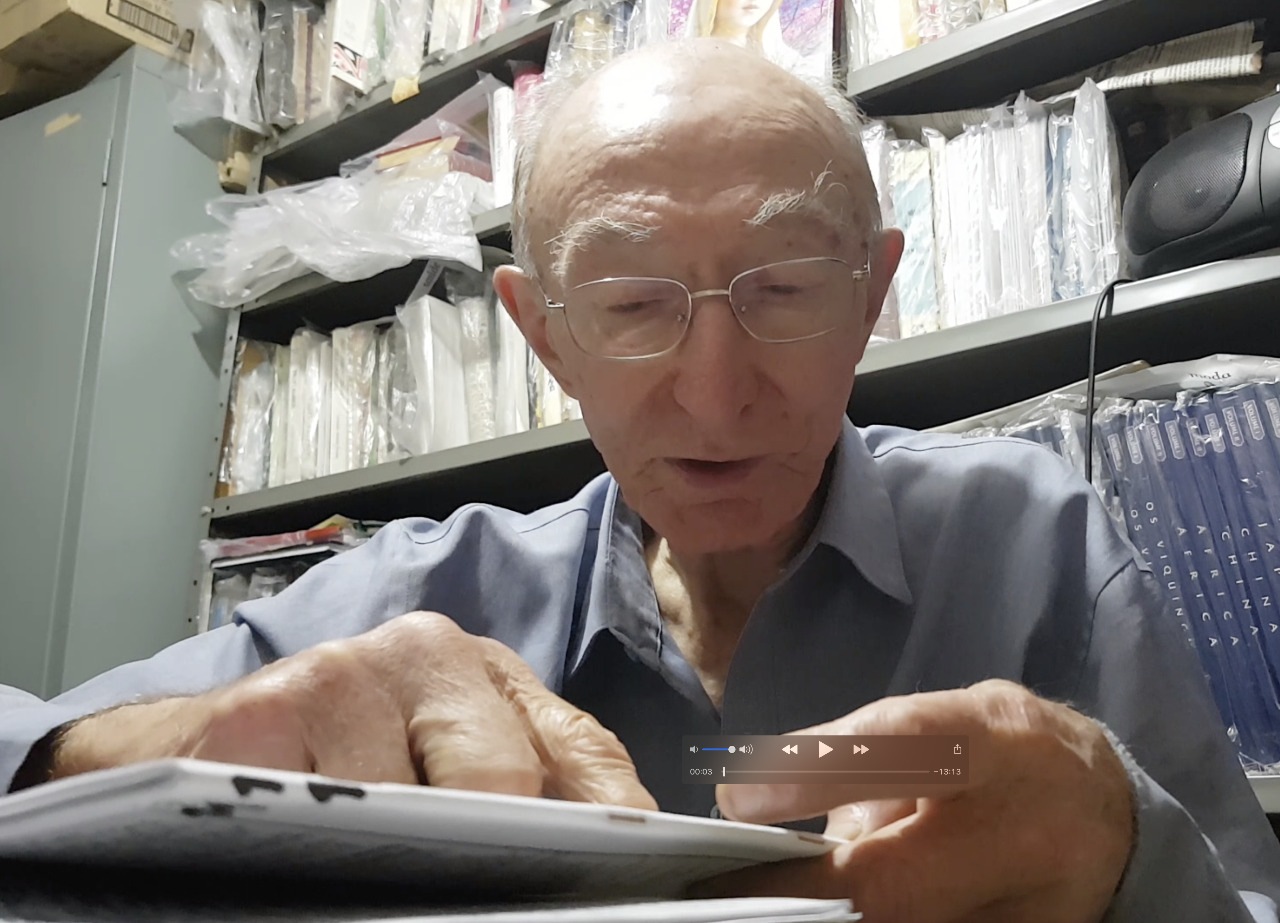
“This notion of a new exclusively online education will be difficult because not everyone will initially have these new technologies at home,” the professor warns, about the lack of access to electronic means and even the Internet, which afflicts part of Brazil and underdeveloped countries.
“Today a large part of the school community has neither the place nor the technical means for this learning. But this may change, perhaps in the near future, but here in Brazil today, people from the interior of the Amazon and other places of extreme poverty have no access”.
Education loses
The school allows social interaction, and this cannot be lost with digital media. This is what Professor Elmar Joenck says: “If educational information is only available online, the socialization aspect, children and young people’s interaction, and even recreation, the practice of sports, is lacking,” he says. “We could reduce the face-to-face burden, for lighter and easier to understand subjects”, he adds.
“Exclusively online education is not possible at this moment in history”. The solution, according to him, is to do a selection of what will be compulsory in person and what could be done online.
“We have to select what is going to be compulsory in person, and what is going to be compulsory online, to be selected by each educational institution. What is online is more supplemental. But everything, it is not possible. The ‘mental and civic’ mentor’s presence aspect remains, and is only more effective in person. This role of education, of the educator in front of the students, is much richer in person,” adds Joenck.
Elmar Joenck currently lives in Curitiba, the capital of Paraná. His home is divided into two large halls. The largest of them, where he spends most of his time, is an enormous library, which also includes a large record collection. Joenck was a Latin professor at the prestigious Pontifical Catholic University of Paraná, in addition to having taught German, French and other languages. He began teaching at Bom Jesus College in 1957.
More: Brazil news in English, every day from The Rio Times.
Editorial responsibility: Matthias Camenzind, Editor-in-Chief · Editorial standards · Report an error