
Key Facts
- WTI settled at US$91.48 a barrel on Friday, September 4, 2026, up US$0.18 or 0.20% for the session and roughly 9.7% above the prior Friday’s US$83.40 close, the strongest weekly advance since mid-July.
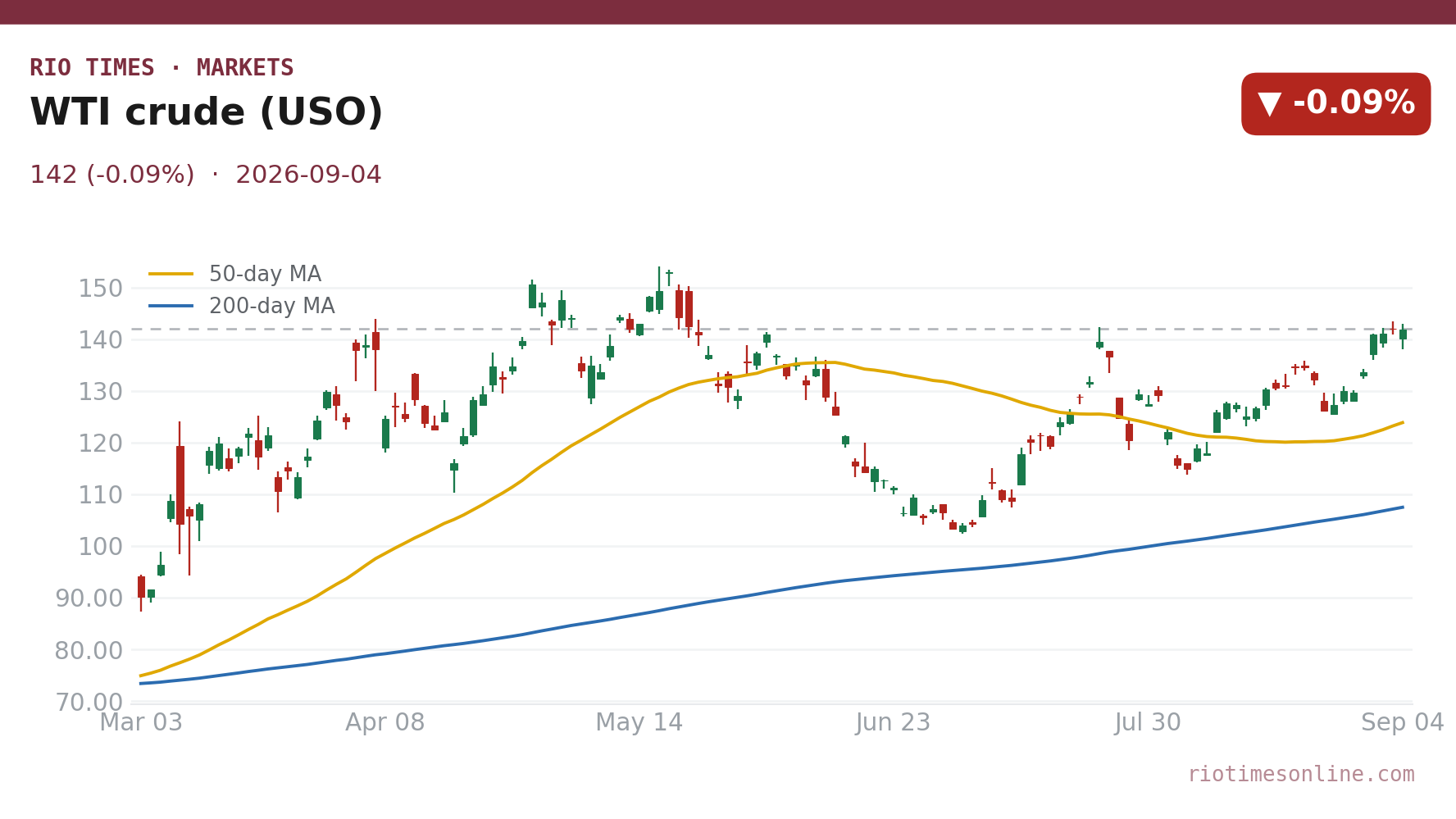
- New York is shut for Labor Day, so there is no Monday close for the United States Oil Fund, which tracks front-month WTI futures, closed at US$141.96, down 0.09% on the day, reflecting how the week’s geopolitical repricing flowed into US retail oil portfolios.
- Petrobras New York shares fell 1.90% to US$20.12 despite the company reporting record second-quarter output of 3.34 million barrels of oil equivalent per day, with own pre-salt production at 2.78 million barrels per day.
- Guyana’s national output slipped from a February peak of 918,000 barrels per day to 869,000 in June, but the arrival of the Errea Wittu production ship in August sets up a possible September start-up and a push above one million barrels per day.
- Colombia’s Ecopetrol added 0.29% to US$17.25 as markets digested a new right-wing administration’s plan to reverse the fracking ban and chase an estimated US$4 billion in new oil investment.
- Argentina’s YPF advanced 0.40% to US$52.62, a small move that leaves the Vaca Muerta shale champion exposed more to domestic policy and midstream capacity than to Friday’s headline crude swings.
Today’s Focus
Oil ended the week of Friday, September 4, 2026 with WTI at US$91.48 a barrel, up 0.20% for the day and nearly 10% for the week, as traders rebuilt a war premium around renewed US-Iran conflict risk. The United States Oil Fund closed at US$141.96, down 0.09%, showing how the front-month futures move translated into retail holdings.
Latin America’s state-linked producers did not track crude higher. Petrobras fell 1.90% to US$20.12 even after record second-quarter output of 3.34 million barrels of oil equivalent per day, while Ecopetrol rose 0.29% to US$17.25 on hopes of a post-Petro exploration revival and YPF added 0.40% to US$52.62.
Guyana’s boom is nearing a new threshold. Stabroek output stood at 869,000 barrels per day in June, down from a February peak, but the 250,000-barrel-per-day Errea Wittu ship arrived in August and could start in September, pushing national capacity above one million barrels per day.
What matters today. The US-Iran war premium is overriding company-level Latin American fundamentals, but Guyana’s imminent one-million-barrel milestone is the structural story foreign investors should not miss.
01 The session in one read
Oil finished a febrile week with WTI at US$91.48 a barrel on Friday, September 4, 2026, up US$0.18 or 0.20% for the session and roughly 9.7% above the prior Friday’s US$83.40 close. It was the strongest weekly gain since mid-July.
The move was a textbook war premium: renewed US-Iran conflict risk made traders price possible Middle East supply disruption into front-month crude. The United States Oil Fund closed at US$141.96, down 0.09%, after tracking that weekly repricing through WTI futures.
Petrobras delivered record output and still fell almost 2% in New York, proof that Friday’s tape was driven by war-risk repricing rather than operational news. WTI has held above US$90 through Monday, trading near US$92.53, so the week’s war premium has not yet been given back. That keeps pressure on import-dependent Latin American economies even as Brazil and Guyana exporters benefit.
02 The board
Petrobras New York shares fell 1.90% to US$20.12, the weakest name on our Latin American oil board, even as the company’s Brazilian pre-salt operations set records. Ecopetrol added 0.29% to US$17.25 and Argentina’s YPF rose 0.40% to US$52.62.
The divergence tells the story: Brazilian exposure to global crude should have lifted Petrobras, but Friday’s tape instead punished the name that had already run hard on production headlines across the quarter.
| Asset | Level | Change |
|---|---|---|
| WTI crude (USO) | US$141.96 | -0.09% |
| Petrobras | US$20.12 | -1.90% |
| Ecopetrol | US$17.25 | +0.29% |
| YPF | US$52.62 | +0.40% |
Source: RT close, 2026-09-04. Where a commodity has no spot feed, an exchange-traded tracker or leading producer is shown as a labelled proxy.
Live Market IntelligenceThe live market board
Rio Times · Live Market Intelligence
Latin America — Cross-Market Board
| Instrument | Last | Change | YoY | Prev. | High | Low | Volume |
|---|---|---|---|---|---|---|---|
| IBOV | 204,120.12 | -1.15% | +21.85% | 206,495.23 | 168,310 | 167,142 | — |
| IPSA | 10,780.31 | -1.88% | — | 10,987.14 | 11,210 | 10,984 | 1,513,213,483 |
| IPC MEX | 69,889.73 | -0.51% | +12.17% | 70,249.54 | 66,121 | 65,405 | 108,886,187 |
| MERVAL | 3,017,221 | — | +30.51% | 3,022,485 | 3,042,365 | 2,991,150 | — |
| COLCAP | 2,528.42 | -1.25% | — | 9.04 | 9.05 | 9.02 | 4,133 |
| BVL PERÚ | 59,561.23 | -4.26% | — | — | — | — | — |
| USD/BRL | 5.16 | +0.01% | -5.13% | 5.16 | 5.18 | 5.14 | — |
| EUR/BRL | 5.95 | +1.01% | -5.83% | 5.89 | 5.98 | 5.94 | — |
| USD/MXN | 17.06 | -0.24% | -8.58% | 17.10 | 17.08 | 17.01 | — |
| USD/CLP | 913.98 | +0.04% | -5.67% | 913.65 | 915.11 | 906.68 | — |
| USD/COP | 3,140 | +0.03% | -22.04% | 3,139 | 3,141 | 3,105 | — |
| USD/PEN | 3.36 | -0.66% | -4.82% | 3.38 | 3.38 | 3.35 | — |
| USD/ARS | 1,493 | +0.10% | +12.96% | 1,491 | 1,494 | 1,480 | — |
| USD/UYU | 40.27 | +1.24% | +1.80% | 39.77 | 40.27 | 40.23 | — |
| USD/PYG | 5,939 | +1.68% | -19.54% | 5,841 | 5,939 | 5,925 | — |
| USD/BOB | 11.64 | -0.76% | +72.04% | 11.73 | 11.72 | 11.64 | — |
| USD/DOP | 58.34 | +1.25% | -3.44% | 57.62 | 58.34 | 58.04 | — |
| USD/CRC | 445.92 | +0.89% | -9.71% | 441.97 | 448.50 | 445.92 | — |
03 What moved it
The rebuilt war premium was the dominant driver. Brent-aligned and WTI-linked barrels both repriced as US-Iran escalation risk raised the probability of supply losses from the Strait of Hormuz chokepoint.
US majors hardened their labor bargaining stance too, with lockouts deployed in refinery contract talks, a signal that management sees high crude prices as leverage. Yet headline WTI held near session highs, helped by a White House push to fast-track Alaska petroleum-reserve permits to as little as 60 days.
04 The Latin American read
Petrobras reported record output of 3.34 million barrels of oil equivalent per day in the second quarter, with operated output at 4.87 million and own pre-salt production at 2.78 million. Búzios platforms exceeded 1.2 million barrels per day in June, and exports hit 996,000 barrels per day.
Still, the New York share price fell as investors ignored operating excellence when geopolitics dominates. Guyana offers a cleaner growth story: Stabroek production was 869,000 barrels per day in June, but the Errea Wittu ship’s arrival in August sets up a possible September start-up and a national capacity above one million barrels per day.
Colombia’s new right-wing government is pivoting from Gustavo Petro’s exploration ban, and markets estimate that reversing the fracking moratorium could unlock US$4 billion in new oil investment. That prospect underpinned Ecopetrol’s small gain to US$17.25.
05 The names to watch
Petrobras is the volume leader: the Tupi field has surpassed 4 billion barrels of cumulative output and pre-salt could reach 82% of total production in the 2026-2030 plan. The market simply ignored that on Friday.
Guyana’s Stabroek, operated by ExxonMobil with Chevron at 30% and CNOOC at 25%, remains the region’s most concentrated deepwater bet. YPF and Vaca Muerta need reform and midstream capacity more than a WTI tailwind, which explains the muted 0.40% move.
06 The outlook
If US-Iran tensions persist, WTI has room to hold above US$90, which would widen import bills for Chile, Peru and Central America while funnelling windfalls to Brazil, Guyana and Colombia exporters. The next marker is whether Guyana’s Uaru project starts in September or slips to the fourth quarter, shifting the region’s marginal barrel balance.
07 What to watch
- US-Iran headlines: Any confirmation of strikes or shipping disruption could extend the war premium; a de-escalation would unwind it fast.
- Guyana Uaru start-up: The September versus Q4 timing determines when the country crosses one million barrels per day.
- Colombia fracking reversal: Legislative pace on rescinding the ban will set how much of the estimated US$4 billion in investment is real.
- Petrobras pre-salt momentum: Whether record 2Q output and Buzios ramp continue will test Friday’s reflexive sell-off in New York.
Frequently Asked Questions
Why did oil rise so much last week?
Renewed US-Iran conflict risk rebuilt a war premium in crude, taking WTI about 9.7% higher week-on-week to US$91.48.
Why did Petrobras shares fall despite record production?
The geopolitical tape dominated Friday’s session, and Petrobras had already priced in strong operational results, leaving room for profit-taking at US$20.12.
What is the significance of Guyana’s Errea Wittu ship?
It is a 250,000-barrel-per-day production vessel that could start in September, lifting national output above one million barrels per day from the Stabroek Block.
How does the US-Iran war premium affect Latin America?
It helps exporters like Brazil and Guyana, but raises fuel import costs for Chile, Peru and Central America.
Market data: RT
This article was produced by The Rio Times’ automated newsroom system. How we use AI · Report an error · Editorial responsibility: Matthias Camenzind, Editor-in-Chief
LatAm Markets: Live Signals → — real-time movers, turnover leaders and FX across Latin America.