
Key Facts
- Gold is trading near US$4,396.65 an ounce on Monday, down about 0.8% with the decline driven by a stronger dollar and rising real yields after strong US employment figures.
- Silver is near US$65.77 an ounce, down about 0.3% on Monday as the metal tracked gold lower and faced the same pressures from higher yields.
- Investors weighed safe-haven demand against macro pressure because lower yields and a softer dollar had supported prices earlier in the week before jobs data landed.
- Mexico, the world’s top silver producer, is exposed as silver moves of this size directly affect revenue assumptions for Mexican miners.
- Peru is a major gold and silver miner so Friday’s price action feeds into export income and fiscal expectations in Lima.
- The session showed gold’s coin flip lasted a day with the market reversing its recent rebound as rate-hike expectations crept back in.
Today’s Focus
Gold and silver fell on Friday, September 4, 2026, as a stronger US dollar and rising Treasury yields made non-yielding metals less attractive. The moves followed stronger-than-expected US employment data that revived talk of a Federal Reserve rate hike.
Gold declined about 1.2% to US$4,419.09 an ounce on Friday, on Reuters figures, and has slipped again on Monday to about US$4,396.65. Silver is near US$65.77. Both metals had been supported earlier in the week by safe-haven flows, a softer dollar, and easing real yields.
For Latin America, the silver decline matters most in Mexico, which is the world’s top silver producer. Peru’s mining sector, a major source of gold and silver, is similarly exposed to the same price drivers.
The session ended with the dollar index up 0.21% to 99.17 and the 10-year Treasury yield near 4.78%. Higher yields increase the opportunity cost of holding gold and silver, which pay no interest.
What matters today. The quick reversal in gold and silver shows how sensitive both metals are to the path of US interest rates, and that sensitivity is transmitted directly to Mexico and Peru.
01 The session in one read
Gold fell 1.2% on Friday, September 4, 2026, to about US$4,419 an ounce. Silver slipped 1.7% to US$65.83 an ounce.
The driver was a stronger US dollar and rising Treasury yields after a strong American jobs report raised the prospect of a Federal Reserve rate hike.
That is a problem for gold and silver because neither metal pays interest, so higher yields make them less appealing relative to bonds.
The most important variable to watch is the next Federal Reserve signal on rate policy. Friday showed that a single strong employment report can reverse a precious-metals rebound, and Monday’s drift lower says the market has not changed its mind.
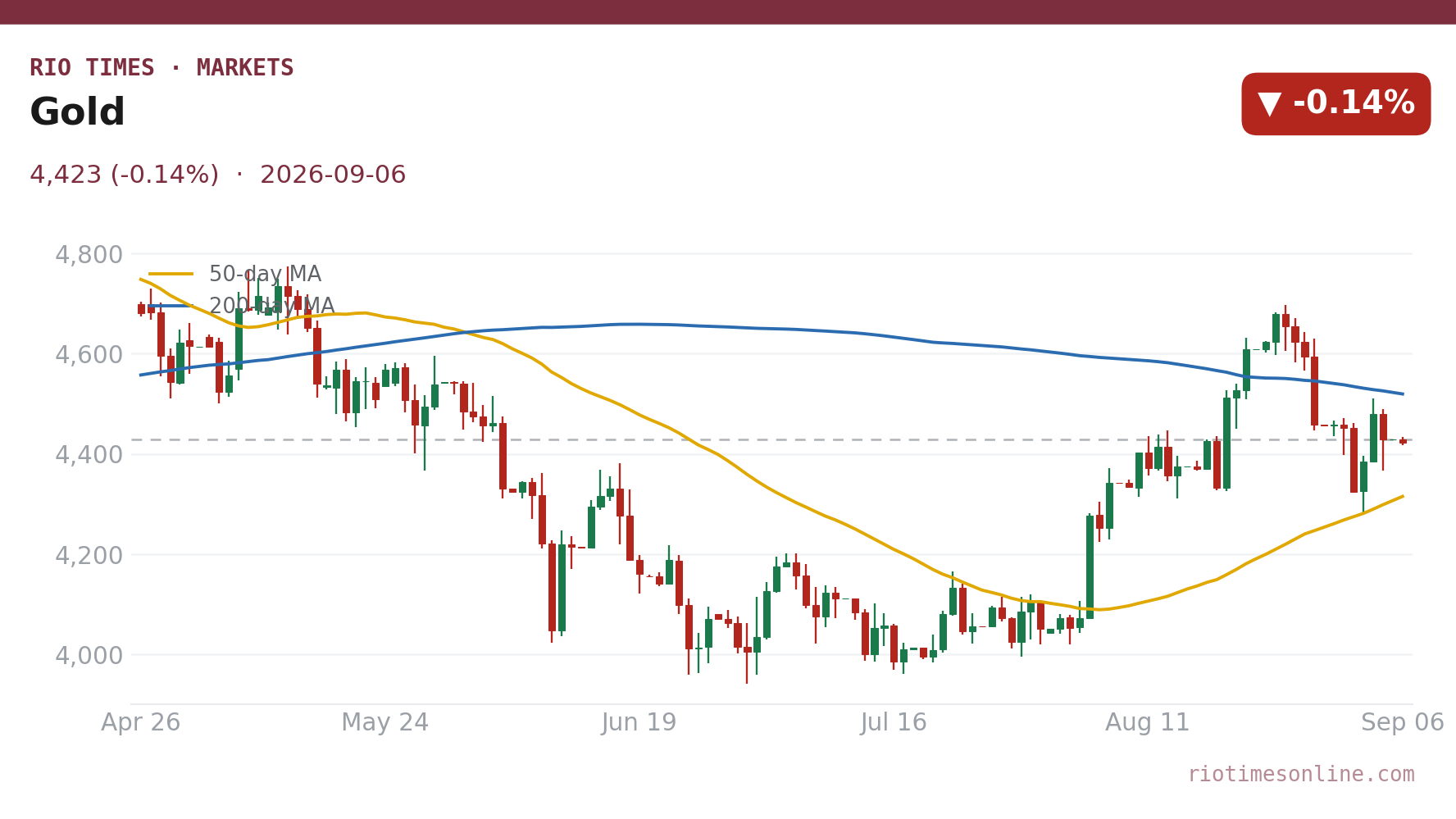
02 The board
The gold proxy settled down 1.2% at about US$4,419 an ounce, while silver closed about 1.7% lower at US$65.83 an ounce.
The moves were modest in percentage terms but directionally sharp, given that both metals had been bid earlier in the week on safe-haven demand.
The dollar index rose 0.21% to 99.17, and the 10-year Treasury yield sat near 4.78% with the 2-year at 4.37%.
| Asset | Level | Change |
|---|---|---|
| Gold | US$4,419/oz | -1.2% |
| Silver | US$65.83/oz | -1.7% |
Source: RT close, 2026-09-04. Where a commodity has no spot feed, an exchange-traded tracker or leading producer is shown as a labelled proxy.
Live Market IntelligenceThe live market board
Rio Times · Live Market Intelligence
Latin America — Cross-Market Board
| Instrument | Last | Change | YoY | Prev. | High | Low | Volume |
|---|---|---|---|---|---|---|---|
| IBOV | 204,120.12 | -1.15% | +21.85% | 206,495.23 | 168,310 | 167,142 | — |
| IPSA | 10,780.31 | -1.88% | — | 10,987.14 | 11,210 | 10,984 | 1,513,213,483 |
| IPC MEX | 69,889.73 | -0.51% | +12.17% | 70,249.54 | 66,121 | 65,405 | 108,886,187 |
| MERVAL | 3,017,221 | — | +30.51% | 3,022,485 | 3,042,365 | 2,991,150 | — |
| COLCAP | 2,528.42 | -1.25% | — | 9.04 | 9.05 | 9.02 | 4,133 |
| BVL PERÚ | 59,561.23 | -4.26% | — | — | — | — | — |
| USD/BRL | 5.16 | +0.01% | -5.13% | 5.16 | 5.18 | 5.14 | — |
| EUR/BRL | 5.95 | +1.01% | -5.83% | 5.89 | 5.98 | 5.94 | — |
| USD/MXN | 17.06 | -0.24% | -8.58% | 17.10 | 17.08 | 17.01 | — |
| USD/CLP | 913.98 | +0.04% | -5.67% | 913.65 | 915.11 | 906.68 | — |
| USD/COP | 3,140 | +0.03% | -22.04% | 3,139 | 3,141 | 3,105 | — |
| USD/PEN | 3.36 | -0.66% | -4.82% | 3.38 | 3.38 | 3.35 | — |
| USD/ARS | 1,493 | +0.10% | +12.96% | 1,491 | 1,494 | 1,480 | — |
| USD/UYU | 40.27 | +1.24% | +1.80% | 39.77 | 40.27 | 40.23 | — |
| USD/PYG | 5,939 | +1.68% | -19.54% | 5,841 | 5,939 | 5,925 | — |
| USD/BOB | 11.64 | -0.76% | +72.04% | 11.73 | 11.72 | 11.64 | — |
| USD/DOP | 58.34 | +1.25% | -3.44% | 57.62 | 58.34 | 58.04 | — |
| USD/CRC | 445.92 | +0.89% | -9.71% | 441.97 | 448.50 | 445.92 | — |
03 What moved it
Strong US employment data was the spark. The report pushed Treasury yields higher as investors priced in a greater chance that the Federal Reserve could hike rates rather than cut.
A stronger dollar also pressured metals, because a firmer greenback makes dollar-priced gold and silver more expensive for buyers using other currencies.
The safe-haven bid that had supported gold and silver earlier in the week faded as the macro focus shifted to yields and rate expectations.
04 The Latin American read
Mexico is the world’s largest silver producer, so a 1.7% drop in silver directly affects revenue assumptions for Mexican miners.
Peru is a major producer of both gold and silver, meaning Friday’s declines feed into export income and could weigh on mining-related tax receipts.
Neither country has a direct currency peg to the metal, but mining companies listed in Mexico City and Lima often trade in sympathy with these daily price moves.
05 The names to watch
Silver-focused Mexican miners are the obvious names to watch, as they carry the most direct sensitivity to a move like Friday’s 1.7% slide.
Peruvian diversified miners with gold and silver output face a similar, if slightly more balanced, exposure.
For investors tracking the commodity without buying futures, exchange-traded funds that hold physical gold or silver remain the most direct proxy, and they weaken mechanically when prices fall.
06 The outlook
The next major signal will be any Federal Reserve commentary on whether the strong jobs report changes the rate path.
If yields keep rising and the dollar firms further, gold’s US$4,300 support could come back into focus just as it did in prior weeks.
07 What to watch
- Federal Reserve commentary: Any hint that the strong jobs report locks in a hike could push gold and silver lower again.
- Treasury yields: If the 10-year yield climbs further above 4.78%, the opportunity cost of holding metals rises in lockstep.
- Dollar index: A sustained move above 99.17 would keep pressure on dollar-priced gold and silver.
- Mexican and Peruvian miners: Watch whether their share prices lag the metals recovery, which often signals rising cost or volume concerns.
Frequently Asked Questions
Why did gold and silver fall on September 4, 2026?
Because a stronger US dollar and rising Treasury yields after strong jobs data made non-yielding metals less attractive.
How much did gold fall?
Gold fell about 1.2% to US$4,419 an ounce on Friday, and eased again on Monday to about US$4,396.
How much did silver fall?
Silver fell 1.7% to US$65.83 an ounce.
Why does this matter for Latin America?
Mexico is the top silver producer and Peru is a major gold and silver miner, so price moves affect mining revenue and export income.
Market data: RT
This article was produced by The Rio Times’ automated newsroom system. How we use AI · Report an error · Editorial responsibility: Matthias Camenzind, Editor-in-Chief
LatAm Markets: Live Signals → — real-time movers, turnover leaders and FX across Latin America.