
MEXICO · SECURITY
Key Facts
- —The country Mexico, where the industrial state of Nuevo León has a single road crossing into Texas, at Colombia, opposite Laredo.
- —Why it matters Public money from a US border state went to a construction firm that Washington says channelled cartel cash into election campaigns.
- —Why now The US Treasury sanctioned the firm on Tuesday, 13 October, transparency records on its state contracts surfaced the same day, and President Claudia Sheinbaum answered on Wednesday.
- —What happened Nuevo León’s border agency Codefront gave CEGESA contracts worth about 110 million pesos (about US$6.0 million) in 2022 and 2023 for works at the Colombia crossing.
- —The numbers The largest contract, from July 2023, was worth 69.99 million pesos (about US$3.81 million); the first, from July 2022, 14.98 million pesos (about US$816,000).
- —What it means for you US banks, contractors and freight firms working the Laredo corridor may not deal with CEGESA, its owners or the other designated companies.
- —Still open Whether Nuevo León reviews the contracts, whether Mexican prosecutors open a case, and which candidates allegedly received cartel money.
- —Power Index Mexico ranks 2nd of 14 in The Rio Times Latin America Power Index, with 71.4 points (October 2026 edition).
Nuevo León, the Mexican industrial state that borders Texas, gave a sanctioned firm public contracts worth about US$6 million. The firm, CEGESA, was accused by the US Treasury on Tuesday of channelling Cartel del Noreste money into election campaigns.
For US companies the case is direct, because American banks and businesses are now barred from dealing with the construction firm. President Claudia Sheinbaum, of the governing Morena party, responded on Wednesday by asking Washington to share its evidence.
How a Sanctioned Firm Won Border Contracts
Mexicanos Contra la Corrupción y la Impunidad (MCCI), an independent anti-corruption group, traced the contracts through Mexico’s National Transparency Platform. It found three awards from Codefront, the state body that runs the Colombia–Laredo international bridge.
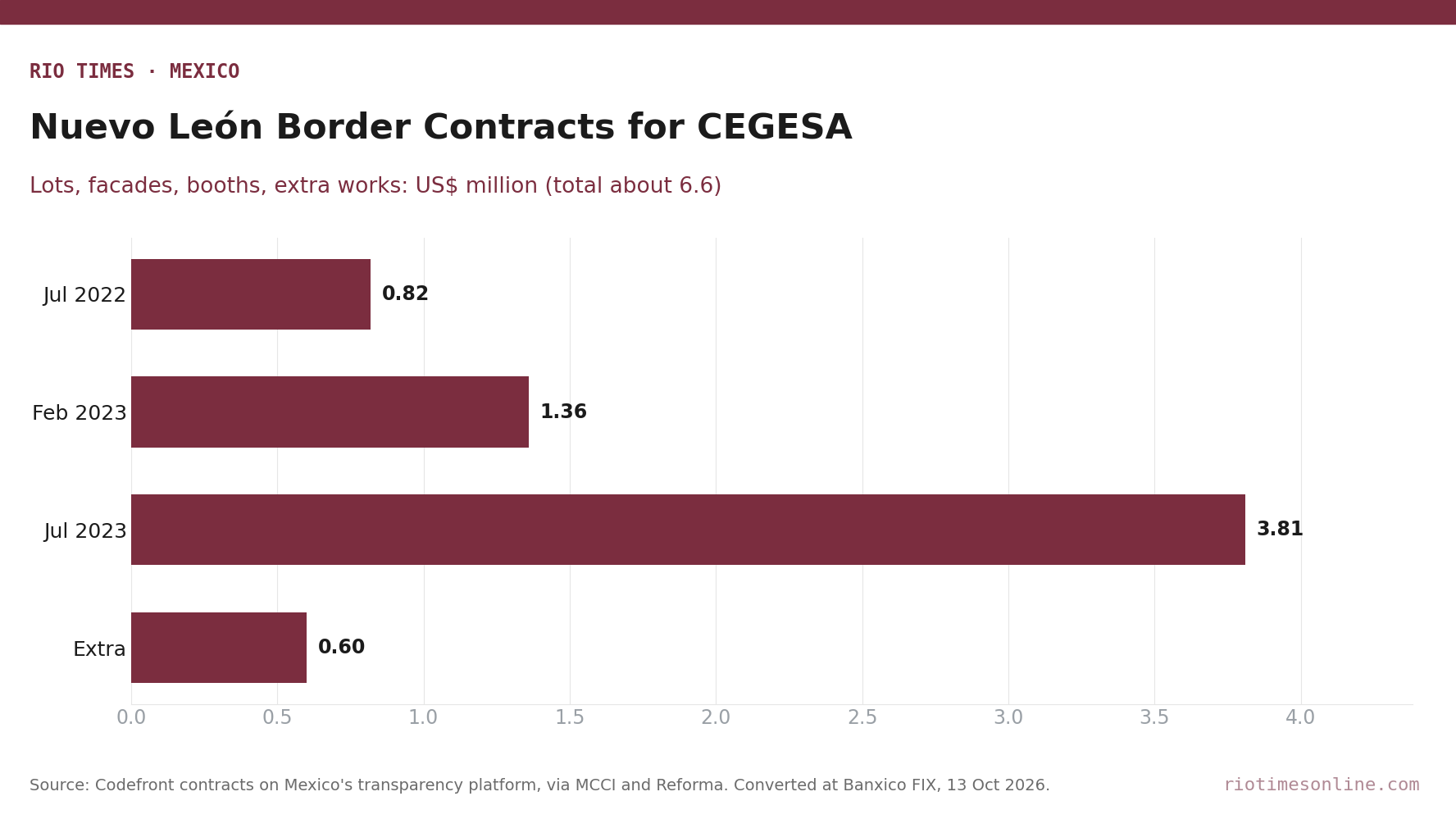
The first, dated 18 July 2022, was worth 14.98 million pesos (about US$816,000) to prepare lots at the Colombia international trade centre. In February 2023 came 24.99 million pesos (about US$1.36 million) to upgrade the crossing’s tourist stop.
The largest, signed in July 2023, was worth 69.99 million pesos (about US$3.81 million) for booths and access lanes. Together the three come to about 110 million pesos (about US$6.0 million), all for works in Anáhuac municipality.
The newspaper Reforma counted a fourth contract, worth 10.95 million pesos (about US$597,000), for complementary works. That lifts the total to 120.9 million pesos (about US$6.6 million), with dollar values at the Bank of Mexico’s FIX rate of 18.3528 pesos per US dollar on 13 October.
The contracts identified by MCCI were signed by Marco Antonio González Valdez, who has led Codefront since October 2021. He also serves as Nuevo León’s secretary of regional and agricultural development under Governor Samuel García.
García, governor since October 2021, belongs to Movimiento Ciudadano, an opposition party to Sheinbaum’s Morena. Codefront’s paperwork lists Gamaliel Garza García as the legal representative and sole administrator of the sanctioned firm.
What Washington Alleges
The Treasury’s Office of Foreign Assets Control (OFAC), which enforces US sanctions, designated four people and 11 entities on Tuesday, 13 October. It ties them to the Cartel del Noreste, a Nuevo Laredo group that grew out of the Los Zetas cartel.
OFAC says CEGESA has been used to funnel money to election campaigns of the cartel’s preferred candidates. It also alleges the company won government contracts corruptly and then subcontracted the work to cartel-affiliated people.
Treasury’s statement cited contracts from the municipality of Nuevo Laredo and the state of Tamaulipas among its government clients. Reforma reports that Garza García owns 99 percent of the firm and his son Gamaliel Garza Elías 1 percent; both are designated.
Tamaulipas, governed by Américo Villarreal of Morena since 1 October 2022, said on Tuesday it had no contracts with any of the 15 designated since then. Its anti-corruption ministry ordered every state agency to block any registration or contract with them.
Reforma found that another Garza company, COPASA, won three Nuevo Laredo street resurfacing contracts in 2025 worth 9.09 million pesos (about US$495,000). A sanctions listing is an administrative measure, not a court conviction, and those named can ask OFAC to remove them.
Sheinbaum Asks Washington for Proof
At her morning press conference on Wednesday, 14 October, Sheinbaum said Mexico joins US sanctions only when its own investigators find irregularities. “When the UIF finds no evidence, it does not join in, and it is only the sanction by the United States,” she said.
The UIF is Mexico’s Financial Intelligence Unit, the finance ministry body that tracks suspicious money and can freeze accounts. Sheinbaum said Washington often alleges links to criminal groups without handing over proof.
“As far as the Finance Ministry has informed me, there is no link they could have with a criminal organisation,” she added. She said Mexican prosecutors can open a criminal case once the United States provides that information.
Her remarks sit uneasily with Treasury’s statement that OFAC coordinated this action and earlier ones with the UIF. Mexico’s Finance Ministry said on Tuesday that the UIF had found signs of possible money laundering among some of those named.
What It Means for You
For US banks, the designation means blocking any assets of CEGESA and its owners that reach their hands. American contractors, fuel buyers and logistics firms near Laredo must screen partners against the updated sanctions list.
The Colombia crossing in Anáhuac is Nuevo León’s only bridge into the United States and a route for cross-border freight. Treasury says nearly 40 percent of all US–Mexico commercial traffic crosses at Laredo, opposite the cartel’s stronghold.
For investors in Mexico, the case shows that public works contractors can carry hidden sanctions risk. Checks on Mexican suppliers now need to include state and municipal contract records, not just company registries.
Bilateral work on cartel finance continues despite the friction over evidence. In April 2026 Mexican authorities suspended a cartel-linked casino on the same day OFAC sanctioned it, Treasury says.
Tuesday’s designations are set out in US Sanctions 11 Firms Tied to a Mexican Cartel, and the wider power map in Mexico Politics Explained, Who Holds Power in 2026. Investors weighing Nuevo León can start with Doing Business in Mexico: A Foreigner’s Guide (2026) and the Monterrey city page.
What Is Not Known
It is not known whether Nuevo León will review the CEGESA contracts or seek to recover any public money. Nor is it clear whether the work at the Colombia crossing was subcontracted to people tied to the cartel.
Treasury has not named the candidates or parties that allegedly received cartel cash through the sanctioned firm. It is also unclear whether the UIF froze any Mexican accounts of the companies designated this week.
Treasury has not disclosed the value of any assets blocked in the United States. Whether Mexico’s Attorney General’s Office will open an investigation into the firm or its owners is not known.
Frequently Asked Questions
What is CEGESA?
CEGESA is a construction company set up in Anáhuac, Nuevo León, in 2016 and owned by Gamaliel Garza García and his son. The US Treasury sanctioned it on 13 October over alleged ties to the Cartel del Noreste.
How much did Nuevo León pay the sanctioned firm?
Records show three contracts worth about 110 million pesos (about US$6.0 million) from 2022 to 2023. Reforma counted a fourth, bringing the total to 120.9 million pesos (about US$6.6 million).
What did Sheinbaum say?
She said Mexico’s Financial Intelligence Unit joins US sanctions only when it finds irregularities of its own. She asked Washington to hand over evidence of any cartel link.
Can Americans do business with CEGESA?
No, US persons are generally barred from transactions with designated companies and people. Any of their assets under US control must be blocked and reported to OFAC.
What happens next in Mexico?
Sheinbaum said prosecutors can open a criminal case once Washington shares its evidence. Where the UIF finds serious irregularities, she said, it must file a complaint with the Attorney General’s Office.
Sources: US Treasury; El Financiero; Infobae México; La Silla Rota (MCCI findings); Vanguardia (Reforma); Proceso; Secretaría de Hacienda; El Economista; Banco de México FIX.
This article was produced by The Rio Times’ automated newsroom system. How we use AI · Report an error · Editorial responsibility: Matthias Camenzind, Editor-in-Chief
Read More from The Rio Times