Mexico Police Detain 39 at Guadalajara Water Protest

SOCIETY · MEXICO
Key Facts
- —The country Mexico, the southern neighbour of the United States. Guadalajara, capital of western Jalisco state, is one of its largest cities and hosts a US consulate general.
- —Why it matters Months of murky, foul-smelling tap water have brought about 10,000 people onto the streets, with clashes outside the governor’s residence.
- —Why now The Jalisco government gave its official toll late on Sunday, 11 October, hours after the clashes at Casa Jalisco ended.
- —What happened About 10,000 people marched for clean water on Sunday, 11 October. Police detained 39 people after clashes that the state blames on a group of about 400.
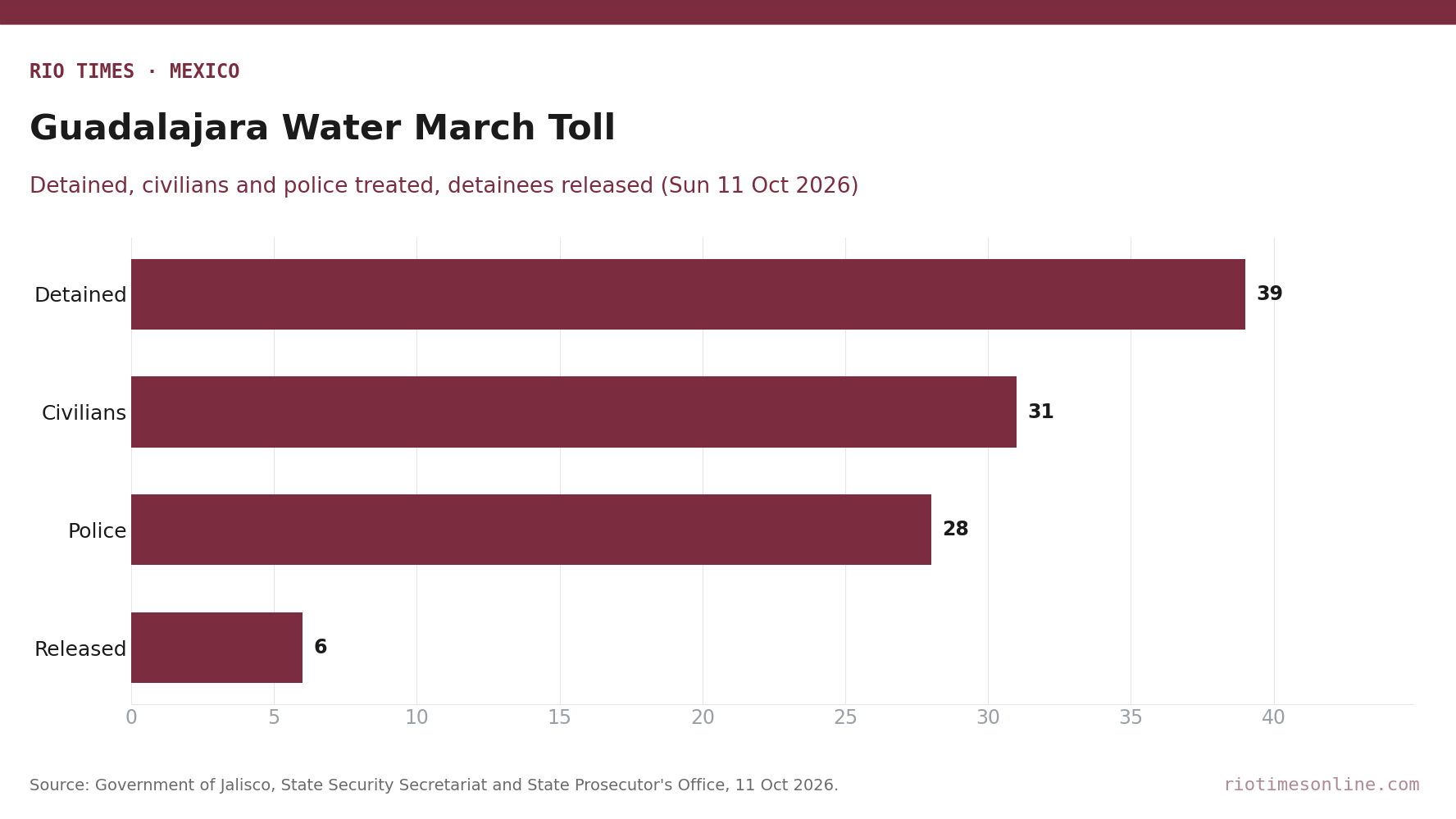
- —The numbers 28 police officers injured, two seriously; 31 civilians given medical care; 21 men and 18 women detained; six released by Sunday night.
- —What it means for you Avoid demonstrations around Casa Jalisco and La Minerva roundabout. Drink bottled or purified water, and expect water rationing in parts of the metro area.
- —Still open How many detainees will be charged, who made up the violent group, and when tap water quality will return to normal.
Police in Mexico detained 39 people on Sunday, 11 October, after a Guadalajara water protest ended in clashes at the governor’s residence. About 10,000 people had marched peacefully against dirty tap water, the state government said. For American visitors and residents, it is a sign that a local utility problem has become a political one.
Jalisco’s government said 28 police officers were injured and 31 civilians needed medical care. It blamed the violence on a separate group of about 400 people, most of them hooded. Protesters and two universities instead questioned the police response and asked for the detainees’ names.
The march left La Minerva roundabout at about 11:30 a.m. local time and reached Casa Jalisco, the governor’s official residence, around noon, the Guadalajara daily El Informador reported. Families, young people and older people took part, the state government said.
How the March Turned Violent
Trouble began when some marchers pulled down metal barriers around Casa Jalisco, El Informador reported. Mud, stones and fruit were thrown at riot police. Some protesters threw buckets and balloons of water.
Riot police answered with water jets, tear gas and at least four stun grenades, the paper said. The crowd fell back at least five times and returned each time. Most of the organisers left around 1:30 p.m., and the last groups withdrew after 4:30 p.m.
Juan Pablo Hernández, Jalisco’s state security secretary, said the group of about 400 arrived armed with sticks and stones. He said it also threw chlorine, rockets and gas bombs. Police responded with “the graduated use of force”, he said.
Two officers were seriously hurt, according to Hernández. One suffered fractures to the skull, cheekbone and nose. Another lost a finger after being hit with a sharp-edged pipe. The government’s account of who started the violence has not been independently confirmed.
Roberto Alarcón Estrada, the state’s general coordinator for security strategy, said the violence “tarnished a legitimate protest”. Some marchers had themselves told people they called “infiltrators” to leave, El Informador reported.
Detainees and Charges
State prosecutor Salvador González de los Santos said the 39 detainees were 21 men and 18 women. All were taken to his office. By Sunday night, the office had released six people while it continues to investigate them. It said four more would be freed overnight on the same terms.
They are being investigated for attacks on public roads, causing injuries and offences against officials, the government said. Release under Article 140 of Mexico’s national criminal procedure code means they stay free while the case is built. Under Mexican law, they are presumed innocent.
Free-expression collectives listed about 50 people they say were held after the Guadalajara water protest, El Informador reported. The authorities had not published their own list to compare. The University of Guadalajara said three of its students were among those held.
ITESO, the city’s Jesuit university, urged the state to favour dialogue and not to criminalise protest, El Universal reported. The Jalisco State Human Rights Commission (CEDHJ), which sent 16 observers, opened an investigation. It has received five complaints of alleged abuse by state police.
Why Guadalajara Is Angry About Its Water
Residents have complained for months about tap water that looks and smells bad. Some marchers told El Informador of skin problems and eye allergies, and of the cost of buying large water jugs. Marchers chanted “water is a right, not a privilege”, Quadratín Jalisco reported.
Governor Pablo Lemus Navarro, who heads the state government, has cut supply from the Las Pintas dam. He said residents had begun to report better colour and smell. The trade-off is about 30% less water for the metro area, the state said.
The government expects rationing for about six months in areas served by the Miravalle water treatment plant. It expects water quality to improve by March or April 2027. The water utility for the metro area is SIAPA.
Opposition leaders sought to keep the focus on the water. Juan Pablo Colín leads the conservative National Action Party (PAN) in Jalisco. He said “the anger of citizens over water problems deserves answers, not confrontation”. Laura Haro, state leader of the Institutional Revolutionary Party (PRI), said hooded people should not discredit a legitimate demand.
What It Means for You
For visitors and foreign residents, the city is functioning normally away from the protest sites. Avoid gatherings near Casa Jalisco, on López Mateos Avenue and at La Minerva. Further marches are possible. Mexico’s constitution bars foreigners from involvement in the country’s political affairs.
Drink bottled or purified water, as most residents already do. If you rent in the metro area, ask your landlord about rationing schedules and storage tanks. October is also festival season, covered in What to Do in Guadalajara in October 2026: Fiestas de Octubre, Romería and Big Concerts, so check event updates before going out.
Western Jalisco has also been dealing with a hurricane, covered in Hurricane Simon Skirts Jalisco, Sinaloa Is Next. Guadalajara itself lies inland and was not on the storm’s coastal path.
What Is Not Known
The authorities have not published the full list of detainees, so the protesters’ count of about 50 cannot be checked. It is not known how many of the 39 will face charges. Who made up the group of about 400 that disrupted the Guadalajara water protest rests on the government’s account.
No independent laboratory results on the tap water have been published in the sources reviewed. Whether the improvement reported after the Las Pintas cut-off will last is also not yet clear.
Frequently Asked Questions
Why did people protest in Guadalajara on 11 October?
About 10,000 people marched against tap water that residents say has looked and smelled bad for months. They walked from La Minerva roundabout to Casa Jalisco, the governor’s residence.
How many people were detained after the Guadalajara water protest?
The Jalisco government said 39 people, 21 men and 18 women, were detained. Six were released on Sunday night, and four more were expected to be freed overnight.
Is it safe to visit Guadalajara now?
The clashes were limited to the area around Casa Jalisco. Visitors should avoid demonstrations, follow local news and drink bottled or purified water.
Sources: El Informador: Jalisco government reports 39 detentions; El Informador: six detainees released; El Informador: protesters withdraw from Casa Jalisco; El Informador: CEDHJ opens investigation; El Informador: water crisis and Las Pintas; El Informador: PAN Jalisco statement; El Universal: government toll; El Universal: UdeG and ITESO statements; Quadratín Jalisco: official toll; Quadratín Jalisco: the march; El Informador: PRI Jalisco statement.
This article was produced by The Rio Times’ automated newsroom system. How we use AI · Report an error · Editorial responsibility: Matthias Camenzind, Editor-in-Chief
Living in or visiting Guadalajara? See this month's events and our Guadalajara city guide with rents, safety and upcoming concerts.