Mexico Fuel Subsidies Keep Inflation Below 4%, Finance Minister Tells Congress
ECONOMY · MEXICO
Key Facts
- —The country Mexico, Latin America’s second-largest economy, where the government has discounted the federal excise tax on petrol and diesel since spring 2026 to cushion global oil prices.
- —What happened On 30 September 2026 Finance Minister Édgar Amador told the Chamber of Deputies that inflation would exceed 4% without the fuel discounts, instead of 3.4% now.
- —The numbers Customs lost 6.95 billion pesos (about US$386 million) to the fuel discounts in August, and 34.4 billion pesos (about US$1.91 billion) from March to August, per the customs agency ANAM.
- —What it means for you Pump prices stay contained while oil is volatile, which keeps transport and food costs calmer. The bill falls on federal revenue instead of drivers.
- —Still open The ministry has not published how it estimated the above-4% figure, nor said when the discounts will be phased out.
Mexico fuel subsidies are holding inflation below 4%, Finance Minister Édgar Amador told Congress on Wednesday 30 September. Without them, he said, prices would be rising faster than the central bank tolerates.
Amador spoke in the Chamber of Deputies, the lower house of Congress, as part of the annual review of President Claudia Sheinbaum’s second state of the nation report. Opposition deputies jeered and held up placards during his opening speech.

What Amador told Congress
“Thanks to these measures, inflation today stands at 3.4%, within the Bank of Mexico’s range,” Amador said, according to Expansión. “Had they not been put in place, our estimate is that inflation today would be above 4%.”
La Jornada reported the same claim: support programmes, above all the fuel subsidy, have kept inflation from passing 4%. The Bank of Mexico (Banxico) targets 3%, with a tolerance band of one point either side.
The latest official reading backs the lower figure. The national statistics institute INEGI put annual inflation at 3.42% for the first half of September 2026.
The above-4% figure is the finance ministry’s own estimate. It has not published the calculation behind it, so the claim cannot be independently checked.
What the fuel discount costs
The tool is the IEPS, a special federal tax on production and services that works as Mexico’s fuel excise. Since late March the government has waived part of it each week, from about 4% for premium petrol to the whole tax for diesel.
Diesel has paid no IEPS for at least three weeks running and receives an extra per-litre stimulus on top, Expansión reported. Rio Times covered that step in Mexico Diesel Subsidy Held at 100% as Petrol Discounts Rise.
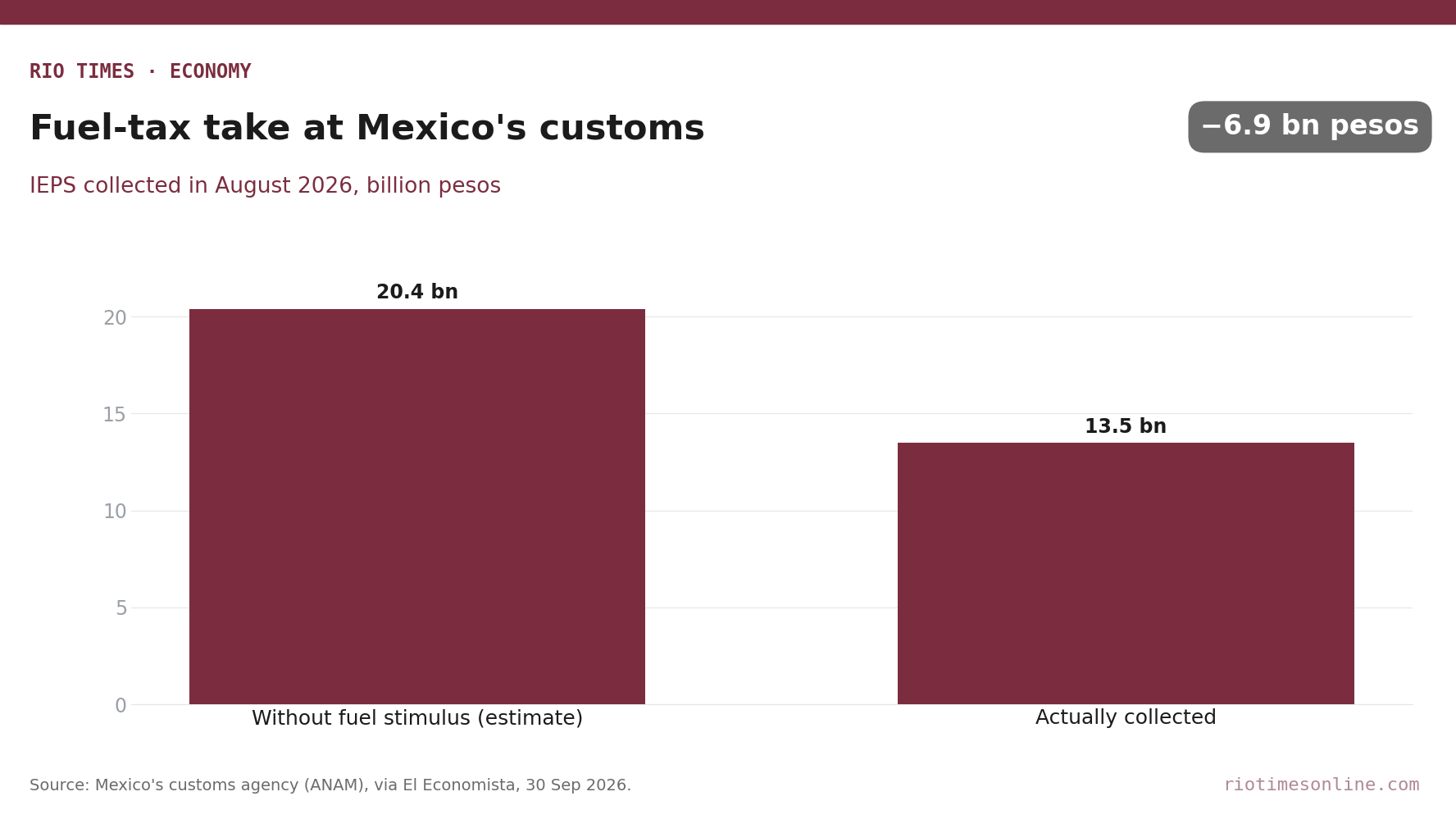
The customs agency ANAM said the discounts cost 6.95 billion pesos (about US$386 million) at the border in August alone. Without them, IEPS collected at customs would have reached 20.4 billion pesos (about US$1.14 billion) instead of 13.5 billion (about US$750 million).
From March to August the customs cost added up to 34.4 billion pesos (about US$1.91 billion), El Economista reported. Figures use 18.0 pesos per US dollar, the rate on 1 October 2026.
Why diesel matters most, and what cushions the cost
Diesel moves most of Mexico’s freight and buses, so its price feeds quickly into food and goods. That is why the deepest discount has gone to diesel rather than premium petrol.
The cost of Mexico fuel subsidies is real but so far contained. Amador said Mexico’s stabilisation funds exceed 170 billion pesos (about US$9.4 billion), their highest level since 2020.
He also told deputies that fiscal consolidation is advancing, with public borrowing expected to fall to 4.1% of GDP this year. Rating agencies have warned they could cut Mexico if consolidation stalls.
The inflation debate is not only about fuel. Critics question how quickly Banxico can reach 3%, as covered in Banxico Independence Questioned as Mexico Waits Until Late 2027 for 3% Inflation.
What Is Not Yet Known
The ministry has not said when or how fast Mexico fuel subsidies will end and the full tax returns. A quick reversal could push pump prices, and inflation, up at once.
Nor is there a full-year cost figure from the government. The weekly discount rates depend on global oil prices, which remain hard to forecast.
Sources: Expansión, report on Finance Minister Édgar Amador’s appearance before the Chamber of Deputies, 30 September 2026; La Jornada, report on the same appearance, 30 September 2026; El Economista, reports on Amador’s speech and on August customs revenue from Mexico’s customs agency (ANAM), 30 September 2026; INEGI inflation figure for the first half of September 2026 as reported by Expansión.
In depth
LatAm Markets: Live Signals → — real-time movers, turnover leaders and FX across Latin America.
Read More from The Rio Times