Lithium Slides as a Data Revision Doubles China’s Stockpiles
Key Facts
- Chinese lithium carbonate futures closed at 134,800 yuan a tonne on Friday, September 11, about US$20,100, down 4.99% on the day and 5.0% on the week.
- The trigger was a counting change, not a new mine. A Chinese data provider revised its inventory method on September 8 and reported stockpiles of 175,000 tonnes, up from 78,800.
- Prices fell more than 14% in three trading days and producers revolted, with Ganfeng Lithium threatening to abandon third-party price benchmarks.
- Albemarle closed at US$117.52, down 3.76%, and Chile’s SQM at US$69.88, down 3.60%. Over the week they lost 6.9% and 8.6%.
- Sigma Lithium was the worst hit, closing at US$9.50 after a 23% weekly fall, following a Brazilian court order suspending its mine’s environmental licences.
- The catch: the price is still roughly double where it was in 2025. A bad week is not the same as a bad market.
Today’s Focus
Trade date: Friday, September 11, 2026. Lithium had its worst week since spring, and the reason was a spreadsheet rather than a mine.
On September 8 the Chinese data provider SMM changed how it samples lithium carbonate stockpiles. Its published inventory figure more than doubled overnight, to 175,000 tonnes from 78,800.
Chinese futures fell more than 14% in three sessions. The most-traded January contract closed Friday at 134,800 yuan a tonne, roughly US$20,100, after touching 128,100 during the day.
Producers did not take it quietly. A petition circulated demanding a regulatory investigation, SMM opened an internal compliance review, and Ganfeng Lithium threatened to stop using outside price benchmarks.
What matters today. Nothing changed underground this week. What changed was the number the market trades against, and that is a problem for everyone who prices a contract off it.
01 The session in one read
Friday extended the slide rather than starting it. Albemarle closed at US$117.52, down 3.76%, and SQM at US$69.88, down 3.60%.
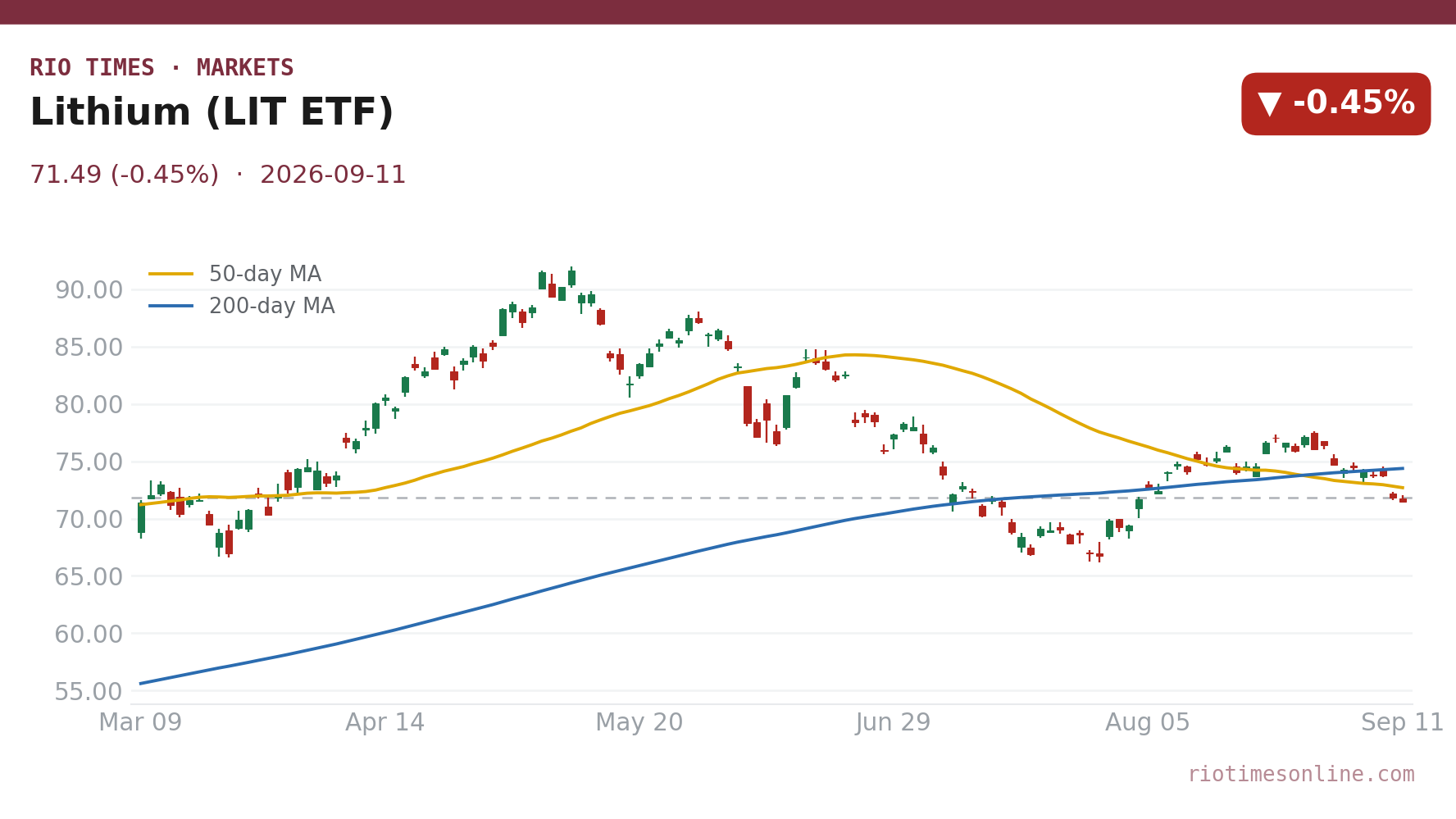
The broader Global X Lithium and Battery Tech fund fell just 0.45%, to US$71.49. That gap is the week in miniature, because the fund holds battery makers as well as miners.
Battery manufacturers benefit when their raw material gets cheaper. The companies digging it do not.
The distinction matters more than it sounds. New supply arrives slowly and can be planned for, while a revision to a widely used inventory series repriced the whole curve in three days.
Two real things did happen alongside it. Albemarle settled with its Chilean union on September 9, removing a strike premium, and Chinese domestic sales of electric vehicles fell 4.6% in August even as exports surged.
Working the other way, the biggest single piece of new Chinese supply is still offline. CATL’s Jianxiawo mine lost its environmental approval in August and one forecaster has halved its 2026 output estimate to 32,000 tonnes.
The variable to watch is whether the disputed inventory series survives. If the industry abandons it, the price that fell this week was measuring something that no longer exists.
02 The board
Every listed producer on the board fell. Sigma Lithium was the outlier at 5.66% lower, and it has now lost roughly a quarter of its value in a week.
The pattern held across the size range. Lithium Americas fell 3.64% to US$2.91, a reminder that smaller developers absorb the sharpest moves in both directions.
| Asset | Level | Change |
|---|---|---|
| Lithium carbonate, Guangzhou Jan contract | 134,800 yuan/t (US$20,100) | -4.99% |
| Lithium and battery fund (LIT) | US$71.49 | -0.45% |
| Albemarle (ALB) | US$117.52 | -3.76% |
| SQM (SQM) | US$69.88 | -3.60% |
| Sigma Lithium (SGML) | US$9.50 | -5.66% |
| Lithium Americas (LAC) | US$2.91 | -3.64% |
Trade date 2026-09-11. Equity closes from RT; futures from the Guangzhou Futures Exchange January 2027 contract. Where a commodity has no spot feed, an exchange-traded tracker or leading producer is shown as a labelled proxy.
Live Market IntelligenceThe live market board
Rio Times · Live Market Intelligence
Latin America — Cross-Market Board
| Instrument | Last | Change | YoY | Prev. | High | Low | Volume |
|---|---|---|---|---|---|---|---|
| IBOV | 187,206.89 | -0.56% | +21.85% | 188,268.59 | 168,310 | 167,142 | — |
| IPSA | 11,220.60 | -0.16% | — | 11,238.58 | 11,210 | 10,984 | 1,513,213,483 |
| IPC MEX | 63,924.77 | -0.28% | +12.17% | 64,106.82 | 66,121 | 65,405 | 108,886,187 |
| MERVAL | 3,098,898 | -1.87% | +30.51% | 3,022,485 | 3,042,365 | 2,991,150 | — |
| COLCAP | 2,589.69 | -1.41% | — | 9.04 | 9.05 | 9.02 | 4,133 |
| BVL PERÚ | 59,373.28 | — | — | — | — | — | — |
| USD/BRL | 5.16 | +0.01% | -5.13% | 5.16 | 5.18 | 5.14 | — |
| EUR/BRL | 5.95 | +1.01% | -5.83% | 5.89 | 5.98 | 5.94 | — |
| USD/MXN | 17.06 | -0.24% | -8.58% | 17.10 | 17.08 | 17.01 | — |
| USD/CLP | 913.98 | +0.04% | -5.67% | 913.65 | 915.11 | 906.68 | — |
| USD/COP | 3,140 | +0.03% | -22.04% | 3,139 | 3,141 | 3,105 | — |
| USD/PEN | 3.36 | -0.66% | -4.82% | 3.38 | 3.38 | 3.35 | — |
| USD/ARS | 1,493 | +0.10% | +12.96% | 1,491 | 1,494 | 1,480 | — |
| USD/UYU | 40.27 | +1.24% | +1.80% | 39.77 | 40.27 | 40.23 | — |
| USD/PYG | 5,939 | +1.68% | -19.54% | 5,841 | 5,939 | 5,925 | — |
| USD/BOB | 11.64 | -0.76% | +72.04% | 11.73 | 11.72 | 11.64 | — |
| USD/DOP | 58.34 | +1.25% | -3.44% | 57.62 | 58.34 | 58.04 | — |
| USD/CRC | 445.92 | +0.89% | -9.71% | 441.97 | 448.50 | 445.92 | — |
03 What moved it
Start with the number that broke. SMM, whose price and inventory assessments underpin a large share of Chinese lithium contracts, altered its sampling on September 8.
Reported stockpiles jumped to 175,000 tonnes from 78,800. Nothing was mined, shipped or consumed to produce that change.
The market treated it as news anyway, because contracts settle against published data. Futures fell more than 14% across three sessions and have not recovered.
The second factor was Chile. Albemarle reached a preliminary wage agreement with its Chilean union on September 9, and members began voting on Friday morning.
A strike at Atacama would have removed real tonnes from the market. Its avoidance removed a risk premium instead.
The third was demand. Chinese carmakers sold 1.643 million electric and hybrid vehicles in August, a record 60.6% of the market, but domestic sales fell 4.6% from a year earlier.
All of the growth came from exports, which rose 130%. That is a healthier picture for China’s carmakers than for its lithium refiners.
04 The Latin American read
Chile mined 56,000 tonnes of lithium content in 2025, third behind Australia on 92,000 and China on 62,000, according to the US Geological Survey. Argentina produced 23,000 tonnes and Brazil 12,000.
Reserves are where the region’s weight shows. Chile holds 9.2 million tonnes and Argentina 4.4 million, together about 37% of the world total of 37 million tonnes.
Bolivia has no reported reserves in that survey at all. It has enormous resources, which is a different and much weaker category, and produces perhaps 3,000 tonnes a year.
Its two Uyuni contracts, one Russian and one Chinese, have been paused by a Bolivian court and never cleared congress. Describing Bolivia as a lever on world supply is not supportable.
Argentina is the real growth story. Seven plants now have 186,000 tonnes a year of capacity, up from 35,500 a decade ago, and 21 lithium projects have been approved under the country’s large-investment incentive regime.
That regime has attracted US$46.7 billion in commitments. Whether the projects are built at a price near US$20,000 a tonne is a separate question.
05 The names to watch
SQM is the largest lithium producer by reported volume, at 233,000 tonnes of carbonate equivalent in 2025. It guides to 280,000 to 290,000 tonnes this year.
Its first-half revenue reached US$4.23 billion, more than double a year earlier, and net income US$1.02 billion. The average price it realised was US$21.80 a kilogram.
Its joint venture with the Chilean state producer Codelco completed on December 27, 2025. The venture runs the Salar de Atacama to 2060, with three board seats each.
Albemarle no longer publishes production tonnage, so the common description of it as the world’s largest producer cannot be checked. It guides to 225,000 to 235,000 tonnes of carbonate equivalent from its energy storage division this year.
It has also raised its forecast for 2026 world lithium demand to 2.2 million tonnes of carbonate equivalent, from 1.8 million in February. A BHP veteran, Ragnar Udd, becomes chief executive on February 1, 2027.
Sigma Lithium is the Brazilian problem. A federal judge suspended the environmental licences for Grota do Cirilo in Minas Gerais after the state’s Quilombola community federation argued the mine sits inside the consultation zone of the Baú community.
It is the third halt in four months. The company says operations continue and has reaffirmed 240,000 tonnes of concentrate over the next twelve months.
06 The outlook
Two questions decide the next fortnight. The first is whether SMM’s revised inventory series is accepted, replaced or abandoned.
The second is Chinese demand, and Tuesday brings August industrial production. A weak reading would confirm what the domestic vehicle numbers already suggest.
Beyond that, the price still sits roughly double its 2025 level and about a third below its May peak. Neither a glut nor a squeeze is settled.
07 What to watch
- The inventory dispute: Whether SMM’s revised stockpile series survives industry pressure will decide what Chinese lithium contracts actually settle against.
- Albemarle’s Chilean union vote: Members began voting on Friday. A rejection would put a strike at the Salar de Atacama back on the table.
- China industrial production, Tuesday: August data will show whether the domestic slowdown behind the 4.6% fall in electric vehicle sales is broadening.
- Sigma Lithium’s appeal: A Brazilian court ruling either restores the licences at Grota do Cirilo or removes 240,000 tonnes of planned concentrate from the market.
Frequently Asked Questions
Why did lithium prices fall this week?
A Chinese data provider changed how it counts stockpiles on September 8, and its inventory figure jumped to 175,000 tonnes from 78,800. Prices fell more than 14% in three trading days as traders rushed to reprice a market they thought they understood.
Is there really more lithium than the market needs?
The overnight jump came from a counting method, not from new mines. Producers dispute it, and one of the largest, Ganfeng Lithium, has threatened to stop using third-party price benchmarks altogether.
Which countries mine the most lithium?
Australia led in 2025 with 92,000 tonnes of lithium content, followed by China on 62,000 and Chile on 56,000, according to the US Geological Survey. Argentina produced 23,000 tonnes and Brazil 12,000.
Why did Sigma Lithium fall so hard?
A Brazilian federal judge suspended the environmental licences for its Grota do Cirilo mine in Minas Gerais after a Quilombola community federation went to court. The shares lost 15.8% on September 8 and 23% over the week.
Market data: RT equity closes and Guangzhou Futures Exchange settlements for Friday, September 11, 2026. Production and reserve data: US Geological Survey, Mineral Commodity Summaries 2026.
This article was produced by The Rio Times’ automated newsroom system. How we use AI · Report an error
LatAm Markets: Live Signals → — real-time movers, turnover leaders and FX across Latin America.
Read More from The Rio Times