Latin American Pulse for Thursday, August 6, 2026
Executive Summary
Latin America's mood on August 6, 2026: a continent grappling with institutional strain, diplomatic ruptures, and bursts of defiant pride, grounded in the.
Rio Times · Latin America
Key Facts
Latin America — —Brazil Diplomatic fury mixes with corporate triumph as 16 officials lose US visas while Itaú posts a US$2.4 billion profit.
—Argentina Relief and deep ideological satisfaction as the BCRA reform bans state financing and the China swap deal is locked in for five years.
—Colombia A nation holding its breath as a freshly sworn-in president faces a fuel-supply time bomb and illegal gold now rivalling coffee exports.
—Chile Quiet pride and fiscal discipline as Vik enters the wine hall of fame and Kast’s tax reform passes, even as Codelco hits a seismic wall.
—Peru A jolt of grand ambition with the US$20.6 billion Lima Metro shock, undercut by the immediate sting of Machu Picchu trains halted by wildfire.
—Venezuela A strange brew of oil-fuelled hope and transactional cynicism as exports to the US triple to 786,000 barrels a day and the Caracas stock exchange surges 146%.
On August 5, 2026, Latin America felt pulled in two directions at once—outward toward global capital and technology, and inward toward old quarrels and institutional weariness.

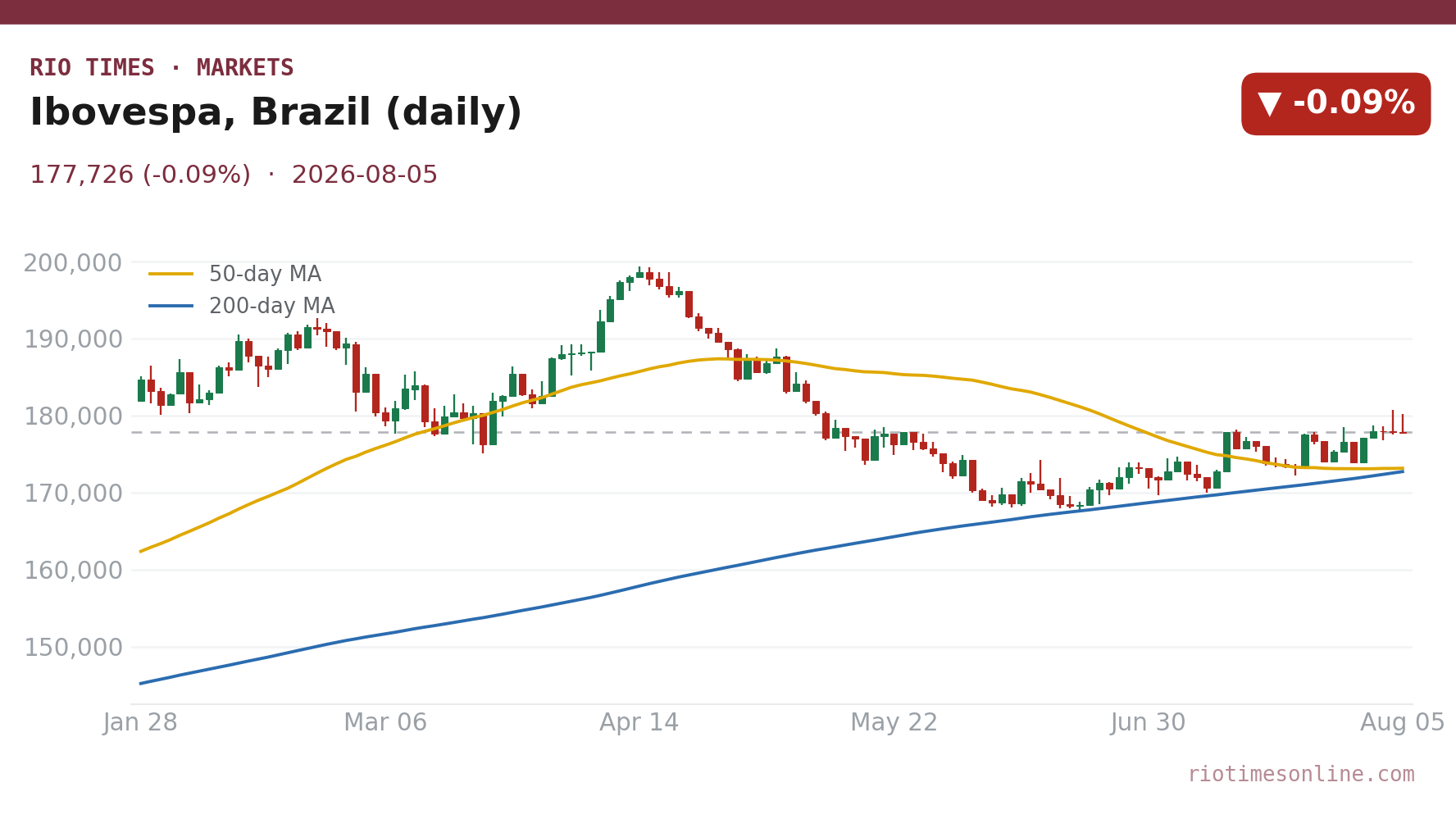
| Instrument | Level | Session |
|---|---|---|
| Ibovespa (Brazil) | 177,726 | -0.09% |
| S&P/BMV IPC (Mexico) | 66,537 | -0.47% |
| S&P IPSA (Chile) | 11,158 | +1.47% |
| S&P Merval (Argentina) | 3,156,332 | -1.02% |
| COLCAP (Colombia) | 2,345 | -1.26% |
| USD/BRL | 5.1206 | -0.15% |
| USD/MXN | 17.2265 | -0.19% |
Source: RT close, 2026-08-05. Figures rendered directly from the feed.
The Continent’s Mood Today
A continent of dealmakers and bruised diplomats woke up on August 5 to a single shared sensation: the centrifuge is spinning faster. Money is moving—US$1.33 billion for Gran Tierra’s Colombian and Ecuadorian assets, US$984 million from the IDB for Brazil’s anti-crime push, a US$630 million Compass IPO breaking Brazil’s five-year drought—yet trust is fraying at the seams. The same morning, Brazil confirmed 16 of its officials lost US visas in a tit-for-tat that downgraded a 200-year alliance with the United States into a diplomatic sulk.
This is not crisis; this is friction as a permanent condition. Beneath the numbers, the continent is asking itself how much sovereignty it is willing to trade for investment, and how much dignity it can afford to keep.
Brazil – Smoldering Pride and Visa Fury
Brazil is furious and flush. The US visa ban on 16 Brazilian officials, including a sitting ambassador, has turned a quiet diplomatic spat into front-page rage. ‘It is an insult dressed as procedure,’ one foreign ministry source told a Brasília beat reporter, though the foreign ministry itself stayed tight-lipped. The wound is real: this is a nation that sees itself as a hemispheric leader, not a supplicant, and the public mood has hardened into a mix of wounded pride and anti-American disdain.
Yet the money tells a different story. Itaú Unibanco posted a US$2.4 billion quarterly profit, extending a record streak. Usiminas saw a 236% profit surge to US$84 million. Gerdau’s profit jumped 70% to US$287 million. Tenda hit record revenue of US$254 million. The corporate sector is roaring, and Brazilians know it. The cognitive dissonance—a humiliated state and a swaggering private sector—is the defining emotional texture of the day.
Live Market IntelligenceLatin America — Cross-Market Board
Rio Times · Live Market Intelligence
Latin America — Cross-Market Board
-0.27%
183,476.86
-0.27%
64,992.23
+1.13%
11,255.90
-0.39%
2,893,751
-1.57%
2,584.72
-0.95%
59,934.37
+1.27%
| Instrument | Last | Change | YoY | Prev. | High | Low | Volume |
|---|---|---|---|---|---|---|---|
| IBOV | 183,476.86 | -0.27% | +21.85% | 183,965.91 | 168,310 | 167,142 | — |
| IPSA | 11,255.90 | -0.39% | — | 11,299.82 | 11,210 | 10,984 | 1,513,213,483 |
| IPC MEX | 64,992.23 | +1.13% | +12.17% | 64,264.16 | 66,121 | 65,405 | 108,886,187 |
| MERVAL | 2,893,751 | -1.57% | +30.51% | 3,022,485 | 3,042,365 | 2,991,150 | — |
| COLCAP | 2,584.72 | -0.95% | — | 9.04 | 9.05 | 9.02 | 4,133 |
| BVL PERÚ | 59,934.37 | +1.27% | — | — | — | — | — |
| USD/BRL | 5.16 | +0.01% | -5.13% | 5.16 | 5.18 | 5.14 | — |
| EUR/BRL | 5.95 | +1.01% | -5.83% | 5.89 | 5.98 | 5.94 | — |
| USD/MXN | 17.06 | -0.24% | -8.58% | 17.10 | 17.08 | 17.01 | — |
| USD/CLP | 913.98 | +0.04% | -5.67% | 913.65 | 915.11 | 906.68 | — |
| USD/COP | 3,140 | +0.03% | -22.04% | 3,139 | 3,141 | 3,105 | — |
| USD/PEN | 3.36 | -0.66% | -4.82% | 3.38 | 3.38 | 3.35 | — |
| USD/ARS | 1,493 | +0.10% | +12.96% | 1,491 | 1,494 | 1,480 | — |
| USD/UYU | 40.27 | +1.24% | +1.80% | 39.77 | 40.27 | 40.23 | — |
| USD/PYG | 5,939 | +1.68% | -19.54% | 5,841 | 5,939 | 5,925 | — |
| USD/BOB | 11.64 | -0.76% | +72.04% | 11.73 | 11.72 | 11.64 | — |
| USD/DOP | 58.34 | +1.25% | -3.44% | 57.62 | 58.34 | 58.04 | — |
| USD/CRC | 445.92 | +0.89% | -9.71% | 441.97 | 448.50 | 445.92 | — |
Argentina – The Relief of a Straitjacket
Argentina exhaled on August 5. The Central Bank reform bill that bans state financing cleared a key hurdle, and for Milei’s supporters, this is the lock on the door they have been waiting for. ‘The printing press is dead,’ a La Nación columnist wrote, capturing the libertarian satisfaction of a nation that has been burned by inflation for generations. The relief is almost physical. Simultaneously, the renewal of the China currency swap deal for a five-year term removed an immediate threat of default. The swap was the safety net beneath the tightrope, and its extension is being received as a grudging adult acknowledgment that Beijing is, for now, the more reliable partner.
The mood is not celebratory. It is the exhausted satisfaction of a patient who has survived a dangerous surgery. Foreigners holding peso-denominated assets should read this as a stabilization bet, not a growth story. The Monotributo brackets rose 16.8% on the same day, a small but telling reminder that inflation is not defeated, only caged.
Colombia – A New President, an Old Knot
Colombia swore in a new president with a razor-thin 49.7% mandate that passed an audit, and the feeling in Bogotá is less a honeymoon than a collective wince. The fuel-supply time bomb is ticking louder than ever: imports are nearing 50% of consumption, and any external shock could mean queues at the pump. Semana ran a deep dive calling it ‘the sword over the new government’s neck.’ Meanwhile, illegal gold now rivals coffee at US$3.5 billion, a statistic that seems to have finally broken through the national consciousness as a symbol of lost control over the territory.
There is pride too. The Youth Philharmonic launched a five-city tour with 90 musicians. Alfonso Lizarazo, creator of ‘Sábados Felices,’ died at 85, and the tributes poured in—a nation clutching at its cultural anchors. For an expat with assets here, the message is clear: the economic fundamentals require watching, not the inaugural speech.
Chile – Orderly Success, Seismic Caution
Chile is feeling competent and careful. Vik winery joined a global Hall of Fame as Santiago hosted top vineyards, a moment of quiet national pride that fits the self-image of a country that exports excellence in bottles. Kast’s tax reform passed, and the financial press treated it not as drama but as engineering. Entel’s profit soared 39% to US$27 million, and Corfo’s lithium payments surged 427% to US$791 million—numbers that suggest a treasury that is not panicking.
Then there is the earth itself. Codelco halted the El Teniente expansion over seismic risk. The decision, announced matter-of-factly, was received as prudent, not panicked. Chileans live with tectonic plates below their feet and in their politics, and on August 5, the national mood was one of managing risks that cannot be eliminated.
Peru – Grand Visions, Burning Hillsides
Peru is suspended between euphoria and emergency. The Fujimori government unveiled a US$20.6 billion Lima Metro plan to build Lines 3, 4, 5 and 6, a project so vast it rewrites the capital’s future. El Comercio called it ‘the shock the city has awaited for decades.’ At the same moment, wildfires near Machu Picchu halted trains and stranded hundreds of tourists. The juxtaposition is cruel: a government promising seamless connectivity while the country’s most sacred landscape burns.
The Peru-China FTA upgrade added e-commerce and supply chain rules on the same day, a quiet bureaucratic win that got less attention than it deserved. Coca-Cola’s US$1 billion expansion plan also landed with a thud of corporate confidence. For a foreigner living in Lima, the emotional takeaway is this: bet on the concrete and steel, but pack a go-bag for the smoke.
Venezuela – The Odd Comfort of a Transactional Boom
Venezuela is feeling something unfamiliar: pragmatic hope. Oil exports to the United States tripled to 786,000 barrels a day, the highest since early 2019. The Caracas stock exchange surged 146%. The bolívar rally cooled, but nobody is calling it stability. Efecto Cocuyo ran the numbers with a tone best described as wary relief. There is no ideological victory lap here, just a weary recognition that oil will always buy a seat at the table, however shabby the chair.
The mood is transactional, not transformational. Venezuelans have been burned too many times to mistake a boomlet for a new dawn. A foreigner with assets here is effectively holding a bet on US refineries needing heavy crude, not on Venezuelan governance improving. The offshore gas auction news that hummed in the background reinforces the pattern: resources flow out, cash trickles in, and the state survives.
The Shared Mood
On August 5, 2026, Latin America shared a mood of scrambled signals. The continent is integrating with global capital markets faster than its political class can manage the resentments that integration stirs. An American tourist whose ambassador just banned Brazilian officials might drink a Chilean Vik wine tonight, unaware that the vineyard and the visa war belong to the same hemisphere, the same day, the same unresolved question of what the region owes its neighbours and what it owes itself. The earth beneath is shifting, literally and figuratively, and everyone feels it.
Frequently Asked Questions
What happened between Brazil and the US regarding visas?
On August 5, 2026, 16 Brazilian officials lost their US visas, and a Brazilian ambassador was targeted, escalating a diplomatic row that has downgraded the 200-year Brazil-US alliance into a broader hemispheric tension.
Why is Colombia’s fuel situation being called a time bomb?
Colombia’s fuel imports are nearing 50% of consumption. Any external supply disruption could trigger domestic shortages, a vulnerability that intensified on the day a new president was sworn in with a narrow 49.7% mandate.
What is the significance of Peru’s Lima Metro shock plan?
The US$20.6 billion plan commits Peru to building Lines 3, 4, 5 and 6 alongside completing Line 2, representing the largest urban infrastructure pledge in the country’s modern history. It was announced on the same day wildfires stranded tourists at Machu Picchu, creating a stark contrast between ambition and immediate crisis.
Sources: The Rio Times, The Rio Times, The Rio Times, The Rio Times
Connected Coverage
Brazil, IDB Sign US$984 Million Anti-Crime Deal
Cancún’s US$270M Medical Nearshoring Hub Targets US Patients
Gran Tierra to Sell Colombia, Ecuador Assets for US$1.33B
Pampa Energía Posts Record Q2, Eyes US$11 Billion Plan
Chile’s Vik Joins Hall of Fame as Santiago Hosts Top Vineyards
Companion: today’s Latin America Power Map (PDF) — our full daily dossier on who holds power across the region.
This article was produced by The Rio Times’ automated newsroom system. How we use AI · Report an error