Latin American Pulse for Friday, September 18, 2026
Executive Summary
Three central banks moved this week and only Brazil cut. Argentina's economy shrank as its market rose, and Chile shuts for four days from today.
Rio Times · Latin America
Key Facts
—Region Three central banks moved this week and only Brazil cut its policy rate.
—Brazil The Bolsa Família floor rises 15% to 691 reais, about US$135, from 1 October.
—Argentina Output fell 0.6% in the second quarter and unemployment reached 7.9%, the highest since 2021.
—Mexico The gap between Mexican and American policy rates is now near a record low of 2.5 percentage points.
—Chile Markets close today and Saturday for Fiestas Patrias after a session that ended at one.
—Colombia The peso was the region’s weakest currency as analysts lifted December inflation forecasts to 6.81%.
—Peru Irregular migrants will be held at disused military sites, starting with a former army school at Ancón.
Three Central Banks, One Direction Away From Brazil
The United States Federal Reserve raised its policy rate by a quarter of a percentage point on Wednesday 16 September. The new target range is 3.75 to 4 percent, the vote was unanimous, and it was the first increase since 2023.
Chair Kevin Warsh said inflation had been too high for too long. Sixteen of eighteen officials expect at least one further increase before the end of the year.
Brazil moved the other way the same evening. Its rate-setting committee cut the Selic to 13.75 percent, the fifth consecutive reduction, and promised to act with what it called serenity and caution.
The Bank of Japan completed the set on Friday morning, raising its own rate to 1.25 percent. That is a thirty-one-year high, and it raises the cost of the yen borrowing that funds investment across emerging markets.
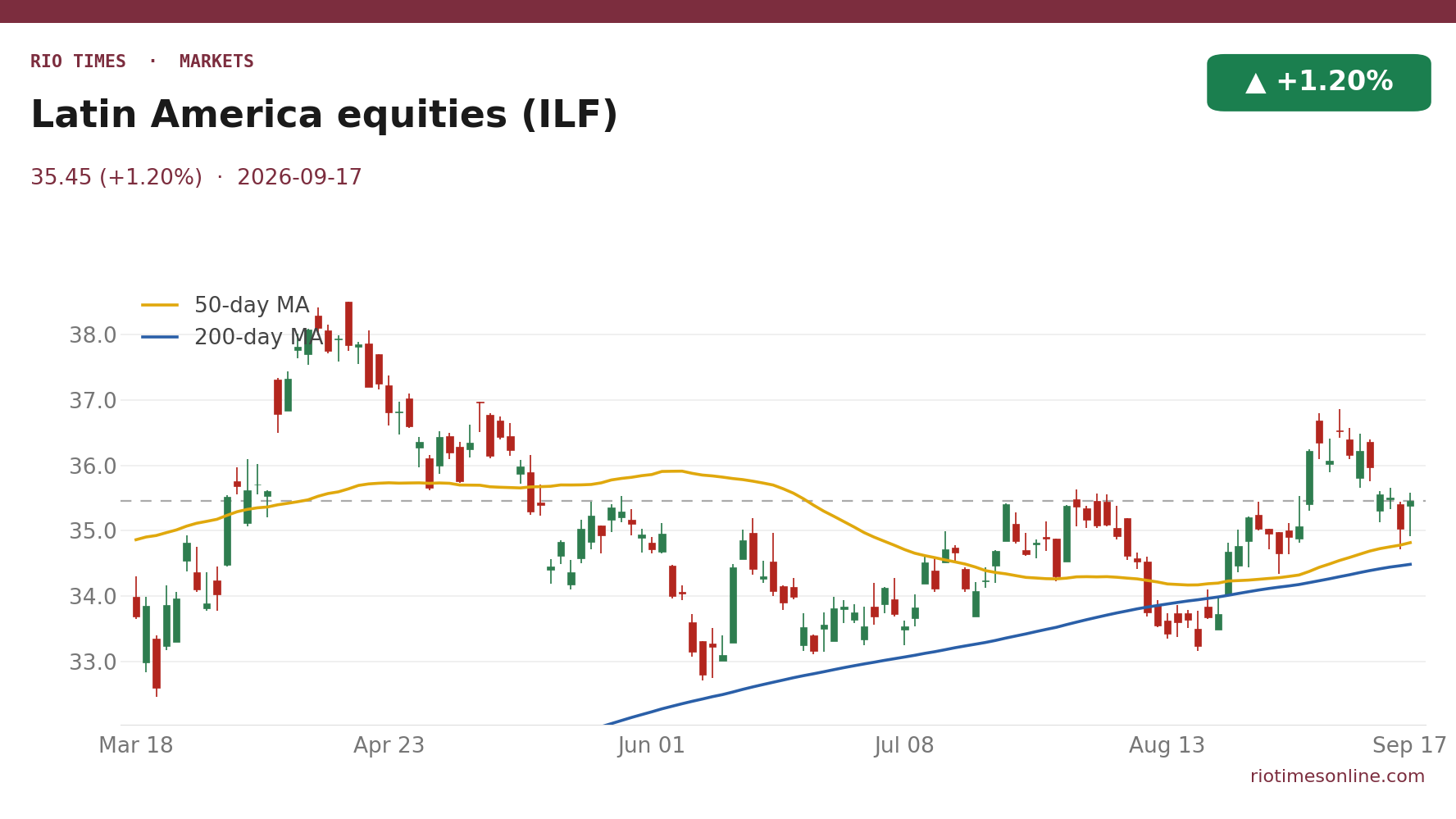
The regional equity picture has been flat rather than falling through all of this. Latin American shares in dollar terms have drifted sideways since the start of September.
That is a reasonable outcome given the week. It also means the adjustment has happened in currencies rather than in share prices.
Brazil: A Welfare Rise Seventeen Days Before the Vote
The government published a 15 percent rise in the Bolsa Família minimum payment in an extra edition of the official gazette on Thursday. The floor goes from 600 to 691 reais, roughly 117 to 135 dollars, from 1 October.
The programme reaches 19.3 million families. It costs 5.8 billion reais, about 1.13 billion dollars, this year, and 22.7 billion reais or some 4.42 billion dollars a year from 2027.
The timing is seventeen days before the first round of the presidential election on 4 October. Two weeks earlier the planning ministry had said no rise was planned and the 2027 budget carried no funds for it.
Markets sold the news and then bought it back. The Ibovespa fell more than one percent before closing up 0.24 percent at 185,992 points. Local outlets described the day as the election trade beating fiscal fear.
Lula also announced free weight-loss medication through the public health system, speaking at a pharmaceutical plant in Montes Claros, Minas Gerais. No start date was given, and a pilot has been running since late June at a federal hospital in Porto Alegre.
Polls remain contradictory. Datafolha put Lula on 39 percent and Flávio Bolsonaro on 36, while other pollsters have the president between 43 and 50.
Live Market IntelligenceLatin America — Cross-Market Board
Rio Times · Live Market Intelligence
Latin America — Cross-Market Board
+0.24%
185,992.03
+0.24%
63,873.32
+0.58%
11,381.18
+1.30%
3,061,512
+1.08%
2,521.85
+0.40%
58,965.05
+1.80%
| Instrument | Last | Change | YoY | Prev. | High | Low | Volume |
|---|---|---|---|---|---|---|---|
| IBOV | 185,992.03 | +0.24% | +21.85% | 185,547.66 | 168,310 | 167,142 | — |
| IPSA | 11,381.18 | +1.30% | — | 11,235.60 | 11,210 | 10,984 | 1,513,213,483 |
| IPC MEX | 63,873.32 | +0.58% | +12.17% | 63,507.11 | 66,121 | 65,405 | 108,886,187 |
| MERVAL | 3,061,512 | +1.08% | +30.51% | 3,022,485 | 3,042,365 | 2,991,150 | — |
| COLCAP | 2,521.85 | +0.40% | — | 9.04 | 9.05 | 9.02 | 4,133 |
| BVL PERÚ | 58,965.05 | +1.80% | — | — | — | — | — |
| USD/BRL | 5.16 | +0.01% | -5.13% | 5.16 | 5.18 | 5.14 | — |
| EUR/BRL | 5.95 | +1.01% | -5.83% | 5.89 | 5.98 | 5.94 | — |
| USD/MXN | 17.06 | -0.24% | -8.58% | 17.10 | 17.08 | 17.01 | — |
| USD/CLP | 913.98 | +0.04% | -5.67% | 913.65 | 915.11 | 906.68 | — |
| USD/COP | 3,140 | +0.03% | -22.04% | 3,139 | 3,141 | 3,105 | — |
| USD/PEN | 3.36 | -0.66% | -4.82% | 3.38 | 3.38 | 3.35 | — |
| USD/ARS | 1,493 | +0.10% | +12.96% | 1,491 | 1,494 | 1,480 | — |
| USD/UYU | 40.27 | +1.24% | +1.80% | 39.77 | 40.27 | 40.23 | — |
| USD/PYG | 5,939 | +1.68% | -19.54% | 5,841 | 5,939 | 5,925 | — |
| USD/BOB | 11.64 | -0.76% | +72.04% | 11.73 | 11.72 | 11.64 | — |
| USD/DOP | 58.34 | +1.25% | -3.44% | 57.62 | 58.34 | 58.04 | — |
| USD/CRC | 445.92 | +0.89% | -9.71% | 441.97 | 448.50 | 445.92 | — |
Argentina: The Economy Shrinks While the Market Rises
The statistics institute reported on Thursday that output fell 0.6 percent in the second quarter. It remained 2.0 percent higher than a year earlier, but unemployment rose to 7.9 percent, the highest since 2021.
That means roughly 1.8 million people without work. A further 10.2 million are in informal employment, about 45 percent of the workforce.
Manufacturing fell 2.1 percent and public administration 1.4 percent. Fishing rose 44.7 percent, mining 16.4 percent and agriculture 6.9 percent, which is the shape of an economy tilting towards exports.
The Merval rose 1.08 percent on the same day, to 3,061,512 points. Country risk also rose, reaching 515, its highest level since 26 August.
The Senate turned the second inocencia fiscal bill into law by 44 votes to 23. Discrepancies below five million pesos will no longer trigger scrutiny from the tax agency, and the benefits expire at the end of 2027.
A separate biofuels bill won only a first-chamber approval, by 41 votes to 25, and now goes to the Chamber of Deputies. August trade figures are published this afternoon, with forecasts near 2.055 billion dollars.
Mexico: Back From the Holiday, Into a Narrower Rate Gap
The Mexican market reopened on Thursday after Wednesday’s Independence Day closure and rose 0.58 percent to 63,873 points. Breadth was strong, with 470 shares advancing against 268 that fell.
The peso firmed to 17.17 to the dollar. Minera Frisco led the market with an 8.22 percent gain, ahead of América at 4.72 percent and Televisa at 3.93.
The central bank has held its policy rate at 6.50 percent since early August and meets again on 24 September. The Federal Reserve’s increase has narrowed the gap between the two countries to about 2.5 percentage points, the smallest on record.
The fourth round of trade negotiations with Washington was postponed on Thursday and reset for 28 and 29 September. It followed a reported telephone call between President Claudia Sheinbaum and President Donald Trump.
Mexico City’s mayor Clara Brugada asked the city congress for leave to travel to New York on 20 and 21 September. She is attending an urban policy summit at the invitation of Mayor Zohran Mamdani.
Security news came from Michoacán. Omar García Harfuch announced the capture of a regional cartel coordinator known as El Señor de la T.
Chile: A Half Session, Then Four Days Off
The Chilean market closed at one in the afternoon on Thursday, on the eve of Fiestas Patrias. It still produced the strongest regional performance, with the IPSA rising 1.30 percent to 11,381 points.
SQM led the index as lithium prices steadied after a long decline. Copper helped too, rising 1.22 percent in London to 6.53 dollars a pound, a third consecutive gain.
The currency reading depends on where you stop the clock. The reference close was 962 pesos to the dollar while Santiago’s official print was 959.25, down 2.43 pesos on the day.
Over the week the dollar is still stronger against the peso, its sixth consecutive weekly rise. That trend matters more than any single session.
Today is Independencia Nacional and tomorrow is the Día de las Glorias del Ejército. The exchange is shut for both, so Chilean shares trade only in New York until Monday.
Politics supplied a smaller story. The energy regional secretary for Coquimbo resigned after failing to prove his academic credentials, the forty-eighth departure from the Kast government.
Colombia: The Peso Pays for an Inflation Forecast
The COLCAP rose 0.40 percent to 2,521.85 points on Thursday, ending a four-session losing run. The peso went the other way and was the weakest major regional currency on the day.
The reference close was 3,132 to the dollar, with local sources quoting prints as high as 3,159. The official rate used for contracts rose 28.01 pesos to 3,128.46.
The central bank published its monthly survey of analysts on the same day. The median forecast for December inflation rose to 6.81 percent from 6.60, against August inflation of 6.33 and a target of 3.
The policy rate stands at 12.00 percent, the highest since 2024, and there was no meeting this week. A rate that high failing to hold the currency is the uncomfortable fact behind the session.
On trade, the head of the exporters’ association said the additional 12.5 percent United States tariff could fall to zero. Washington kept Colombia on its drug-control blacklist this week while redirecting about 52 million dollars of assistance towards the region.
The statistics agency publishes its July activity index at noon. Consensus is 2.9 percent against June’s 3.5, with individual forecasts running from 0.2 to 2.3.
Peru and Venezuela: Detention Sites and Drilling Rights
Peru’s defence minister Rafael Belaúnde told a congressional committee on Thursday that irregular migrants will be held at disused military facilities. The first will be the former army armour school at Ancón.
The government also intends to extend the window for expulsions from three days to seven. Peru is governed by President Keiko Fujimori.
In Venezuela, two American companies took oil and gold concessions with President Trump’s backing. Continental Resources takes an Orinoco Belt block and Heeney Capital a gold interest.
The announcement was made on Wednesday at a meeting of energy ministers in Houston. It is the clearest sign yet of a commercial normalisation running ahead of any political one.
What the Day Adds Up To
The region ends the week with a narrower cushion than it began. Two of its three main funding markets raised rates and the third, Brazil, cut into the gap.
Equity markets have absorbed that without much difficulty so far. Every major regional index rose on Thursday and the adjustment has shown up in currencies instead.
The Colombian peso is where it has shown up most clearly. A policy rate of 12 percent failing to hold a currency is the warning the rest of the region should read.
Brazil is the interesting counter-case. It cut rates, announced election spending, and its currency held, which tells you how much foreign money is still arriving.
Frequently Asked Questions
What did the Federal Reserve decide this week?
It raised its target range by a quarter point to 3.75-4.00 percent on 16 September, the first increase since 2023. The vote was unanimous and most officials expect another rise before December.
Why did Brazil cut rates in the same week?
Brazil’s Copom cut the Selic to 13.75 percent, its fifth consecutive quarter-point reduction, because domestic inflation has allowed continued easing. The two decisions narrowed the gap that rewards investors for holding Brazilian assets.
What changed in the Bolsa Família programme?
The minimum payment rises 15 percent from 600 to 691 reais, roughly 117 to 135 dollars, effective 1 October. It reaches 19.3 million families and was published seventeen days before the first round of voting.
What did Argentina’s second-quarter data show?
Output fell 0.6 percent from the previous quarter and unemployment rose to 7.9 percent, the highest since 2021. About 1.8 million people are out of work and 10.2 million are in informal employment.
Are Chilean markets open today?
No. The Bolsa de Santiago is closed on 18 September for Independencia Nacional and on 19 September for the Día de las Glorias del Ejército.
Why did the Colombian peso fall?
Analysts lifted their median December inflation forecast to 6.81 percent in the central bank’s monthly survey, while the Federal Reserve’s increase reduced the reward for holding pesos. The currency was the weakest major regional performer on Thursday.
What is happening with Peru’s migrant detention plan?
Defence Minister Rafael Belaúnde confirmed that irregular migrants will be held at disused military sites, beginning with the former army armour school at Ancón. The expulsion window is to be extended from three days to seven.
Sources: Federal Reserve implementation note and Copom statement of 16 September 2026; Bank of Japan statement of 18 September 2026; Diário Oficial da União extra edition of 17 September; Poder360 and Metrópoles on the health announcement; O Povo on the Datafolha poll; INDEC national accounts and labour-market releases; Infobae, La Nación and Parlamentario on the Senate votes; El Financiero and Infobae on Mexico; La Tercera, Diario Financiero and BioBioChile on Chile; Portafolio, Infobae and El Tiempo on Colombia; Nodal and Infobae on Peru; El Comercio on the Venezuelan concessions; RT end-of-day series.
This article was produced by The Rio Times’ automated newsroom system. How we use AI · Report an error