Latin America Defense Monitor — August 22–29, 2026
Weekly Edition · Saturday, August 29, 2026 · Issue #19
Executive Summary
The Big Picture: This week’s Latin America Defense Monitor opens in Colombia, where the new president, Abelardo de la Espriella, turned three weeks of promises into action. On Thursday the air force bombed camps of the FARC-dissident faction run by alias “Calarcá” in the southern department of Guaviare — Operation AMÓN — killing at least eight fighters in a strike led by Kfir jets and Super Tucano turboprops, followed by commandos on the ground. It is the second airstrike since he took office on August 7, and part of a first-100-days plan built around 15 “beta operations” against armed-group leadership.
The week before, De la Espriella had flown to Panama City to sign Colombia up to the Shield of the Americas, the US-led security alliance pushed by Donald Trump — and named a brand-new military high command to run the offensive, recalling a general that Gustavo Petro had pushed out. Washington is now talking about joint US–Colombian military operations and a proposed $1 billion assistance package.
Elsewhere, the US military used a high-energy laser for the first time in anger on the Mexican border, burning three cartel drones out of the sky over the Rio Grande Valley. An Ecuadorian official confirmed US Special Forces are operating inside Ecuador, with two US warships on the way. A US aircraft carrier moved into the Caribbean near Venezuela, and another suspected drug boat was hit at sea, killing four. And in Argentina, the combined exercise Fraterno XXXIX with Brazil ended with an open sales pitch: Brazil parked its brand-new Tamandaré frigate and Riachuelo-class submarine at Mar del Plata and invited the Argentine Navy to shop.
Latin America Defense Monitor: Where Things Stand
| Country | Status | What’s Happening |
|---|---|---|
| Colombia | High | Operation AMÓN airstrike in Guaviare kills 8+ fighters of Calarcá’s FARC-dissident bloc; second strike of the new government; 15 “beta operations” planned for the first 100 days; new high command named; joins the Shield of the Americas. |
| US–Mexico border | High | US Army uses a high-energy laser operationally for the first time, downing three “cartel-linked” drones in the Rio Grande Valley; Sheinbaum warns over sovereignty. |
| Ecuador | Elevated | Official confirms US Special Forces are operating inside the country; two US warships arriving to support anti-cartel campaigns. |
| Caribbean / Venezuela | Elevated | US carrier arrives in the Caribbean in a buildup near Venezuela; another boat strike kills four, taking the campaign’s reported toll past 195. |
| Argentina / Brazil | Active | Fraterno XXXIX combined exercise concludes; Brazil showcases the Tamandaré frigate and Humaitá submarine at Mar del Plata as candidates to renew Argentina’s fleet. |
| Peru | Active | Lockheed Martin proposes a $1.8bn industrial and social package tied to its F-16 Block 70 offer, reviving the fighter competition after the April scandal. |
| Bolivia | Watch | Political tension around President Paz’s inner circle; a March photo with Rubio at the Escudo summit resurfaces in a domestic scandal. |

President Abelardo de la Espriella announced Thursday that the armed forces carried out Operation AMÓN in the early hours against camps of the Jorge Suárez Briceño Bloc — the FARC-dissident structure commanded by alias Calarcá — in rural El Retorno, Guaviare. Initial reports put the dead at eight or more. Troops seized over a dozen rifles and five machine guns.
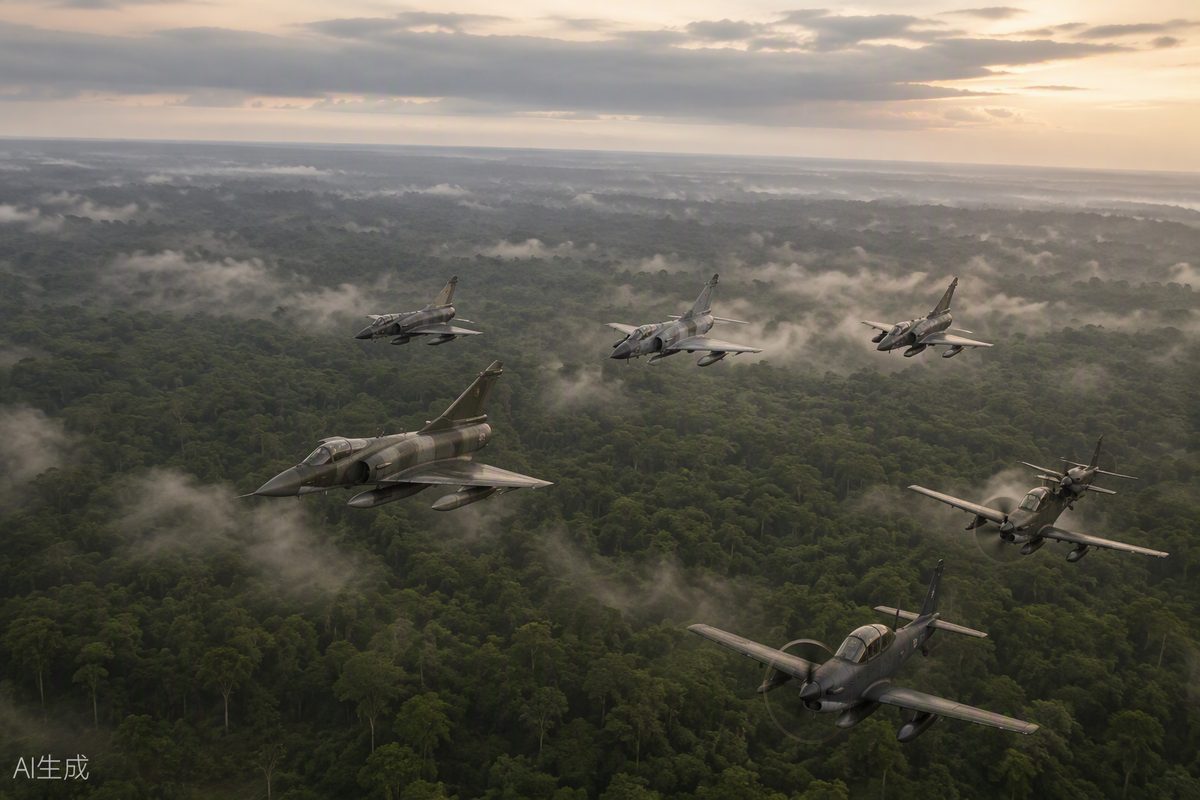
The operation, run by the Joint Special Operations Command, opened with a precision aerial bombardment by five Kfir fighter jets and six Super Tucano aircraft, followed by a commando assault. Troops remain in the area and the offensive is continuing.
The target matters. Calarcá’s Estado Mayor de Bloques y Frentes is fighting a territorial war against Iván Mordisco’s rival dissident faction across Meta and Guaviare — a fight that, according to the military, includes the forced “registration” (carnetización) of rural civilians. It was precisely General Erik Rodríguez Aparicio’s public warnings about that practice that got him pushed aside by Petro. De la Espriella has now brought him back as commander-general of the armed forces.
Days before the strike, De la Espriella stood in Barranquilla and presented his complete new military leadership. General Erik Rodríguez Aparicio — 35 years of service, removed under Petro after flagging forced civilian registration in Meta and Guaviare — returns as commander of the armed forces, with the confidence of Defense Minister (retired general) Jorge Mora.
The appointment followed Colombia’s formal adhesion to the Shield of the Americas at a ceremony in Panama City — the US-championed security bloc launched at the Doral summit in March. According to reporting by Finance Colombia, the government still owes the public a full explanation of three US announcements: joint US–Colombian military operations, the Escudo membership itself, and a proposed $1 billion US assistance package.
Not everyone is on board. A Medellín judge is reviewing the legality of Colombia’s foreign military operations — an early sign that the courts intend to watch how far the alliance goes.
Late Tuesday and early Wednesday, Joint Task Force–Southern Border used the Army Multipurpose High Energy Laser (AMP-HEL) — a system developed by AeroVironment — to shoot down three drones it said were operated by Mexican cartels in the Rio Grande Valley. NORAD and US Northern Command confirmed it Thursday. Officials called the drones “hostile,” said they posed a physical threat to troops and Border Patrol agents, and declined to say whether the engagements happened over US or Mexican soil.
“Cartel networks are increasingly employing unmanned aircraft systems to facilitate illicit human-smuggling and actively spy on our personnel,” said task-force commander Maj. Gen. Curtis Taylor, who thanked Mexico’s government and military for their cooperation.
It is the first confirmed operational use of a directed-energy weapon in the US cartel fight — and a redemption story of sorts. In February and March, the same laser family caused chaos: CBP zapped what turned out to be Mylar balloons near El Paso, soldiers shot down a CBP drone near Fort Hancock, and the FAA twice closed Texas airspace. A Pentagon–FAA safety agreement followed. This week, the system worked as advertised. Separately, JIATF-401 last month awarded CACI up to $500 million for the SkyValor jammer.
Ecuadorian officials confirmed this week that American special-operations soldiers are working inside the country in the fight against cartels, and that two US warships are arriving to support military campaigns (Task & Purpose, Aug 25).
The confirmation formalizes what had been visible for months: Ecuador, whose port cities have become some of the most violent places on earth as cocaine routes shifted to the Pacific, is now the most forward-leaning US security partner on South America’s west coast.
A US aircraft carrier arrived in the Caribbean this week in what Defense News described as a buildup near Venezuela, replacing the long-deployed USS Abraham Lincoln — which, after a record nine months at sea, was relieved in the Middle East and is heading home via a historic port call in Thailand.
On Wednesday, the US military struck another boat it said was smuggling drugs in the Caribbean, killing four — the latest in a campaign whose reported death toll passed 190 in July and keeps climbing. The strikes continue even as, inside Venezuela, high-stakes political negotiations proceed under the new government.
The combined Argentina–Brazil exercise Fraterno XXXIX wrapped up with a notable port call: the frigate Tamandaré (F200) — the most modern surface warship built in South America — and the submarine Humaitá (S-41), second of the Riachuelo class, docked at Mar del Plata and opened their hatches to the Argentine Navy.
Brazil’s naval-projects agency EMGEPRON briefed Argentine commanders on the MEKO A-100/Tamandaré program (built with TKMS, Embraer and Atech) and on PROSUB, the submarine program developed with France’s Naval Group. The context is plain: Argentina’s MEKO 360 destroyers are down to three tired hulls, its submarine force needs replacing, and Argentina has been evaluating the Scorpene design that underpins the Riachuelo class — including a letter of intent with Naval Group.
Lockheed Martin has proposed an industrial and social partnership package worth $1.8 billion to Peru, attached to its F-16 Block 70 offer (Airforce Technology, Aug 29). The bid lands three months after Peru’s fighter scandal — the $3.5 billion deal signed in April without the president’s knowledge, $462 million already paid, still under congressional investigation — poisoned the procurement well.
| Country | The Deal | Where It Stands | Why It Matters |
|---|---|---|---|
| Peru | F-16 Block 70 + $1.8bn industrial/social package (Lockheed) | Proposed Aug 29 | Post-scandal reset of the region’s most troubled procurement |
| Argentina | Frigates & submarines (Brazil’s Tamandaré / Riachuelo among candidates) | Brazil pitching after Fraterno XXXIX | Would be the biggest intra-South American arms deal ever |
| Colombia | $1bn US assistance package under the Shield of the Americas | Announced; terms unexplained | Funds the new offensive; sovereignty terms unclear |
| Colombia | Petro-era $12bn plan (17 Gripens, helicopters, boats, vehicles, rifles) | Gripen survives; rest under new-government review | Successor government inherits — or trims — the region’s biggest buy |
| US (border) | AMP-HEL lasers + $500m SkyValor jammer (CACI) | Laser now operational; contract awarded July | Counter-drone kit the whole region will copy |
| Ecuador | US security assistance, Special Forces presence | Confirmed this week | Deepest US footprint on the Pacific coast in decades |
Three weeks into a new Colombian government, the hemisphere’s security map has been redrawn at speed. Colombia is bombing again — with a new high command, a new alliance and American money on the way. Ecuador has US soldiers inside its borders. The US is burning drones out of the Texas sky with a laser and sinking boats in the Caribbean, with a carrier on station to make sure everyone notices.
Meanwhile, at a naval base in Mar del Plata, Brazil opened the doors of its newest frigate and submarine and quietly asked Argentina: why buy from Washington, Paris or Berlin when the neighbor builds them?
That is the split running through this edition of the Latin America Defense Monitor: the US is selling protection, Brazil is selling products, and everyone else is choosing a cart. Colombia chose the US track — airstrikes, alliance, assistance. Argentina is being courted down the industrial track. Peru is discovering that after a scandal, even fighter jets must be sold with schools and factories attached.
The risks stack up in the same places as always. Airstrikes in Guaviare will be measured by what happens to the civilians Calarcá was registering by force. The laser shootdowns will be measured by whether they stay north of the border line. The Escudo will be measured by its terms, not its ceremonies.
Six countries flew together over the Atacama in July to prove the region’s air forces could cooperate. This week showed what they’re organizing against — and who gets to lead the fight. For now, the answer, from the Rio Grande to Guaviare, is Washington.
Background: Colombia’s Guaviare Air Strike Kills 11 in Camp Tied to Calarcá.
Background: US Army Uses a Laser Weapon for the First Time to Down Three Cartel Drones on the Mexico Border.
Previous edition: Latin America Defense Monitor — July 2–7, 2026.
This article was produced by The Rio Times’ automated newsroom system. How we use AI · Report an error · Editorial responsibility: Matthias Camenzind, Editor-in-Chief