Why Latin America’s China Boom Carries a Hidden Double Risk
Markets · Trade
—The warning. A Moody’s report says Latin America’s deepening reliance on China carries a double risk.
—The first risk. A flood of cheap Chinese goods threatens the region’s own factories.
—The second risk. The region’s exports to China are sliding back toward raw commodities.
—The scale. Trade between China and the region passed five hundred billion dollars last year.
—The exposure. Income now hinges on commodity prices and Chinese demand staying high.
—The stake. The long-term danger is a slow slide away from industry.
Latin America China dependence has powered a trade boom for two decades, but a new ratings-agency report warns the relationship is turning lopsided.
A boom with a catch
For two decades, the trade relationship between Latin America and China has looked like a clear win for the region. China’s appetite for raw materials lifted exports, investment and growth across South America.
A new report from the ratings agency Moody’s warns that the same relationship now carries a hidden double risk, one that could quietly undermine the region’s longer-term prospects.
For readers new to the topic, a ratings agency is a firm that judges how safely governments and companies can borrow. When one flags a structural risk, investors and finance ministries tend to listen.
The two sides of Latin America China dependence
The first risk runs from China into the region. Moody’s argues that imbalances in Chinese industry, where factories produce more than the home market can absorb, send a wave of cheap goods abroad.
Those low-priced exports compete directly with Latin American producers in sectors such as steel, vehicles, electronics and chemicals, squeezing the region’s own manufacturers in their home markets.
The second risk runs the other way. The region’s exports to China are increasingly concentrated in raw commodities, the least processed and lowest-value goods, rather than finished products.
In plain terms, Moody’s says Latin America is slipping backwards in the value chain: selling more raw material and making fewer finished goods, the opposite of how economies usually try to develop.
Live Market IntelligenceBrazil — Live Market Board
Rio Times · Live Market Intelligence
Brazil — Live Market Board
-0.47%
205,526.47
-0.47%
66,790.35
-0.26%
10,912.39
-0.49%
2,813,491
-0.79%
2,576.10
-0.24%
59,543.73
-0.58%
| Instrument | Last | Change | YoY | Prev. | High | Low | Volume |
|---|---|---|---|---|---|---|---|
| IBOV | 205,526.47 | -0.47% | +21.85% | 206,505.98 | 168,310 | 167,142 | — |
| USD/BRL | 5.16 | +0.01% | -5.13% | 5.16 | 5.18 | 5.14 | — |
| SELIC | 14.00% | — | — | — | — | — | |
| PETR4 | 41.64 | -0.05% | +35.19% | 41.66 | 41.97 | 41.15 | 41,499,400 |
| VALE3 | 72.97 | +0.83% | +30.75% | 72.37 | 73.54 | 72.66 | 17,658,000 |
| ITUB4 | 38.60 | -1.03% | +4.57% | 39.00 | 39.34 | 38.39 | 29,487,800 |
| BBDC4 | 16.85 | +0.36% | +3.50% | 16.79 | 16.90 | 16.67 | 19,416,900 |
| BBAS3 | 19.37 | +0.47% | +0.73% | 19.28 | 19.44 | 19.16 | 11,069,200 |
| B3SA3 | 14.26 | -0.21% | +12.73% | 14.29 | 14.47 | 14.11 | 33,037,800 |
| ABEV3 | 14.89 | -0.80% | +21.91% | 15.01 | 15.07 | 14.81 | 16,453,100 |
| WEGE3 | 47.59 | +0.49% | +29.99% | 47.36 | 48.08 | 47.36 | 3,364,600 |
| PRIO3 | 59.14 | -0.19% | +50.67% | 59.25 | 59.81 | 58.74 | 3,325,600 |
| SUZB3 | 41.33 | +2.35% | -23.55% | 40.38 | 41.48 | 40.35 | 3,914,900 |
| RENT3 | 34.68 | -0.09% | +0.84% | 34.71 | 34.96 | 34.35 | 7,979,100 |
| AZZA3 | 15.89 | -2.63% | -53.76% | 16.32 | 16.42 | 15.82 | 1,330,300 |
| CSNA3 | 4.30 | +0.47% | -42.65% | 4.28 | 4.41 | 4.26 | 10,076,100 |
| GGBR4 | 24.69 | +2.19% | +51.38% | 24.16 | 24.85 | 24.18 | 7,047,600 |
| ENEV3 | 24.21 | -1.38% | +70.49% | 24.55 | 24.64 | 23.99 | 9,297,000 |
A lopsided relationship
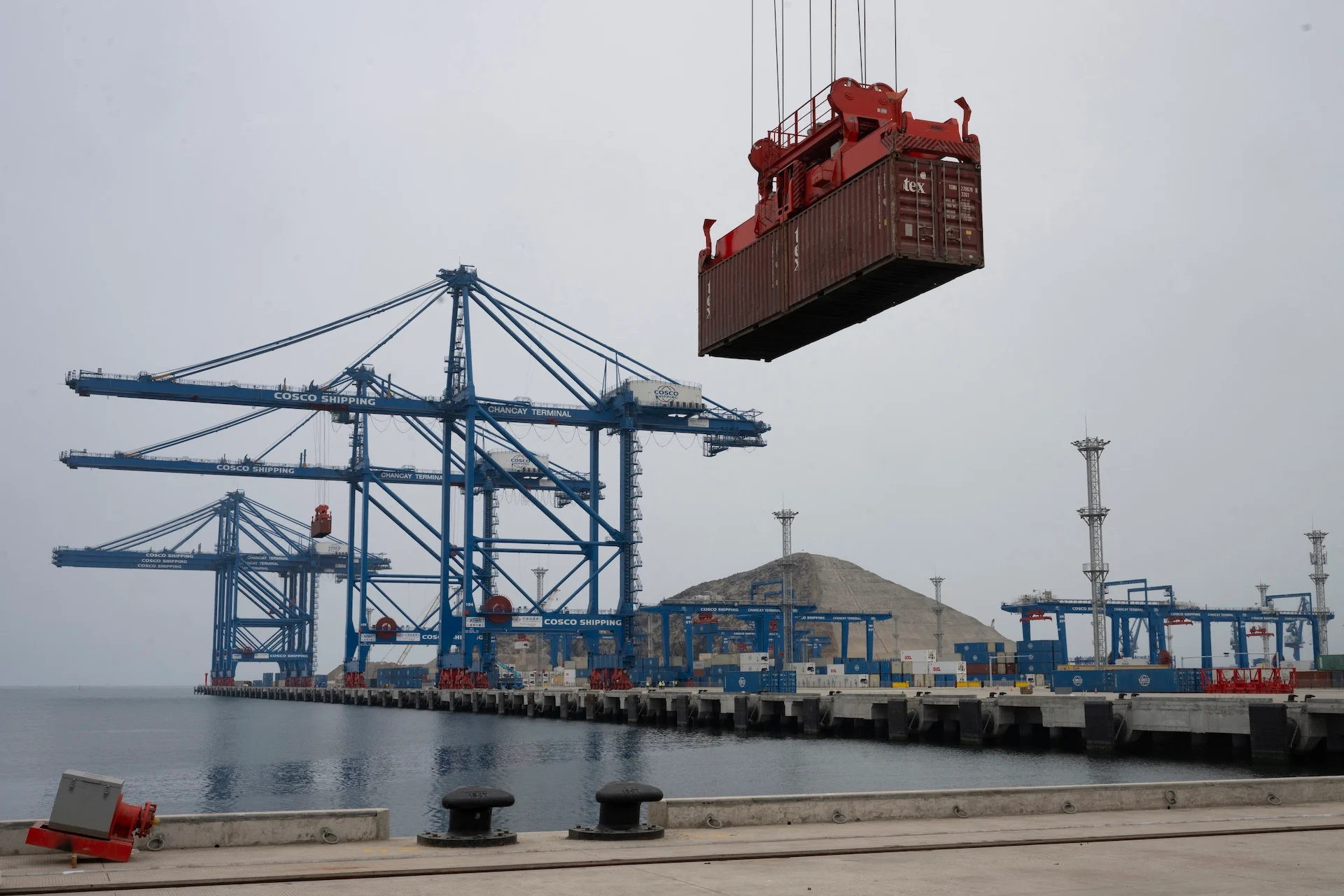
The numbers show how deep the link has become. Trade between China and Latin America passed five hundred billion dollars in 2025, the fruit of a partnership that has grown relentlessly for years.
But the balance is uneven. The region’s exports to China, worth roughly one hundred and seventy billion dollars, are dominated by commodities, while what it buys back is largely manufactured goods.
That pattern means a large share of the region’s trade income depends on two things it cannot control: the swings of global commodity prices and the strength of Chinese demand.
When either falters, export revenues can fall sharply. Moody’s says this specialisation leaves the region more exposed to outside shocks and less able to cushion them.
Not every country is equally exposed
The picture varies across the region. Moody’s judges some manufacturing bases more resilient than others, depending on how directly they compete with Chinese goods and how large their industrial sector is.
Peru, for example, is seen as broadly resilient. Only its textiles and clothing and its electrical and optical equipment look notably vulnerable, and its manufacturing sector is small enough that the wider economic hit would be limited.
Larger industrial economies face a sharper test. Countries with big steel, car or chemical sectors have more to lose when cheaper Chinese rivals arrive, because those industries employ more people and matter more to output.
The agency frames the challenge as how to keep the benefits of trade with China without deepening a dependence that limits the region’s ability to diversify its economy.
The geopolitical layer
The economic risk does not stand alone. Moody’s notes that the trade relationship is also being reshaped by geopolitics, as shifting alignments between major powers redraw the map of who trades with whom.
Latin America increasingly finds itself courted by both Washington and Beijing, each wary of the other’s influence. That rivalry can bring investment, but it can also turn trade into a tool of pressure.
Recent events have made the point vividly, from disputes over strategic ports to sudden import curbs used as leverage. Commerce and politics are increasingly hard to separate in the region.
For governments, that adds a layer of complexity. Decisions about trade and investment now carry strategic weight that goes well beyond the simple economics of buying and selling.
Why it matters for investors
For investors, the report is a reminder to look past headline growth. A region riding a commodity boom can look healthy while quietly losing the industrial base that supports long-term prosperity.
It also flags where the pressure points lie. Manufacturers exposed to Chinese competition face a tougher road, while commodity exporters remain at the mercy of prices set far beyond their borders.
The policy response will matter. Some governments are already reaching for tariffs and industrial incentives to protect or build local industry, with mixed and still-uncertain results.
The deeper question Moody‘s poses is whether Latin America can turn its China trade into lasting development, or whether the boom simply locks the region into selling raw materials for years to come.
More: Brazil news in English, every day from The Rio Times.
Frequently Asked Questions
What is the Latin America China dependence risk?
It is a double risk identified by Moody’s. Cheap Chinese manufactured goods threaten Latin America’s own factories, while the region’s exports to China are increasingly limited to raw commodities, leaving it exposed to price swings and a long-term slide away from industry.
How big is China’s trade with the region?
Trade between China and Latin America passed five hundred billion dollars in 2025. However, the region’s exports to China, worth around one hundred and seventy billion dollars, are dominated by commodities, while it imports mostly higher-value manufactured goods in return.
Which countries are most at risk?
Those with large industrial sectors that compete directly with Chinese steel, vehicles, electronics and chemicals face the sharpest pressure. Moody’s views some smaller manufacturing bases, such as Peru’s, as broadly resilient, since their limited size means a smaller overall economic impact.
Connected Coverage
Latin America Economy 2026: Growth, Tariffs and Opportunities
How a Panama Port Fight Became China’s Quiet War on Shipping
This article was produced by The Rio Times’ automated newsroom system. How we use AI · Report an error · Editorial responsibility: Matthias Camenzind, Editor-in-Chief