Key Facts
- Mexico Q1 GDP lands at midday, with economists looking for about a 1.5% quarterly bounce, which would be the fastest clip in over a year.
- Brazil’s labour-market report is seen showing unemployment near 5.5%, a multi-year low that keeps services inflation sticky as the Selic is cut from 14.25%.
- Tuesday’s regional boards were mixed: Argentina’s Merval fell 1.48% and Chile’s IPSA slid 0.77%, while the Chilean peso strengthened almost 1%.
- Brazil’s National Monetary Council meets today, adding a policy layer to the morning’s trading.
- US core PCE later this morning is the key risk: a hot number lifts the dollar and squeezes the region’s rate-sensitive currencies.
Today’s Focus
Wednesday’s session in Latin America is not about a single overnight shock but a cluster of domestic data points that will test local conviction. Mexico’s first-quarter GDP report lands at midday, with economists looking for a 1.5% quarterly bounce. That would be the fastest clip in over a year and could give the peso a tangible bid after a sleepy Tuesday session where it barely moved.
Brazil is up next with its own labour-market report. A drop in the unemployment rate to 5.5% would be the lowest in years, yet it’s a double-edged sword: a tight jobs market props up consumption but keeps services inflation sticky. That is precisely the headache for the central bank as it slowly cuts the Selic rate from 14.25%. The National Monetary Council meets today, adding a policy layer to the morning’s trading.
The regional board shows a mildly positive lead from Tuesday’s close in São Paulo and Bogotá, offset by a sharp markdown in Buenos Aires, where the Merval fell 1.48%. Chile’s IPSA also slid 0.77%, though the currency there had a stellar day, strengthening almost 1% against the dollar. The takeaway is a market that is rotating, not retreating, ahead of the data.
The global backdrop is holding steady. S&P 500 futures are little changed, and Asian shares traded without drama overnight. The real risk event is the US core PCE release later this morning: a hot number would lift the dollar and squeeze the region’s rate-sensitive currencies, while a soft print would vindicate the rate-cutting trades that have supported the Ibovespa and the peso.
What matters today. Whether Mexico’s GDP and Brazil’s unemployment figures validate the recent rally in local assets or expose them as overextended.
| Instrument | Level | Session |
|---|---|---|
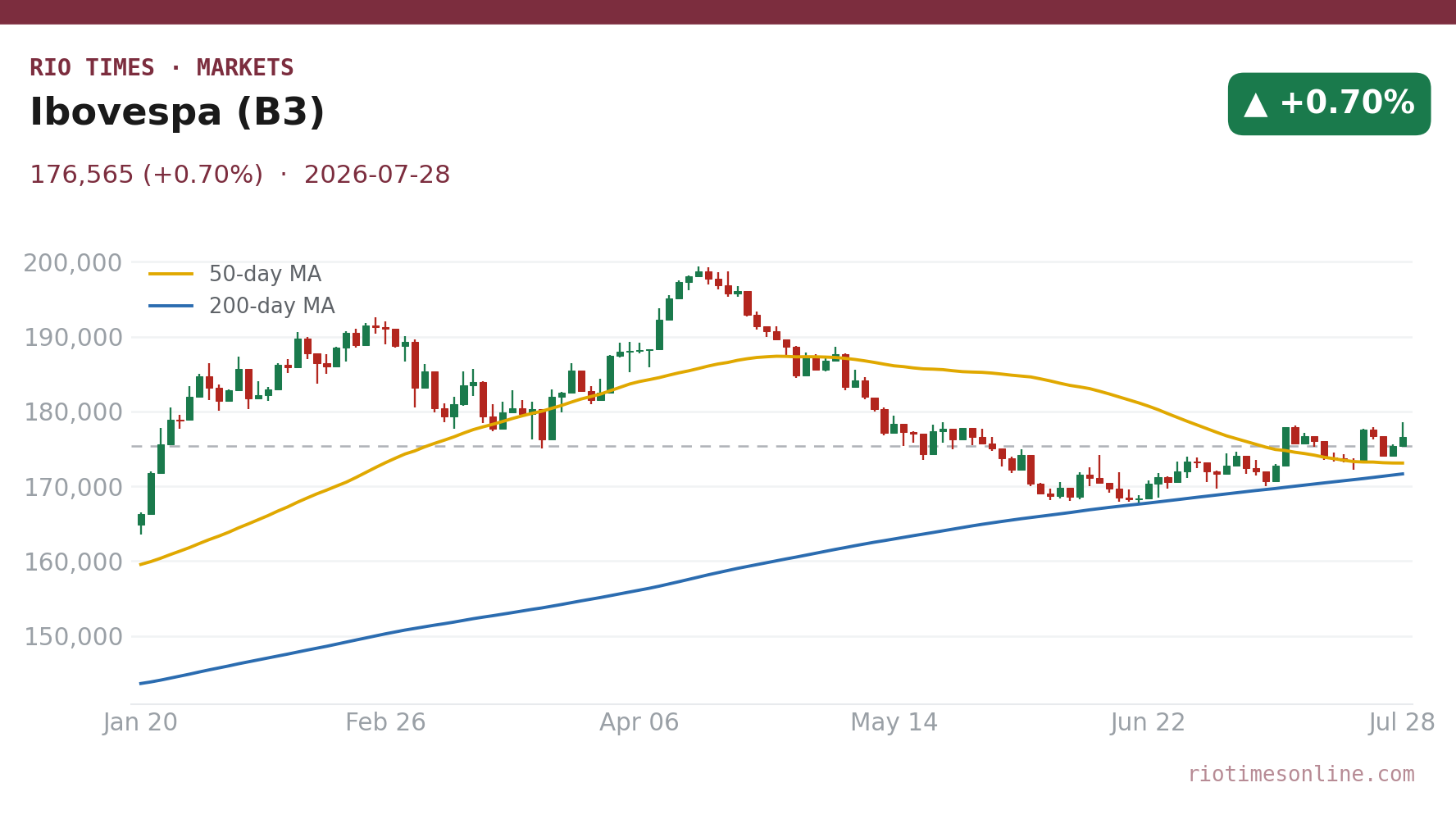
| Ibovespa (Brazil) | 176,565 | +0.70% |
| S&P 500 (US) | 7,429 | +0.21% |
| USD/BRL | 5.1212 | +0.09% |
| USD/MXN | 17.431 | -0.11% |
| USD/CLP | 930.9 | -0.95% |
| USD/COP | 3,204 | -0.39% |
| USD/ARS | 1,500 | +0.18% |
Latin American markets — Source: RT close, 2026-07-28. Figures rendered directly from the feed.
01 The overnight tape in one read
Global markets handed Latin America a steady, unhurried baton on Wednesday. Asian equities traded in narrow ranges overnight, with no major index making a move larger than half a percentage point. Japan’s Nikkei 225 was flat to slightly higher, while Chinese shares drifted without conviction. The overnight pulse is one of waiting — for the US inflation data, for Mexico’s GDP, for anything that breaks the summer calm.
European futures point to a muted open, with the Euro Stoxx 50 barely changed. The continent’s own economic narrative, of growth near 1.7% and a decelerating global backdrop, offers no fresh catalyst. Brent crude, the lifeblood of the region’s commodity exporters, held steady in the mid-$70s, offering neither a tailwind nor a headwind for Petrobras or Ecopetrol shares.
The S&P 500 closed Tuesday up 0.21%, a whisper of a gain that kept the index within touching distance of its record high. Futures in the early hours of Wednesday are essentially flat. The market is saving its energy for the 8:30 a.m. ET data dump: US GDP, jobless claims, and the core PCE deflator, the Fed’s inflation compass. That trio will set the dollar’s direction for the rest of the week.
For Latin America, this global stillness is a chance to focus on the home front. The dollar is steady against most emerging-market currencies, meaning the real, the peso, and the Chilean peso start the day from a neutral position, with local stories — BCB meetings, GDP prints, unemployment — doing the steering.
The absence of a dominant global risk-off or risk-on signal overnight leaves Latin American markets to trade on their own fundamentals. Mexico’s GDP and Brazil’s jobs data are genuine market movers, but the consensus expectations already point to solid numbers. That raises the bar for a positive surprise. The main risk is that in-line data is met with profit-taking in Mexico City and São Paulo, especially given the Ibovespa’s two-day winning streak. Watch the US core PCE as the true swing factor for currency desks across the region.
02 The board before the open
| Instrument | Level | Change | Read |
|---|---|---|---|
| Ibovespa | 176,565 | +0.70% | Two-day climb; still 11% below 52-wk high |
| S&P/BMV IPC | 67,308 | +0.18% | Modest gain, awaiting GDP catalyst |
| IPSA | 10,880 | −0.77% | Weakest regional close; CLP rallied 0.95% |
| Merval | 3,256,362 | −1.48% | Worst daily performance in LatAm |
| COLCAP | 2,301 | +0.80% | Region’s best gainer on Tuesday |
| S&P 500 | 7,429 | +0.21% | Steady; just 2.4% below all-time high |
| USD/BRL | 5.1212 | +0.09% | Real barely budged |
| USD/MXN | 17.431 | −0.11% | Peso firm into GDP release |
| USD/CLP | 930.9 | −0.95% | Biggest FX mover; peso surged |
| USD/COP | 3,204 | −0.39% | Colombian peso ticked higher |
| USD/ARS | 1,500 | +0.18% | Controlled depreciation continues |
Tuesday’s scoreboard reveals a region split down the middle. Brazil’s Ibovespa and Colombia’s COLCAP led the gainers, while Argentina’s Merval sank nearly 1.5% and Chile’s IPSA retreated 0.77%. The IPC in Mexico was barely positive, up just 0.22%, as traders held fire ahead of the GDP print.
The currency market told a different story entirely. The Chilean peso was the star performer, strengthening almost a full percentage point against the dollar, a move that hints at either hawkish local rate expectations or a sudden inflow. The Colombian peso also put in a solid shift, gaining 0.39%, while the real and the Mexican peso were largely static. The Argentine peso’s daily crawl of 0.18% remains a metronome of managed depreciation. Rio Times · Live Market Intelligence
Live Market IntelligenceLatin America — Cross-Market Board
Latin America — Cross-Market Board
Instrument Last Change YoY Prev. High Low Volume
IBOV
187,206.89
-0.56%
+21.85%
188,268.59
168,310
167,142
—
IPSA
11,220.60
-0.16%
—
11,238.58
11,210
10,984
1,513,213,483
IPC MEX
63,924.77
-0.28%
+12.17%
64,106.82
66,121
65,405
108,886,187
MERVAL
3,098,898
-1.87%
+30.51%
3,022,485
3,042,365
2,991,150
—
COLCAP
2,589.69
-1.41%
—
9.04
9.05
9.02
4,133
BVL PERÚ
59,373.28
-0.32%
—
—
—
—
—
USD/BRL
5.16
+0.01%
-5.13%
5.16
5.18
5.14
—
EUR/BRL
5.95
+1.01%
-5.83%
5.89
5.98
5.94
—
USD/MXN
17.06
-0.24%
-8.58%
17.10
17.08
17.01
—
USD/CLP
913.98
+0.04%
-5.67%
913.65
915.11
906.68
—
USD/COP
3,140
+0.03%
-22.04%
3,139
3,141
3,105
—
USD/PEN
3.36
-0.66%
-4.82%
3.38
3.38
3.35
—
USD/ARS
1,493
+0.10%
+12.96%
1,491
1,494
1,480
—
USD/UYU
40.27
+1.24%
+1.80%
39.77
40.27
40.23
—
USD/PYG
5,939
+1.68%
-19.54%
5,841
5,939
5,925
—
USD/BOB
11.64
-0.76%
+72.04%
11.73
11.72
11.64
—
USD/DOP
58.34
+1.25%
-3.44%
57.62
58.34
58.04
—
USD/CRC
445.92
+0.89%
-9.71%
441.97
448.50
445.92
—
03 What the data shows — a rotation into healthcare and value
| Stock | Move | Turnover | Note |
|---|---|---|---|
| PETR4 (Petrobras PN) | +1.2% | R$1,232m | Oil steady; heavy turnover leader |
| VALE3 (Vale ON) | +0.5% | R$927m | Iron ore stable; second in volume |
| ITUB4 (Itaú Unibanco PN) | +0.9% | R$818m | Bank sector bid; defensive rotation |
| AXIA3 (Axial Par) | +8.7% | R$665m | Surge on high volume; speculative move |
| ABEV3 (Ambev ON) | −0.3% | R$603m | Consumer staple; marginal profit-taking |
| VAMO3 (Vamos) | +5.0% | R$47m | Top gainer on lower turnover |
| HAPV3 (Hapvida) | +4.0% | R$45m | Healthcare rally continues |
| TTEN3 (Tres Tentos) | −16.0% | R$128m | Heavy sell-off; largest loser |
| VIVT3 (Telefônica Brasil) | −6.3% | R$453m | Telecoms under pressure; high volume |
| TIMS3 (TIM Brasil) | −5.8% | R$406m | Sector-wide telecom weakness |
The B3’s turnover table on Tuesday tells the story of a market that was both active and selective. Petrobras shares, ticker PETR4, drew the heaviest volume at R$1.2 billion, a clear sign that oil’s steady footing is keeping Brazil’s state-controlled oil giant at the centre of trader attention. Vale, ticker VALE3, followed with R$927 million, its iron-ore engine humming without drama.
But the real action was in the mid-cap and sector names. A brutal rotation hit telecoms: Vivo, trading as VIVT3, slumped 6.3% on heavy turnover of R$453 million, and TIM, ticker TIMS3, dropped 5.8% on R$406 million in volume. The pain was concentrated and severe. At the same time, healthcare and services rallied: Hapvida, ticker HAPV3, rose 4.0%, and Vamos, the truck rental firm trading as VAMO3, jumped 5.0%. The standout loser was agribusiness firm Tres Tentos, ticker TTEN3, which cratered 16.0% — a stock-specific event that traders will be dissecting for any read-across to the broader agri sector.
04 Brazil and the currencies
The real enters Wednesday’s session exactly where it left off, pinned near 5.12 to the dollar. That stability masks the tension underneath. Today’s IGP-M inflation print for July is expected to show a sharp deflation of -1.07%, a wholesale-price signal that could give the central bank cover to keep cutting the Selic at its next meeting. But the unemployment rate, due at the same time, is the real wild card. A figure below the 5.5% consensus would suggest the labour market is tighter than policymakers think, potentially slowing the pace of rate cuts.
The National Monetary Council, or CMN, meets today in Brasília. While it does not set the Selic — that’s the Copom’s job — it defines the inflation targets that guide monetary policy. Any hint of a target revision or a methodological tweak would ripple through the yield curve and the real instantly. The currency’s 52-week range of 4.89 to 5.59 shows just how much room there is for a move if the policy backdrop shifts.
Across the region, the peso’s post-float mirage continues. The official rate is pegged near 1,500 to the dollar, but the parallel market rate tells a different story of chronic excess demand for dollars. In Chile, the peso’s near-1% rally on Tuesday was the region’s standout FX move, carving a path below 931 to the dollar. It’s a move that suggests either portfolio inflows or a hawkish repricing of local rate expectations. The Colombian peso’s 0.39% gain is gentler but points in the same direction: an Andean FX market that is attracting, not repelling, capital.
05 The regional setup
| Index | Country | Change |
|---|---|---|
| Ibovespa | Brazil | +0.70% |
| S&P/BMV IPC | Mexico | +0.22% |
| IPSA | Chile | −0.77% |
| Merval | Argentina | −1.48% |
| COLCAP | Colombia | +0.80% |
The Latin American equity board is a mosaic of local stories rather than a single regional theme. Colombia’s COLCAP was the session’s winner, gaining 0.80% as business sentiment data out today is expected to show a further improvement from -2.9 to -2.2. That’s still negative territory, but the direction of travel is what matters for a market that has been starved of good news.
Mexico’s IPC, the Mexbol, is the index to watch today. Its barely-there 0.22% gain on Tuesday feels like a placeholder ahead of the GDP release. A quarterly growth rate of 1.5% would be the strongest in over a year and could validate the peso’s current firmness near 17.43 to the dollar. Chile’s IPSA, down 0.77%, is the outlier to the downside, but its loss came with a sharply stronger peso — a combination that often points to a rotation out of export-heavy large-caps and into rate-sensitive domestic plays. Argentina’s Merval remains a volatility machine, its 1.48% drop a reminder that high nominal returns come with equally high daily swings.
06 The technical picture
The Ibovespa’s two-day winning streak has lifted the index to 176,565, but it remains 11.1% below its 52-week high of 198,657. That gap is the bull’s target and the bear’s evidence — the market has spent months unable to challenge its own ceiling. The first level to watch on the upside is 179,000, a threshold that has capped rallies since May. On the downside, 174,000, the July swing low, is the line in the sand.
Mexico’s IPC is in a tighter range, sitting 6.0% below its 52-week high of 71,601, with a clear floor at its 52-week low of 60,774. The GDP print could be the catalyst that pushes it back toward the 70,000 handle, a psychologically important level for local retail and institutional traders alike. Chile’s IPSA, at 10,880, is mid-range and drifting; it lacks momentum in either direction, which makes it vulnerable to a sharp move on any surprise from the US data.
The S&P 500’s technicals are the region’s quiet anchor. At 7,429, it is just 2.4% below its all-time high of 7,610. A break above that level would be a powerful risk-on signal for all emerging markets, while a rejection could trigger the kind of correlated sell-off that spares no Latin American bourse.
07 What to watch
- Mexico’s GDP (12:00 BRT): The 1.5% quarterly print is the consensus; anything north of 1.8% could send the IPC and the peso sharply higher, while a miss below 1.0% would revive fears of a deeper slowdown.
- Brazil’s unemployment and IGP-M (11:00-12:00 BRT): A jobless rate below 5.5% and a deflationary IGP-M would create a confusing signal for the central bank — strong domestic demand alongside falling wholesale prices.
- US core PCE (08:30 ET): The global rates anchor. A print above the 3.5% estimate would lift the dollar and hurt the real and the peso; a soft number would validate the EM carry trade.
- Telecoms sector spillover: After Tuesday’s 5-6% drops in Vivo and TIM on heavy volume, watch for contagion to other Brazilian utilities or a snap-back bid from bargain hunters.
Frequently Asked Questions
Why did the Chilean peso rally so much on Tuesday while the IPSA fell?
A sharply stronger peso often hurts the IPSA because the index is packed with exporters who earn in dollars. The peso’s 0.95% gain likely reflected local rate expectations or portfolio inflows, not equity-market sentiment.
What’s at stake in Brazil’s CMN meeting today?
The National Monetary Council sets the inflation target. While it does not change the Selic, any shift in the target band or methodology would immediately move the real and the long end of the yield curve.
Why did telecoms stocks Vivo and TIM crash?
There was no single public catalyst on Tuesday, but the heavy turnover suggests institutional selling. Traders should watch for any sector-wide regulatory news or a broker downgrade hitting the wires.
How exposed is the region to today’s US core PCE?
Directly. Latin American currencies and equities have rallied in 2026 partly on the expectation of Fed cuts. A hot core PCE print — above the 3.5% forecast — would challenge that narrative and could trigger a swift dollar bid against the real, the peso, and the Chilean peso.
This article was produced by The Rio Times’ automated newsroom system. How we use AI · Report an error
LatAm Markets: Live Signals → — real-time movers, turnover leaders and FX across Latin America.
Read More from The Rio Times