Today’s Focus
The broad dollar weakened overnight, pushing the euro to 1.1423 and the British pound to 1.3386, and that softer greenback is the main engine for Latin American assets this morning. It reinforces the global carry trade — where investors borrow in low-yielding currencies to buy higher-yielding ones — which has been the region’s most reliable tailwind all month. Brazil’s real, Mexico’s peso and Colombia’s peso all start the day in the strong half of their yearly ranges.
The mood got an extra lift from Asia, where Chinese equities led a region-wide rally. Shanghai gained 1.4% and Hong Kong’s Hang Seng added half a percent, responding to fresh signs of stabilisation in the world’s second-largest economy. That matters for Latin America because China is the biggest customer for the copper, iron ore and soybeans the region exports, so any pulse of Chinese demand quickly feeds into local equities and currencies.
Colombia is today’s local wildcard, with GDP, economic activity and trade figures all landing before lunchtime. The Colombian peso has already appreciated sharply over the past year — the dollar is down roughly 15% against it — and fresh data will test whether the rally still has legs. Argentina also reports economic activity later, giving the Merval and the peso a domestic catalyst of their own.
What matters today. Whether the softer dollar and Asian optimism are enough to keep Latin America’s carry trade rally going through a session heavy with Colombian and Argentine data.
| Instrument | Level | Session |
|---|---|---|
| Ibovespa (Brazil) | 173,371 | -0.20% |
| S&P 500 (US) | 7,443 | -0.19% |
| USD/BRL | 5.0901 | -0.41% |
| USD/MXN | 17.4299 | -0.61% |
| USD/CLP | 934.5 | -0.05% |
| USD/COP | 3,269 | +0.35% |
| USD/ARS | 1,482 | +0.20% |
Source: market close, 20 July 2026.
Key Facts
- A softer dollar sets the tone — the euro reached 1.1423 and sterling 1.3386 overnight, and a weaker dollar is the main support for Latin American currencies and shares this morning
- China is buying again — Shanghai rose 1.4% to 3,967.13 and Hong Kong’s Hang Seng 0.5%, which matters because China is the biggest customer for the region’s copper, iron ore and soybeans
- Colombia is the day’s test — GDP, economic activity and trade figures all land before lunchtime, and will show whether the peso’s roughly 15% rise against the dollar over the past year still has room to run
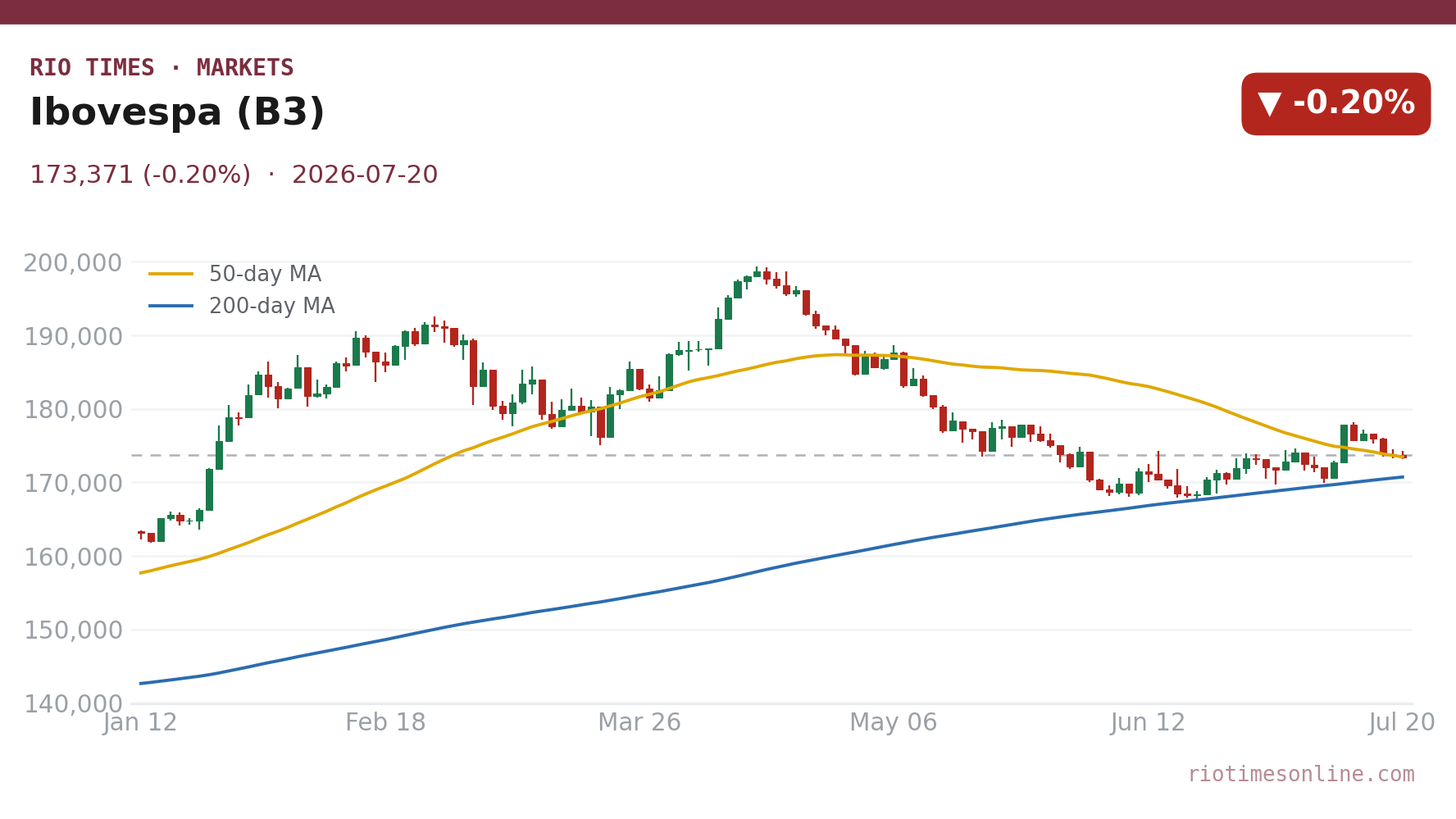
- Monday closed soft — the Ibovespa slipped 0.20% to 173,371.35 and the S&P 500 0.19% to 7,443.28, so the region opens from a flat base rather than a rally
01 The overnight tape in one read
Global equities set a friendly table for Latin American markets entering Tuesday’s session. In Asia, China’s Shanghai Composite climbed 1.4% to 3,967.13, the session’s standout, after economic signals pointed to a gradual demand recovery. Japan’s Nikkei 225 added 0.7%, South Korea’s Kospi matched that gain, and Hong Kong’s Hang Seng Index rose 0.5% to 24,340.73.
European trading was quieter but still positive. London’s FTSE 100 edged up 0.3% to 10,529.39, while Paris’s CAC 40 was effectively flat. The real action was in currencies, where the euro strengthened to 1.1423 dollars and sterling climbed to 1.3386.
The dollar’s softness is the thread connecting all of this. It slipped against the yen to 162.18 and weakened across the board, as US interest-rate expectations cooled. US futures suggest Wall Street will open modestly higher, extending Monday’s session where the Nasdaq led with a 0.9% gain to 26,107.01 and the S&P 500 added 0.4%.
For emerging markets, and Latin America in particular, a weaker dollar lowers the bar for everything else to go right. It makes the real’s 14.25% Selic yield, the Mexican peso’s high local rates and the Colombian peso’s carry appeal even more attractive to global investors.
The external setup is constructive. US futures are pointing slightly higher after the S&P 500 closed at 7,543.59 on Monday, Europe’s FTSE 100 gained 0.3% and Asian indices rose across the board. Oil prices are cooperating too — not spikey enough to frighten importers, not weak enough to punish producers. The dollar’s soft tone is unambiguous support for the whole region’s currencies and equities. But the day’s real test comes from Colombia’s economic figures. A strong GDP print could supercharge the peso and the COLCAP, while a miss might trigger the kind of quick profit-taking that concentrated carry trades are prone to. Watch the Colombian data, then watch how fast it ripples through Mexico City and São Paulo.
02 The board before the open
| Instrument | Level | Change | Read |
|---|---|---|---|
| S&P 500 | 7,543.59 | +0.4% | US large-cap equities — constructive lead |
| Shanghai Comp | 3,967.13 | +1.4% | China demand signal — key for LatAm commodities |
| FTSE 100 | 10,529.39 | +0.3% | European risk appetite stable |
| EUR/USD | 1.1423 | +0.4% | Dollar softness — broad tailwind for EM FX |
| Oil (WTI) | ~US$68 | — | Stable crude — neutral-to-positive for the region |
The pre-open board shows a synchronised global risk-on tilt, modest in size but consistent across geographies. The Shanghai Composite’s 1.4% surge is the most consequential single number for Latin America, because Chinese economic health is a direct driver of demand for copper from Chile, iron ore from Brazil and oil from Colombia and Mexico.
The euro’s push above 1.14 is equally important. A weaker dollar is practically rocket fuel for Latin American currencies, all of which are priced against it. When the greenback falls, the real, peso and sol tend to rise, sometimes faster than the dollar’s decline because local interest rates are so much higher than those in the developed world. Rio Times · Live Market Intelligence
Live Market IntelligenceLatin America — Cross-Market Board
Latin America — Cross-Market Board
Instrument Last Change YoY Prev. High Low Volume
IBOV
206,495.23
-0.86%
+21.85%
208,295.98
168,310
167,142
—
IPSA
10,985.55
+0.54%
—
10,926.50
11,210
10,984
1,513,213,483
IPC MEX
70,249.54
+1.43%
+12.17%
69,258.58
66,121
65,405
108,886,187
MERVAL
3,017,221
—
+30.51%
3,022,485
3,042,365
2,991,150
—
COLCAP
2,560.37
+1.07%
—
9.04
9.05
9.02
4,133
BVL PERÚ
59,870.67
-0.52%
—
—
—
—
—
USD/BRL
5.16
+0.01%
-5.13%
5.16
5.18
5.14
—
EUR/BRL
5.95
+1.01%
-5.83%
5.89
5.98
5.94
—
USD/MXN
17.06
-0.24%
-8.58%
17.10
17.08
17.01
—
USD/CLP
913.98
+0.04%
-5.67%
913.65
915.11
906.68
—
USD/COP
3,140
+0.03%
-22.04%
3,139
3,141
3,105
—
USD/PEN
3.36
-0.66%
-4.82%
3.38
3.38
3.35
—
USD/ARS
1,493
+0.10%
+12.96%
1,491
1,494
1,480
—
USD/UYU
40.27
+1.24%
+1.80%
39.77
40.27
40.23
—
USD/PYG
5,939
+1.68%
-19.54%
5,841
5,939
5,925
—
USD/BOB
11.64
-0.76%
+72.04%
11.73
11.72
11.64
—
USD/DOP
58.34
+1.25%
-3.44%
57.62
58.34
58.04
—
USD/CRC
445.92
+0.89%
-9.71%
441.97
448.50
445.92
—
03 What the data shows — B3 turnover concentrates in the usual giants
| Stock | Move | Turnover | Note |
|---|---|---|---|
| PETR4 | — | R$1,109m | Petrobras preferred — session’s liquidity champion |
| VALE3 | — | R$942m | Vale — still the iron-ore bellwether |
| CVCB3 | -11.5% | R$31m | CVC Brasil — steepest fall, light turnover |
| CASH3 | +5.1% | R$50m | Méliuz — top gainer, modest volume |
| BRAV3 | +2.1% | R$123m | Brava Energia — solid gain on decent flow |
Monday’s B3 session did not produce a single unifying narrative but it did reinforce the hierarchy of Brazilian liquidity. Petrobras preferred shares, known locally by the ticker PETR4, dominated turnover with R$1.1 billion changing hands, followed by mining giant Vale at R$942 million. These two names remain the most reliable barometers of foreign sentiment toward Brazil because they are the easiest for overseas investors to buy and sell.
The outliers were dramatic but thin. Travel operator CVC Brasil tumbled 11.5 per cent, yet only R$31 million in shares traded, suggesting a seller met a shallow order book rather than a fundamental reassessment. On the upside, cashback firm Méliuz jumped 5.1 per cent on R$50 million in turnover — a similar story of a small-cap move that says more about liquidity than conviction. The absence of large, broad-based institutional flows is consistent with investors waiting for clearer macro signals.
04 Brazil and the currencies
The Brazilian real begins Tuesday on firm ground, with the dollar quoted at 5.0901 reais in the latest session, a decline of 0.41 per cent. That keeps the real solidly in the strong half of its 52-week range, roughly 8.9 per cent below its weakest point, and the explanation is straightforward. Brazil’s Selic base rate of 14.25 per cent is among the highest real interest rates in any major economy, and global investors are being paid handsomely to hold reais.
Foreign flows confirm the story. Brazil attracted US$6.6 billion in net inflows through mid-February, reversing 2025’s record US$33.3 billion exit, with the financial channel accounting for US$6 billion of that. The carry trade maths are compelling: borrow in yen at near-zero or euros at declining rates, buy Brazilian bonds yielding 14.25 per cent, and pocket the difference — made even sweeter when the real strengthens against the funding currency.
The Mexican peso is playing a similar tune. At 17.4299 per dollar, down 0.61 per cent on the session, the peso is trading firmly in the strong half of its range, supported by Banxico’s relatively high rates and the softer dollar. The Chilean peso barely moved at 934.5 per dollar, while the Colombian peso weakened fractionally to 3,269 per dollar ahead of today’s data deluge — a tiny 0.35 per cent move that looks like position-squaring rather than a trend change.
Argentina’s peso continues its managed drift, at 1,482 per dollar, a 0.20 per cent move. The Argentine currency does not participate in the carry trade the way its regional peers do, because capital controls and a tightly managed exchange rate limit foreign participation. Instead, Argentine risk appetite shows up on the Merval equity index, where domestic investors hedge inflation by buying shares.
05 The regional setup
| Index | Country | Change |
|---|---|---|
| Merval | Argentina | +0.74% |
| IPSA | Chile | +0.10% |
| Ibovespa | Brazil | -0.20% |
| IPC (Mexbol) | Mexico | -0.74% |
| COLCAP | Colombia | +0.00% |
Monday’s session delivered a split regional picture that should begin to converge at Tuesday’s open. Argentina’s Merval led with a 0.74 per cent gain, a continuation of its role as the region’s inflation-hedge vehicle, while Chile’s IPSA crept up 0.10 per cent in quiet trading. Brazil’s Ibovespa slipped 0.20 per cent — its fourth consecutive down day — while Mexico’s IPC gave back 0.74 per cent, underperforming on what was otherwise a benign global day.
The Colombian COLCAP was precisely flat, which makes it the session’s most telling number. Investors in Bogotá are on hold until today’s GDP and trade figures land, after which the index is likely to move sharply in one direction. Colombia’s market has been a regional darling, with a COLCAP that jumped 4.48 per cent in a single May session and a peso that has appreciated roughly 15 per cent against the dollar over the past year. High expectations mean high risk of disappointment.
The common factor across all five boards is that none of Monday’s moves were large enough to signal a genuine shift in conviction. They look like position-tidying ahead of the week’s main events: Colombian data today, US oil inventories tomorrow, and the steady drumbeat of central bank commentary from Brasília, Mexico City and Santiago.
06 The technical picture
The Ibovespa’s four-day losing streak has brought it to 173,371, roughly 12.7 per cent below its 52-week high of 198,657. That is deep enough to start attracting value-oriented buyers but not yet at a level that screams capitulation. The 52-week range floor sits at 132,129, far below current levels, so the index is in a technical no-man’s-land — well off the highs but not at obvious support.
Mexico’s IPC at 66,123 is 7.7 per cent below its own 52-week peak of 71,601, a narrower but persistent discount that reflects investor caution around North American trade policy and domestic political noise. The US S&P 500 at 7,443 is a mere 2.2 per cent off its high, a tight range that has provided little directional inspiration for Latin American equities.
On the currency side, the dollar-real rate of 5.0901 is comfortably below the 5.5901 high and above the 4.8909 low, giving the real room to run in either direction. A sustained break below 5.00 would be a powerful bullish signal for Brazilian assets across the board. For now, the technical message across the region is one of consolidation — markets that have already priced in much of the good news on rates and the dollar, and are waiting for the next catalyst.
07 What to watch
- Colombia GDP and trade data: The numbers land mid-session and will set the tone for the COLCAP and the Colombian peso; a strong print could lift the whole Andean region’s risk appetite.
- Brazil’s 4-day Ibovespa slide: Another down day would make it five straight, which is rare enough to attract bargain-hunters or trigger stop-losses depending on the opening tone.
- US dollar index trajectory: The euro’s push above 1.14 suggests the dollar is still weakening; if that continues through the US session, expect all Latin American currencies to firm into the close.
- Argentina economic activity report: Due at 19:00 local time, the reading provides a check on whether the Merval’s strong run is backed by activity data or pure inflation hedging.
Frequently Asked Questions
What is the carry trade and why does it matter for Latin America?
The carry trade is when investors borrow in a low-interest-rate currency, like the yen or euro, and invest in a high-interest-rate currency, like the Brazilian real or Mexican peso. Latin America benefits because its central banks have kept rates high to fight inflation, making local bonds and currencies extremely attractive to global yield-seekers.
Why did the Ibovespa fall four days in a row?
The four-day dip looks like profit-taking and position-squaring after a strong run, not a fundamental shift. The index remains well off its April highs of 198,657, and with the Selic at 14.25 per cent and foreign flows positive, the backdrop for Brazilian equities is still supportive.
What do Colombia’s GDP numbers mean for regional markets?
Colombia has been a top performer in Latin America, with the COLCAP and the peso both rallying sharply. If GDP comes in strong, it validates those gains and could lift sentiment across the region. A miss could trigger a sharp reversal in the peso and the Bogotá exchange.
How does China’s stock market affect Latin America?
China is the largest buyer of Latin American commodities — copper from Chile and Peru, iron ore from Brazil, soybeans from Argentina. When Chinese equities rally, as the Shanghai Composite did overnight, it signals that investors expect stronger Chinese demand, which feeds directly into Latin American export earnings and stock prices.
This article was produced by The Rio Times’ automated newsroom system. How we use AI · Report an error · Editorial responsibility: Matthias Camenzind, Editor-in-Chief
LatAm Markets: Live Signals → — real-time movers, turnover leaders and FX across Latin America.