Julio Le Parc’s Tate Show Opens Weeks After the Artist’s Death
Culture
Key Facts
A dazzling Julio Le Parc Tate Modern retrospective has opened in London just weeks after the Argentine master of light and movement died in Paris, turning what was meant as a celebration into a farewell.
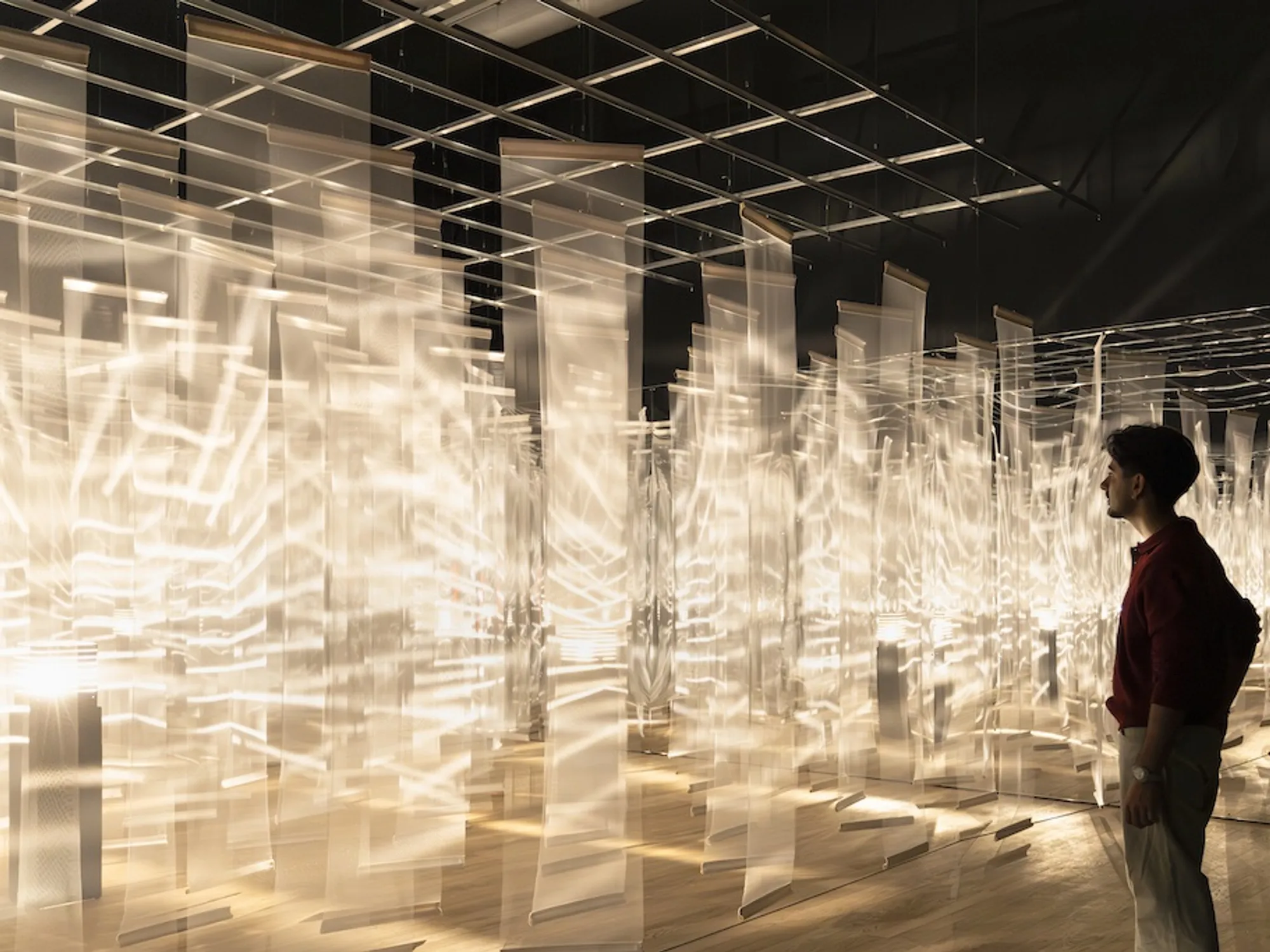
Tate Modern has opened a major retrospective of Julio Le Parc, one of the most influential figures in kinetic and optical art. The show runs from the eleventh of June into next May.
It arrives with an unexpected weight. Le Parc died in Paris on the thirtieth of May, at the age of ninety-seven, only days before the opening he had worked toward and hoped to see.
The exhibition was built in close partnership with the artist and his studio. What was planned as a living tribute has become a final encounter with his life’s work.
What the Julio Le Parc Tate Modern show puts on display
The show gathers more than sixty works across seven decades. It traces his path from a young painter in Argentina to a fixture of the Paris art scene he joined in the late nineteen-fifties.
The heart of it is the light. Spotlights, mirrors and moving parts throw shifting patterns across the rooms, and several works respond directly to the people walking past them.
One suspended piece, a cloud of translucent blue discs called Blue Sphere, breaks apart as you approach. From a distance it reads as a glowing planet; up close it dissolves into fragments.
Early rooms hold his black-and-white geometric studies, patterns that seem to rotate or flicker on the wall. Some even leave an afterimage on the eye, so the viewer finishes the work simply by looking.
Art you play rather than admire
Le Parc’s central idea was simple and radical. He wanted art to be experienced rather than observed, and he treated the visitor as a collaborator instead of a spectator.
That makes the show unusually easy to enjoy. You do not need to know the art theory of nineteen-sixties Paris to feel the surprise of a moving reflection or a vibrating pattern.
There are rooms where visitors press buttons, move parts and play. He called his goal a more democratic art, something anyone could walk into and enjoy without instruction.
That belief had roots in a group he helped found in Paris in nineteen-sixty, a collective of artists set on dissolving the gap between the artwork and the person standing before it. They wanted art off its pedestal.
The Tate show leans into that history with its Game Room installations from the mid-sixties, pieces designed to be handled rather than guarded. It is a striking thing to see in a major museum.
For a reader in London, that directness is the appeal. The intellectual argument is there, but it reaches you through the senses first, which is rare for a museum retrospective.
A Latin American artist at the centre, not the edge
Born in the wine region of Mendoza in nineteen-twenty-eight, Le Parc moved to Paris in nineteen-fifty-eight and helped found a collective devoted to optical and kinetic experiments.
He won the grand prize for painting at the Venice Biennale in nineteen-sixty-six, a high point that placed a Latin American artist at the front of a European avant-garde.
His influence runs straight to the present. The crowd-pleasing light and mirror installations that fill museums today owe a clear debt to the path he opened decades ago.
The Tate show is part of a wider moment for the region’s artists, who are moving from the margins of the global art world to its centre. Le Parc was there early.
When does the Julio Le Parc Tate Modern exhibition run?
“Julio Le Parc: Light, Colour, Action” runs at Tate Modern in London from the eleventh of June, 2026 until the third of May, 2027. It is open daily, with late hours on Fridays and Saturdays.
Why is the show described as poignant?
Le Parc helped plan the retrospective with his studio but died in Paris on the thirtieth of May, at ninety-seven, just days before it opened. A celebration of his career became a farewell instead.
What kind of art did Le Parc make?
He was a leading figure in kinetic and optical art, using light, mirrors, colour and movement to create immersive works. Many change as the viewer moves, turning the audience into part of the piece.
More: Argentina news in English, every day from The Rio Times.
Frequently Asked Questions
When does the Julio Le Parc retrospective run at Tate Modern and how large is it?
The exhibition 'Julio Le Parc: Light, Colour, Action' runs at Tate Modern in London from June 11, 2026 to May 3, 2027. It brings together more than 60 works spanning a seven-decade career, from the late 1950s to the 2020s.
Why does the Tate Modern retrospective carry unexpected emotional weight?
Le Parc died in Paris on May 30, 2026, at age 97, just days before the opening he had hoped to attend. The exhibition was built in close partnership with the artist and his studio, meaning what was planned as a living tribute became a farewell to his life's work.
Is there anything at Tate Modern beyond the main retrospective galleries?
Yes, a newly made 2026 light mobile hangs in the entrance hall of the museum's Blavatnik building, separate from the main show itself. This fresh commission was created specifically for the occasion.
Connected Coverage
Julio Le Parc, Argentine Master of Kinetic Art, Dies at 97
Latin American Art Is Having Its Moment, at Auction and in Museums
This article was produced by The Rio Times’ automated newsroom system. How we use AI · Report an error
Read More from The Rio Times