IPC Hits Record Highs as Banxico Pauses Rate Cuts Amid Peso Pullback
Mexico’s benchmark S&P/BMV IPC index surged to fresh all-time highs this week, topping 68,858 points, even as the peso gave back part of January’s sharp gains following the nomination of Kevin Warsh as the next Federal Reserve chair and Banco de México’s decision to pause its easing cycle at 7.00%.
Key Market Data
| Indicator | Value | Change |
|---|---|---|
| S&P/BMV IPC Index | 68,858.28 | +1.86% (weekly) |
| IPC All-Time High | 70,150.32 | Intraday record |
| USD/MXN Spot | 17.4288 | +0.38% (daily) |
| USD/MXN Weekly Range | 17.1279 – 17.5297 | — |
| Banxico Policy Rate | 7.00% | Unchanged (Feb 5) |
| Headline Inflation (mid-Jan) | 3.77% | Down from 3.80% |
| Core Inflation | 4.47% | Up from 4.43% |
| IPC YTD Performance | +33.74% | 12-month return |
| 52-Week USD/MXN Range | 17.1099 – 21.0880 | -14.69% YoY |
Performance Analysis
The Mexican equity market delivered another stellar week, with the IPC index climbing 1.86% to close near 68,858 points — within striking distance of the intraday record at 70,150 registered during the session.
The rally extends a remarkable run that has seen the benchmark gain over 33% in the past twelve months, propelled by a combination of resilient corporate earnings, nearshoring-driven optimism, and favorable carry trade dynamics that have attracted foreign capital into peso-denominated assets.
Industrials and consumer sectors led the advance, with Grupo México surging 7.70% to 209.00 pesos earlier in the week, followed by Pinfra and Arca Continental posting gains above 5%.
Mining heavyweight Industrias Peñoles remained the index’s top annual performer with a staggering 267% yearly gain, reflecting elevated precious metals prices.
On the downside, Grupo Televisa continued its structural decline, shedding 3.23%, while Genomma Lab lost 1.73%. The breadth was constructive, with advancers outnumbering decliners 136 to 122 on the exchange.
Key Drivers
The dominant macro event of the week was Banxico‘s unanimous decision on February 5 to hold its benchmark rate at 7.00%, pausing the easing cycle that had delivered twelve consecutive cuts totaling 300 basis points since March 2024.

The central bank cited persistent core inflation — stubbornly above 4% — as the primary justification, while pushing back its convergence timeline to the 3% target from Q3 2026 to Q2 2027.
The decision was widely anticipated by all 27 economists surveyed by Bloomberg and reinforces expectations that Banxico will remain on the sidelines through at least March before reassessing.
Externally, the nomination of Kevin Warsh as the next Federal Reserve chair triggered a sharp recalibration across global markets.
The dollar strengthened as markets interpreted the pick as supportive of Fed credibility and potentially hawkish on the balance sheet, lifting U.S. yields and raising the opportunity cost of holding emerging market positions.
The peso weakened past 17.40 per dollar after touching a best-of-year level near 17.11 on January 29, as carry trade unwinding and heavy profit-taking amplified the correction.
The U.S. government’s partial shutdown added noise by suspending key labor data releases. Domestically, Mexico’s GDP grew 0.7% in 2025, with a Q4 rebound following the Q3 contraction, though the recovery remains modest by historical standards.
Technical Outlook
| Level | IPC Index | USD/MXN |
|---|---|---|
| Resistance 2 | 70,150 (ATH) | 17.53 (weekly high) |
| Resistance 1 | 68,858 (current) | 17.47 (Bollinger mid) |
| Current Price | 68,858 | 17.4288 |
| Support 1 | 67,142 (20-DMA) | 17.33 (recent low) |
| Support 2 | 65,262 (50-DMA) | 17.11 (2026 low) |
The IPC trades well above all major moving averages on both daily and weekly timeframes, with the RSI at 66.63 on the daily chart — approaching overbought territory but not yet signaling exhaustion.
The weekly RSI at 70.33 warrants attention as the index tests record levels. The MACD histogram on the weekly chart shows strong positive momentum at 2,417 points, reinforcing the bullish structure.
On the daily chart, Bollinger Bands are expanding upward, confirming the trend’s acceleration. The key risk is a pullback toward the 20-day moving average near 67,142 if profit-taking intensifies.
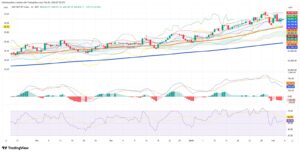
For USD/MXN, the pair remains within a well-defined bearish channel on the daily and 4-hour charts. The recent bounce from 17.11 has carried the rate back toward the 17.40–17.50 resistance zone, where the Ichimoku cloud and 50-day moving average converge.
The daily RSI at 43.60 shows neutral-to-bearish conditions, while the 4-hour RSI has recovered to 55.88, suggesting the corrective bounce may have further room.
A sustained break above 17.53 would challenge the broader downtrend, while a failure to hold above 17.40 could reignite selling toward the 17.10–17.15 support area.
Analyst Perspectives
“Banxico’s pause was the right call given core inflation persistence, but the window for resumed cuts remains open,” said Carlos Capistran, Head of Mexico and Canada Economics at Bank of America.
The bank recently raised its 2026 GDP forecast to 1.5% from 1.2%, citing a stronger-than-expected end to 2025 and a potential FIFA World Cup boost.
Bank of America projects 100 basis points of total cuts in 2026, with easing resuming at alternating meetings after February.
Vanguard’s research team projects the peso ending 2026 in a range of 18.0 to 18.5 per dollar, noting that while nearshoring trends and carry trade dynamics remain supportive, the narrowing rate differential and modest growth trajectory will gradually erode the “superpeso” narrative.
BBVA Research expects a gradual improvement in economic activity in 2026, forecasting 1.2% GDP growth, with consumption recovering progressively while investment remains the weakest link until uncertainty dissipates.
Looking Ahead
Markets will be closely watching several key dates and events in the coming weeks. The next Banxico monetary policy decision is scheduled for March 26, where the board will reassess inflation dynamics and the feasibility of resuming the easing cycle.
Mexico’s January inflation data, due in the coming days, will be critical in gauging the impact of the IEPS tax hikes and minimum wage increases that took effect at the start of the year.
The Federal Reserve’s next meeting on March 18 will provide further clarity on the U.S. rate path, with markets currently pricing two cuts for 2026.
Meanwhile, developments around USMCA compliance and the approaching 2026 review process remain an overhang for trade-exposed sectors.
Mexico’s 2026–2030 infrastructure investment plan, totaling 5.6 trillion pesos through public-private partnerships across energy, railways, and ports, could provide additional catalysts for the equity market if execution materializes.
Mexico’s equity market continues to defy skeptics with record-setting rallies, but the peso’s recent wobble and Banxico’s cautious pivot signal that the path forward will require navigating between persistent inflation, external rate pressures, and a modest domestic growth recovery.
Related coverage: Brazil’s Morning Call | Ibovespa Holds Near Record as Earnings Season Splits Brazili This is part of The Rio Times’ daily coverage of Latin American news and financial markets.
Key Facts
— Deep Dive
— For the complete picture, read our in-depth guide: Mexico Economy 2026: GDP, Peso, Nearshoring, Banxico and Trade
This article was produced by The Rio Times’ automated newsroom system. How we use AI · Report an error · Editorial responsibility: Matthias Camenzind, Editor-in-Chief
Read More from The Rio Times