Diplomacy
Key Facts
—The claim. Ambassador Yang Yang says Chinese direct investment reached $10.6bn in 2024, from $256m in 2019.
—The problem. UNCTAD records total inflows to Guyana from all sources in 2024 at $8.3bn.
—The scale. The Chinese figure equals roughly two-fifths of Guyana’s entire annual economic output.
—The oil stake. China’s largest asset is CNOOC’s quarter share of the Exxon-operated Stabroek Block.
—The contradiction. CNOOC’s own filings record no capital contributed to that block in 2024 or 2025.
—The trade. Two-way trade did hold up, reaching $2.89bn in 2025, roughly double the year before.
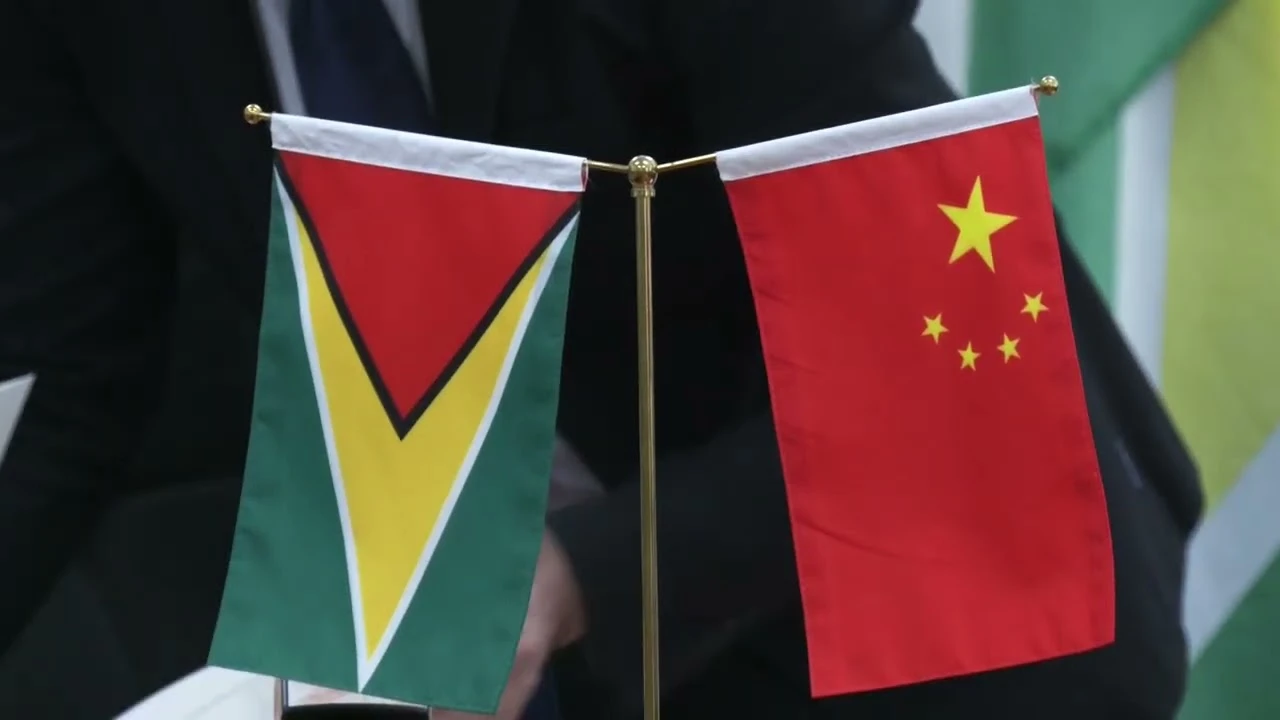
Officials in Georgetown gathered this week to celebrate the Guyana China partnership. The speeches were warm, and one of the numbers behind them does not survive contact with the arithmetic.
The occasion was a seminar marking the hundred and fifth anniversary of the founding of the Chinese Communist Party, held alongside Guyana’s sixtieth year of independence. Public works minister Juan Edghill spoke of old friends who stood by the country before the oil came.
Ambassador Yang Yang answered in kind, offering cooperation in governance, poverty reduction, party-building and the digital economy. Edghill noted Guyana is running more than twelve thousand projects nationwide.
None of that is the interesting part.
The Guyana China investment number that will not add up
Last year the ambassador told an audience in Georgetown that Chinese direct investment in Guyana had risen from two hundred and fifty-six million dollars in 2019 to ten point six billion in 2024. She called it a fortyfold increase, and the multiplication is sound.
The trouble is what independent statisticians recorded that year. The United Nations trade body puts Guyana’s total foreign direct investment inflows in 2024, from every country and every company on earth, at eight point three billion dollars.
One country cannot supply more than the whole. The gap is more than two billion dollars, and no reconciliation has been offered.
Consider the scale another way. Guyana’s economy is worth somewhere near twenty-five billion dollars a year, so the Chinese figure would represent about two-fifths of national output arriving from a single source in twelve months.
A history that makes it stranger
Chinese investment in Guyana was, until very recently, modest. Figures compiled by the Inter-American Development Bank from Chinese government data put the accumulated stock at about a hundred and thirty-five million dollars in 2013.
The total Chinese stake across the entire Caribbean that year came to roughly six hundred million. A single year of ten point six billion would dwarf that regional total many times over.
There are plausible explanations. Contract values for construction work are not the same thing as direct investment, and cumulative totals are not annual flows.
But nobody has said which of those the number is, and that is the point. An investor building a model of Chinese exposure in the region has no way to use it.
What China actually owns
The visible Chinese footprint is real and easy to point at. A new Demerara River bridge worth about two hundred and sixty million dollars, six regional hospitals, the expansion of the international airport, a conference centre and a friendship park.
The largest Chinese asset in the country, however, is not made of concrete. It is the twenty-five percent stake the state oil firm CNOOC holds in the Stabroek Block, the offshore field that transformed Guyana.
Here the ambassador’s arithmetic runs into a second obstacle. According to filings this publication examined last week, CNOOC contributed no fresh capital to that block in either 2024 or 2025.
The reason is structural rather than sinister. A cost-recovery clause lets the venture pay for itself out of the oil it produces, so the partners rarely wire money in.
What the Guyana China relationship means for investors
The trade figures, unlike the investment ones, hold together. Beijing’s own foreign ministry reports two-way trade of two point eight nine billion dollars in 2025, and that is consistent with the one point four billion the embassy reported for the year before.
Guyana was the first English-speaking Caribbean state to recognise Beijing, in 1972, and remains China’s largest trading partner in the bloc. That relationship is not in question.
What is in question is how much capital has actually crossed the ocean, and in which direction it is counted. For a foreign reader assessing exposure to a small country with a very large oil field, the distinction is not academic.
Until someone states plainly what the ten point six billion measures, it belongs in a speech rather than a spreadsheet.
How much has China invested in Guyana?
China’s ambassador puts direct investment at ten point six billion dollars in 2024, up from two hundred and fifty-six million in 2019. That figure exceeds the eight point three billion in total inflows the United Nations trade body recorded for Guyana that year from all sources combined.
What does China own in Guyana?
Its largest holding is the quarter share the state oil company CNOOC has in the Stabroek Block, alongside ExxonMobil and Hess. Chinese contractors have also built or are building a new Demerara River bridge, six regional hospitals and an expansion of the main airport.
Is trade between them growing?
Yes, and those numbers are internally consistent. Two-way trade reached two point eight nine billion dollars in 2025, roughly double the previous year, and Guyana remains China’s largest trading partner within the Caribbean Community.
Connected Coverage
Two of Guyana’s Three Oil Partners Have Put In No Cash for Two Years
Guyana Banked $2bn of Oil Money in Six Months. The Field Made $12bn
More: Latin America news in English, every day from The Rio Times.
Frequently Asked Questions
Did China really invest $10.6 billion in Guyana in 2024?
That figure is disputed — the UN trade body recorded only $8.3 billion flowing into Guyana from all countries combined in 2024, so one country cannot have contributed more than the total. No explanation has been offered for the gap of more than $2 billion.
What does China actually own in Guyana?
China's biggest asset is a 25% stake in the Stabroek offshore oil block, held by state oil company CNOOC alongside ExxonMobil. Chinese contractors have also built or are building a new Demerara River bridge worth about $260 million, six regional hospitals, and an airport expansion.
Is trade between China and Guyana actually growing?
Yes, and unlike the investment figures, the trade numbers check out — two-way trade reached $2.89 billion in 2025, roughly double the year before. Guyana is China's largest trading partner in the Caribbean Community.
This article was produced by The Rio Times’ automated newsroom system. How we use AI · Report an error · Editorial responsibility: Matthias Camenzind, Editor-in-Chief