Tax-Free Food Imports: Guatemala Widens Its White Maize Quota to 115,000 Tonnes
ECONOMY · GUATEMALA
Key Facts
- —The country Guatemala, Central America’s most populous nation, no longer grows enough maize, black beans or rice for its own table, and fills the gap with imports.
- —What happened On 4 August 2026 the Economy Ministry raised the duty-free white maize quota by 50,000 to 115,000 tonnes, Prensa Libre and Diario de Centro América reported.
- —The numbers As of 4 September, importers held 61.9% of the white maize quota, 63% of rice, 36.1% of beans and 14.7% of yellow maize (ministry data via Prensa Libre).
- —What it means for you Duty-free grain is meant to steady prices of tortillas, beans, eggs and meat. Growers warn it may arrive with the autumn harvest and depress farm prices.
- —Still open Whether the Agriculture Ministry asks for new or larger quotas before year-end, as the minister suggested in Congress in early September.
Tax-free food imports keep Guatemala’s staple grains flowing, but each shipment is a bet. On 29 September columnist Byron Ponce Segura set out who carries the risks, in the Guatemalan news site Plaza Pública.
The official figures give his argument weight. The Economy Ministry has already enlarged the white maize quota to 115,000 tonnes this year, after the first allowance ran short.

How the shortage quotas work
The tool is called a shortage tariff quota. It lets approved firms bring in a fixed tonnage with no import duty, justified by a risk of scarcity.
The Agriculture Ministry requests each quota for the fiscal year. The Economy Ministry approves, opens and administers it, according to Prensa Libre.
Only four staples qualify: white maize, yellow maize, black beans and paddy rice. Ponce Segura writes that the country lost the ability to grow enough of them long ago.
Yellow maize mostly feeds poultry, cattle and pigs, so it sits behind every egg and steak. White maize becomes the flour for tortillas, the daily base of the Guatemalan diet.
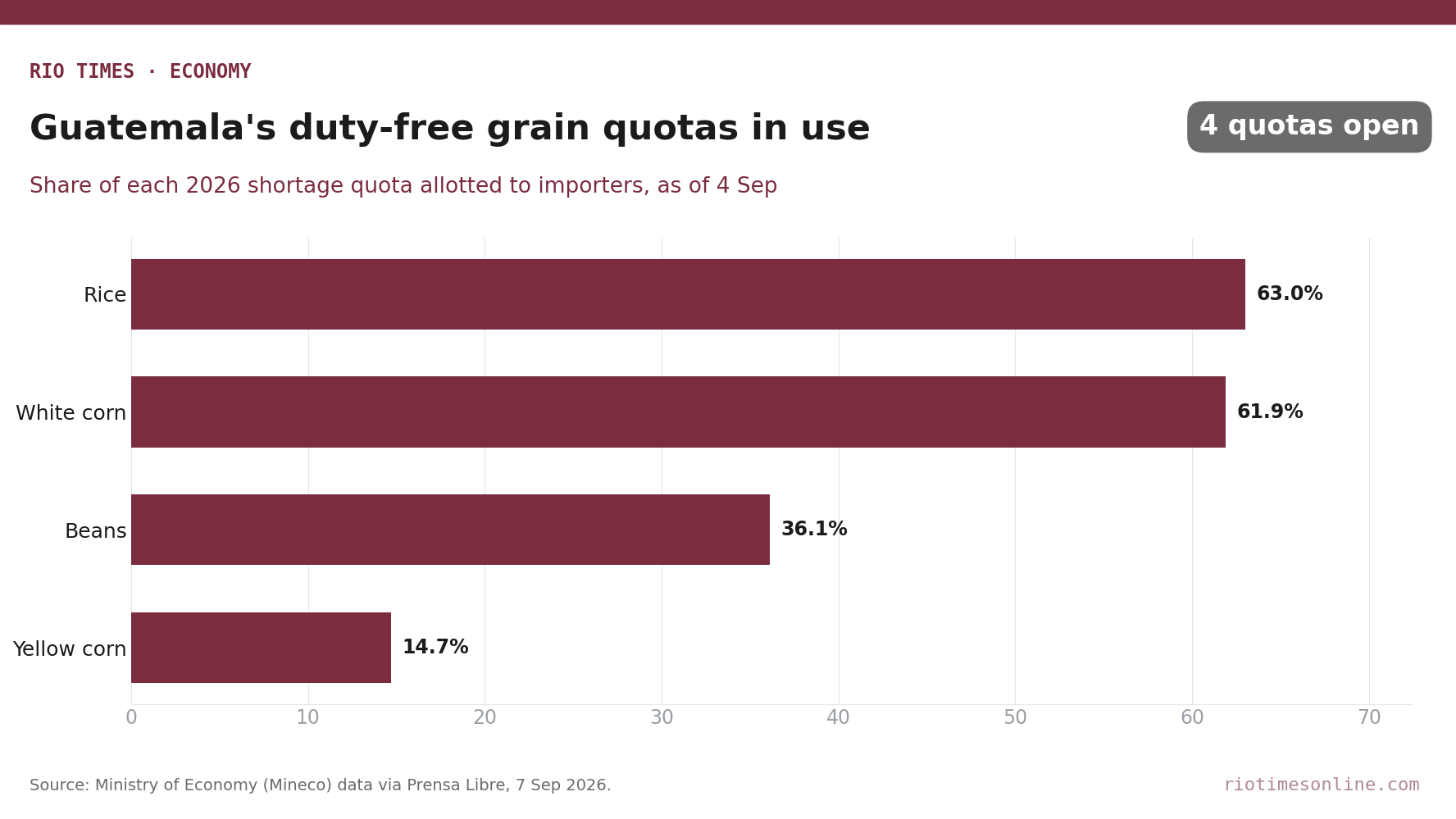
Where the 2026 quotas stand
White maize opened on 1 April with 65,000 tonnes. A ministerial accord added 50,000 more on 4 August, because the first volume was close to running out.
By 4 September, ten firms had been allotted 71,159 tonnes of it, and 62,975 tonnes had actually entered the country. It is the only quota enlarged so far this year.
The yellow maize quota is far larger, at 650,000 tonnes, yet only 14.7 percent had been allotted. The black bean quota of 20,000 tonnes was 36.1 percent allotted.
Paddy rice stood at 63 percent of 60,000 tonnes. All four figures come from the Economy Ministry, as published by Prensa Libre on 7 September.
The importer’s gamble
Ponce Segura argues that removing the duty raises importers’ appetite for risk. They must buy when harvests abroad make grain cheap, then wait for ships and berths.
Every day of delay adds cost, and that cost reaches the consumer. Approval is not automatic, so some firms buy and ship before the permit arrives.
That leaves them exposed to cargo stuck at sea if the answer is no. Rice works differently: importers must also buy the domestic crop, which protects local farmers and mills.
The column adds that a few millers are said to dominate the rice trade and set the final price. That claim is the author’s and has not been independently confirmed.
Farmers’ fears and the government’s case
Gustavo Rivas, president of the national basic grains association, reported maize losses in the east and on the south coast. He told Prensa Libre that Petén and Ixcán still produced a crop.
He fears the extra imports will land as that harvest reaches market in September and October. In his view, supply will be ample and domestic growers could lose on price.
The ministry counters that tax-free food imports guard supply for the rest of the year and keep consumer prices from rising. Drought has already hit the Dry Corridor, as covered in Guatemala Drought Wipes Out Maize in 36,000 Dry Corridor Households.
What Is Not Yet Known
Agriculture minister María Fernanda Rivera told Congress that new quotas for all four grains are under study. No volumes or dates have been published.
No figures show how much the duty waiver lowered shop prices this year. Ponce Segura’s second column, on farmers, government and consumers, has not yet appeared.
Sources: Plaza Pública, Byron Ponce Segura (29 Sep 2026); Prensa Libre (7 Sep 2026); Diario de Centro América (Aug 2026).
This article was produced by The Rio Times’ automated newsroom system. How we use AI · Report an error
Read More from The Rio Times