Guatemala Pretrial Detention Reform Passes Congress With 139 Votes in Favour
JUSTICE · GUATEMALA
Key Facts
- —The country Guatemala, a Central American country of about 18 million people whose prisons hold more than three times their official capacity, according to 2025 figures.
- —What happened On Tuesday 29 September, Congress approved Decree 23-2026, rewriting the rules for jailing suspects before trial. It passed with 139 votes in favour, Publinews and Soy502 reported.
- —Who is involved Congress and its justice-reform committee, the Public Prosecutor’s Office, which must now prove any need for detention, and the Supreme Court, which gets a new monitoring unit.
- —What it means for you Anyone arrested must see a judge within 24 hours and cannot be sent to a detention centre before that hearing. Homicide, extortion and drug crimes still rule out release.
- —Still open President Bernardo Arévalo has not yet signed the decree. Reports differ on the exact release deadlines, and nobody has costed the new unit.
Guatemala’s Congress has passed a pretrial detention reform that makes jail before trial the exception rather than the routine. Deputies approved Decree 23-2026 on Tuesday 29 September with 139 votes in favour.
The 15-article law amends the Code of Criminal Procedure, merging two bills that the justice-reform committee had backed. Its stated aims are to ease prison overcrowding and protect the presumption of innocence.

What the new law changes
Anyone arrested must get a first hearing before a judge within 24 hours. Until that hearing happens, nobody may be moved to a detention centre.
Arrests at night or on holidays go to the duty court, which can use electronic files. The hearing may be held by video if the suspect agrees, Prensa Libre reported.
Detention may only be ordered after a formal committal order and a real risk of flight or of obstructing the investigation. The Public Prosecutor’s Office must now prove that risk; the defence can challenge it.
That office changed leadership this year, as covered in Guatemala’s New Attorney General Turns on His Predecessor’s Network. The law also gives judges a catalogue of ten alternatives, from regular check-ins to house arrest and electronic monitoring.
Who stays in custody
The reform is not a general release. Homicide, murder, aggravated rape, kidnapping, extortion, aggravated robbery and drug-trafficking offences still bar any alternative to detention.
For tax fraud and smuggling, only bail is allowed. An amendment by deputy Andrea Reyes added recruiting minors for crime to the excluded list.
Judges are told to favour alternatives for people over 65, the seriously ill, pregnant women and sole carers. Electronic monitoring fees can be waived for those who cannot pay.
Deadlines for prosecutors
Three months after a detention order, a judge must ask prosecutors to close their investigation if they have not done so. If they still fail to act, the judge may provisionally close the case.
A new Unit for the Control of Coercive Measures, attached to the Supreme Court, will track every detainee and deadline. Detainees, lawyers and relatives will have direct access to that information.
Supporters and sceptics
Congress president Luis Contreras said nobody should stay in jail longer than necessary without cause. Security analyst Óscar Morales told Prensa Libre the change was positive but should also exclude corruption offences.
Publinews reported that the reform divides opinion over possible impunity. The committee itself warned it will only work if the state funds courts, prisons and the new unit.
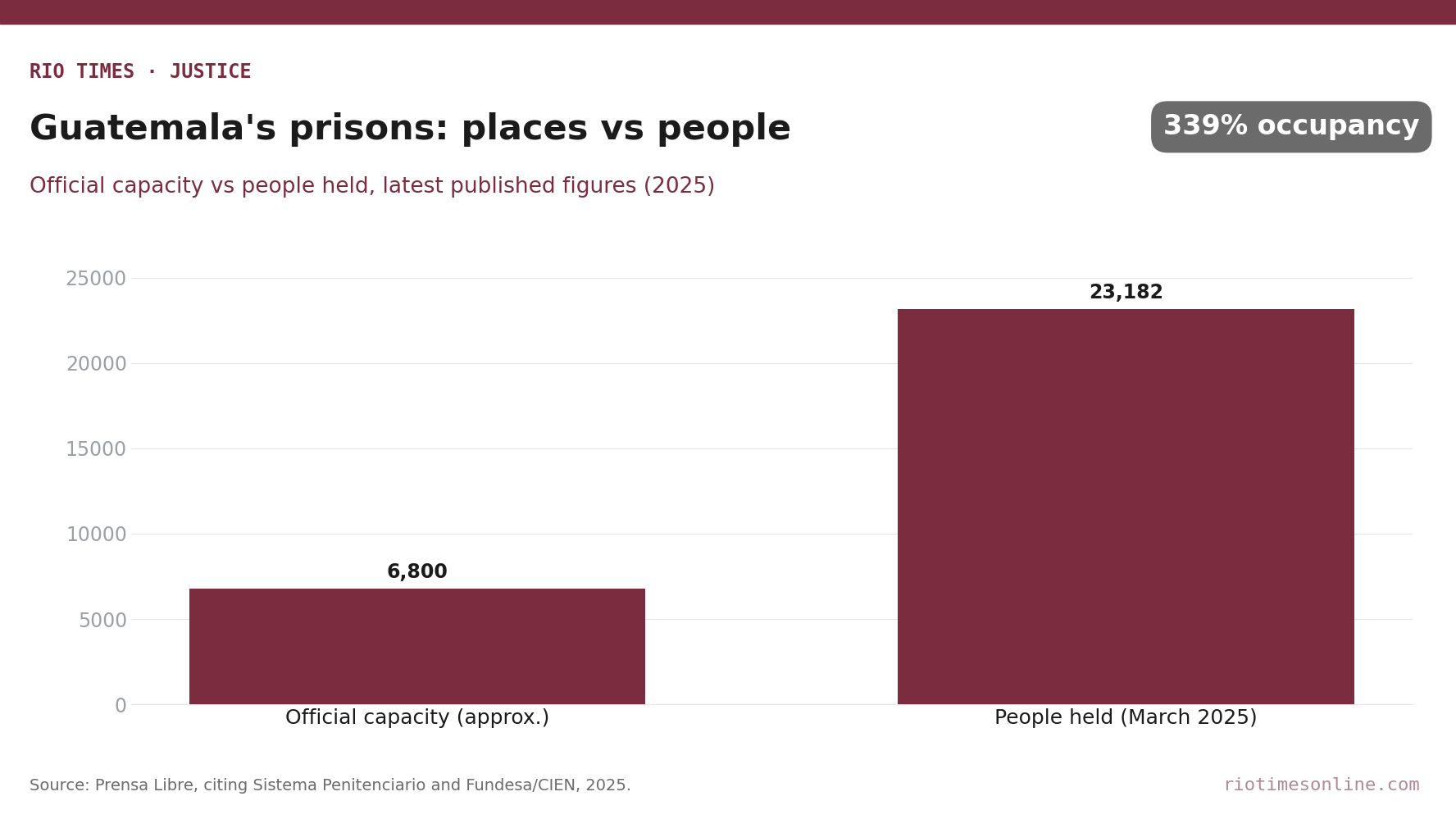
The pressure behind it is real. The prison service counted room for about 6,800 people in 2025, while 23,182 were held that March, according to Prensa Libre.
The think tank CIEN said in July 2026 that 40 percent of pretrial detainees had waited two years or more. It added that no new prison had been built in 15 years.
What Is Not Yet Known
President Bernardo Arévalo has not said whether he will sign the decree. It takes effect the day after publication in the official gazette, according to República.
Reports differ on the release deadlines: Soy502 describes a one-year ceiling on detention, while Prensa Libre lists shorter stage-by-stage limits. No budget for the monitoring unit has been announced.
Sources: Publinews (30 Sep 2026); Prensa Libre (29 Sep 2026); Soy502 (29 Sep 2026); La Hora (29 Sep 2026); República (29 Sep 2026); Prensa Libre, prison data (2025); La Hora on CIEN (22 Jul 2026).
This article was produced by The Rio Times’ automated newsroom system. How we use AI · Report an error
Read More from The Rio Times