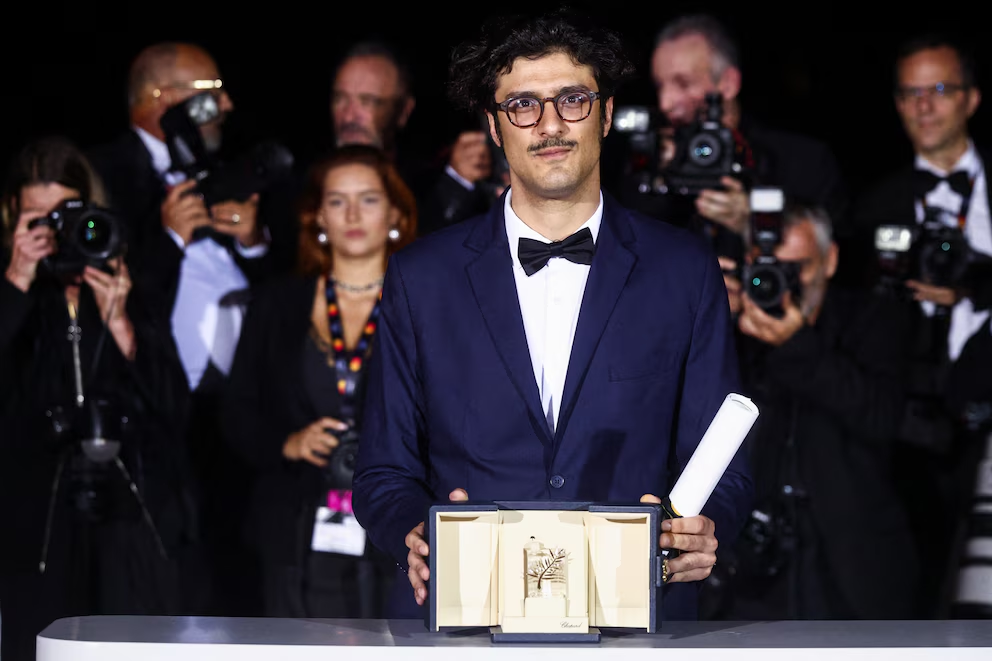
—Historic win:. Argentine director Federico Luis won the Palme d’Or for Best Short Film at Cannes on Saturday May 23, a first for Argentine cinema.
—The film:. Para los contrincantes is a 15-minute fiction-documentary hybrid shot on 16mm in Mexico City’s Tepito, following a 10-year-old amateur boxer.
—Production structure:. The short is a four-country coproduction between Mexico, Chile, France and Argentina, anchored by Mexican producers Elena Fortes and Fernanda de la Peza.
—The jury:. The short-film jury, led by Spanish director Carla Simon, awarded the prize unanimously; the main Palme d’Or went to Cristian Mungiu’s Fjord.
—Luis at Cannes before:. Luis, born in Buenos Aires in 1990, won the Critics’ Week Grand Prize in 2024 with his debut feature Simon de la montana.
—Wider regional palmares:. Marina de Tavira shared Un Certain Regard Best Performance, and Brazilian-coproduced Elefantes na Nevoa took that section’s Jury Prize and Best Sound Design.
One-stop reference
Company Intelligence
Every listed company in Latin America — financials, ownership and structure for 1,450+ companies across 26 exchanges, in one place.
The first Argentine Palme d’Or in 79 years arrived not through the main competition but through a 15-minute short shot on 16mm in a working-class Mexican neighbourhood, and the geometry of that result tells the structural story of where Latin American cinema is being recognized in 2026.
Federico Luis took the Palme d’Or for Best Short Film with Para los contrincantes on Saturday May 23 at the Palais des Festivals in Cannes, the first time in the festival’s 79-year history that an Argentine filmmaker has received a Palme d’Or in any category. The unanimous prize was announced by Spanish director Carla Simón, president of this year’s short-film jury.
Luis discovered the subject while preparing a separate feature with Mexican novelist Mario Bellatin, who took him to a Tepito youth boxing tournament. The director cast Damián López, a 10-year-old amateur boxer, and filmed a real bout on 16mm rather than staging a scripted fight.
The Tepito coproduction stack
The financing geometry is the structural story. A 15-minute short with an Argentine director, a Mexican shoot, and Chilean, French and Argentine coproducers is the kind of stacked package that has become standard for Latin American art cinema reaching A-list European festivals.
Luis dedicated the prize to Tepito, the Mexico City district often stereotyped as dangerous. He also referenced the difficult climate for Argentine independent cinema under Javier Milei’s government, telling EFE that independent filmmakers will continue working despite cuts in state support.
Why this matters for Latin American cinema in 2026
The 2026 palmarés is unusually parallel-section-heavy for the region. No Latin American film competed for the main Palme, but the region collected the Best Short Palme (Luis), Un Certain Regard Best Performance (Marina de Tavira), and the Un Certain Regard Jury Prize plus Best Sound Design (Brazilian-coproduced Elefantes na Névoa).
Chilean filmmaker Diego Céspedes sat on the main competition jury under Park Chan-wook. Recognition is migrating into alternative pathways while main-competition slots tighten around European and Asian auteurs.
Where to watch Para los contrincantes and Luis’s previous work
Short-film distribution typically follows the festival circuit before reaching streaming, and a Best Short Palme accelerates that process. Para los contrincantes will tour major Latin American festivals over the coming months, with curated streaming pickup likely on Mubi or Filmin once the festival window closes.
Key Facts
— Where to find Federico Luis’s work
—Argentina. Simón de la montaña on Netflix Argentina; Para los contrincantes pending distribution announcement
—Mexico, Brazil and Spanish-speaking Latin America. Simón de la montaña on Netflix regional storefronts; Para los contrincantes likely on Mubi Latinoamérica after the festival window
—Europe. Festival circuit through summer 2026; streaming on Filmin Spain expected later in the year
— The Rio Times links only to authorized platforms. Unauthorized streaming sites violate copyright held by the filmmakers and their distributors, and undermine the commercial returns funding independent Latin American cinema.
Is this really the first Argentine Palme d’Or ever?
Yes, according to La Nación’s coverage of the closing ceremony. In the 79-year history of the Festival de Cannes, Luis is the first Argentine filmmaker to receive a Palme d’Or in any category, short or feature.
Where was Para los contrincantes filmed?
In Tepito, a working-class neighbourhood of Mexico City known for its boxing tradition. The central 10-minute fight was shot at a real youth tournament rather than a staged sequence.
Who produced the film?
A four-country coproduction between Mexico, Chile, France and Argentina, anchored by Mexican producers Elena Fortes and Fernanda de la Peza. Writer Mario Bellatin introduced Luis to Tepito’s youth boxing scene.
What else has Federico Luis directed?
His feature debut Simón de la montaña won the 2024 Critics’ Week Grand Prize at Cannes and is on Netflix. He is in pre-production on a second feature about a dog trainer, also based on a Bellatin text.
Who won the main Palme d’Or at Cannes 2026?
Romanian director Cristian Mungiu’s Fjord, his second Palme after 4 Months, 3 Weeks and 2 Days in 2007, starring Sebastian Stan and Renate Reinsve.
Connected Coverage
The Argentine Palme caps the broader Latin American Cannes story analyzed in our Cannes 2026 Latin American cinema piece, fits the regional cultural-economy context in our cultural-export economy analysis, and complements the streaming-platform context in our Latin American streaming services 2026 guide.
 RTAsk Rio Times17 years of Latin America reporting, on demand.Open the full Ask Rio Times →