Afewerki Keeps Eritrea Economy Closed as Colluli Potash Draws China and Russia
Economy · Eritrea
—The stakes. Eritrea remains one of Africa’s most isolated command economies, yet its Red Sea coast and two mines now attract large foreign mining players.
—The drivers. The Bisha mine, majority-owned by China’s Zijin Mining, keeps producing copper and zinc, while the Colluli potash project inches toward commercial output.
—The date. As of September 2026, no firm date confirms Colluli is producing at scale, with World Bank guidance pointing to end-2027.
—The economic cost. Indefinite national service and tight state controls keep private investment scarce, with greenfield FDI recorded at zero from 2022 to 2024.
—The geopolitical pull. Gulf, Russian, and Chinese interest in Eritrea’s Red Sea coast persists because that coastline commands access to one of the world’s busiest trade lanes.
Asmara is doubling down on the command economy even as the ground beneath it shifts. Two Chinese-backed mining projects now shape Eritrea’s external balance, while its Red Sea shore turns every domestic policy choice into a regional security question.
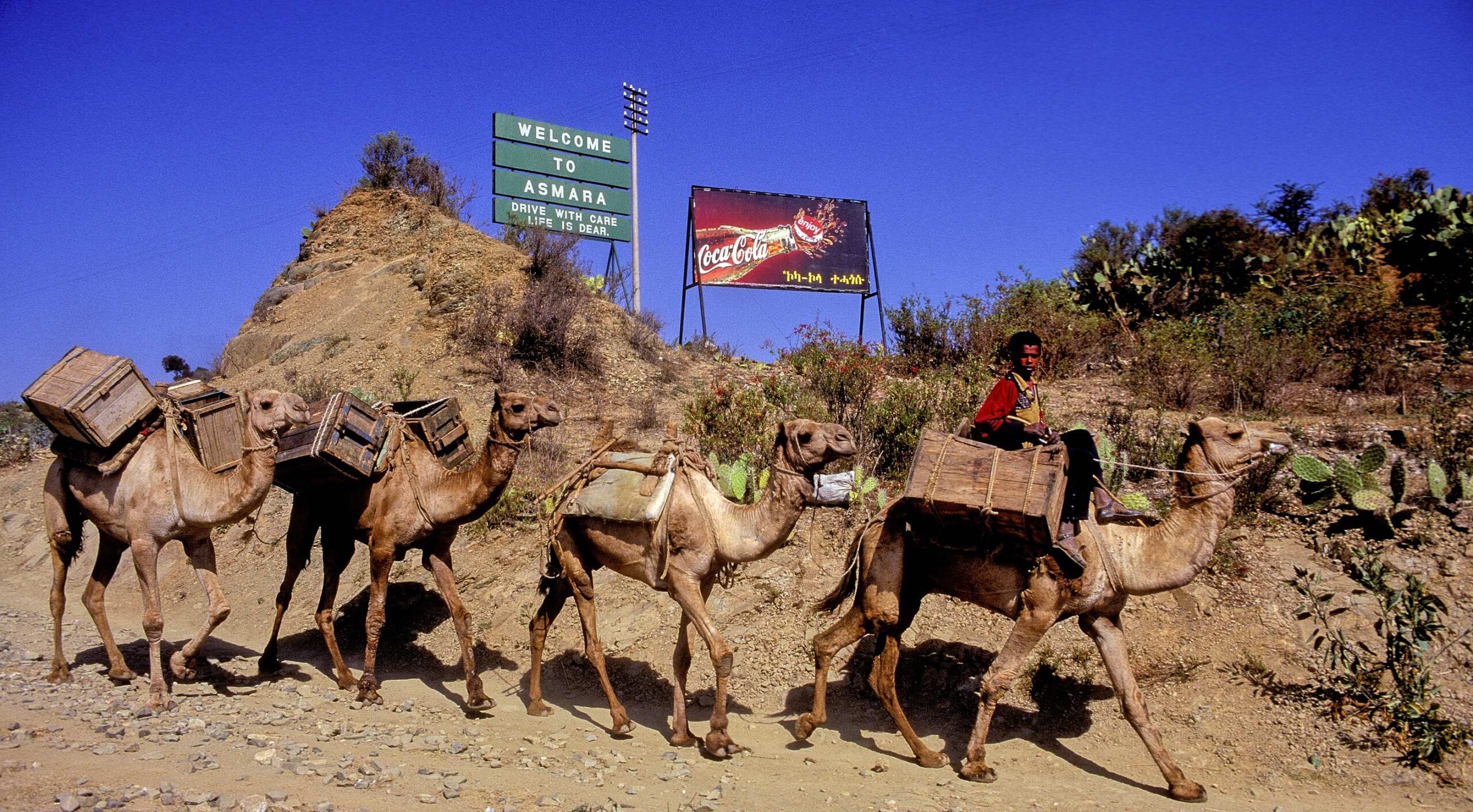
A Command Economy Sealed by the PFDJ
Eritrea in 2026 remains a highly centralised command economy controlled by the ruling People’s Front for Democracy and Justice, known as the PFDJ, and the military.
The BTI 2026 country report calls Eritrea an authoritarian one-party state under President Isaias Afwerki, with no independent judiciary and no free media.
Civil society and ordinary economic activity face severe restrictions, making formal private sector growth extremely difficult.
For foreign investors, this means a market where the state decides which projects may exist and how revenues are handled.
The country’s overall performance stays poor and diversification limited, even as segments such as mining register expansion.
FDI Inflows: Negative, Tiny, Then Negative Again
UNCTAD data cited by Bank of Scotland shows foreign direct investment inward flows were negative USD 32 million in 2022, USD 2 million in 2023, and negative USD 28 million in 2024.
The same source records zero greenfield investments from 2022 to 2024.
That absence of new foreign projects reinforces Eritrea’s position as one of Africa’s least attractive destinations for fresh capital.
Existing mining assets are therefore central, because new non-mining investment remains virtually absent.
Bisha Mine: The Chinese-Backed Base
The Bisha mine is Eritrea’s largest and longest-running mining operation and was first developed by Canadian firm Nevsun Resources.
In December 2018, China’s Zijin Mining Group acquired Nevsun Resources, the mine’s operator, inheriting the joint venture with the Eritrean National Mining Corporation, or ENAMCO.
Bisha produces gold, copper, and zinc, and according to BTI 2026, copper mining there has historically been the government’s only stable foreign income.
Colluli Potash: Size, Split, and Stalled Start
The Colluli Potash Project sits in the Danakil Depression in southern Eritrea and is widely described as one of the world’s largest and easiest-to-exploit potash deposits.
Development is split into two phases: Phase I requires USD 298 million for 472,000 tonnes per year, while Phase II adds USD 202 million to double output to 944,000 tonnes yearly.
Colluli was originally owned by Australia’s Danakali Ltd and ENAMCO, but in March 2023 Danakali sold its stake for USD 166 million.
Colluli is now equally owned by China’s Sichuan Road and Bridge Group and ENAMCO, giving Beijing direct sway over Eritrea’s next major export.
Copper, Zinc, and Potash: The 2026 Macro Story
The African Development Bank estimates real GDP growth of 2.9 per cent in 2024 and 3.2 per cent in 2025, and projects 2.8 per cent in 2026, led by mining and services.
The World Bank estimates real GDP growth at 3.2 per cent in 2025, supported by strong mining output and private consumption, with inflation near 3.9 per cent.
The World Bank projects GDP growth of 3.5 per cent in 2026 and 3.6 per cent in 2027, driven by Bisha and Colluli expansion.
The World Bank also expects a large current account surplus around 14 per cent of GDP in 2026, reflecting mining exports and tight import controls.
Those numbers depend on execution because AfDB lists delays in Colluli production, metals price swings, and regional insecurity as key downside risks.
Colluli’s Contribution: Promise Without a Date
The World Bank expects Colluli to become operational by end-2027, with potential to contribute up to 10 per cent of Eritrea’s GDP once fully operational.
The World Bank expects Colluli, once operational, to contribute up to 10 per cent of GDP and about USD 200 million a year in fiscal revenue.
A UNDP assessment estimated fiscal effects around USD 204 million per year by 2026 and exports of USD 537 million by 2030.
That gap between World Bank caution and faster unofficial timelines is precisely what makes Colluli a source of both promise and risk.
Indefinite National Service and Its Economic Cost
Eritrea maintains indefinite national service, a system that draws large numbers of citizens into state labour rather than formal market employment.
This structure acts as a permanent economic drag by suppressing private wages, entrepreneurship, and household consumption.
It feeds the centralised model described by BTI 2026, because the state can direct labour without normal market pricing.
The economic cost is visible in weak private investment and an FDI picture that stays negative or close to zero outside mining.
For foreigners, national service is not a technical regulatory issue but the heart of why the domestic economy remains so closed.
The Red Sea Coast: Why the World Keeps Looking
Eritrea’s Red Sea coast sits along one of the world’s most important maritime trade routes, giving it strategic value far beyond its domestic output.
The South China Morning Post reports that Chinese Belt and Road engagements with Eritrea rose 359 per cent in the first half of 2023 compared with the same period in 2022.
Gulf states, Russia, and China all follow Eritrea’s ports closely because Red Sea access affects energy shipments, military reach, and trade security.
Even with a closed economy, that geography keeps Eritrea relevant to investors tracking East Africa and the Horn.
In this sense, every mining contract and port negotiation is also a geopolitical signal.
Afwerki’s Refusal to Open Up
President Isaias Afwerki has consistently refused to liberalise Eritrea’s economy or loosen PFDJ control.
BTI 2026 describes severe restrictions on economic activity, no independent judiciary, and no free media under his rule.
Foreign firms are admitted selectively, mainly into state-linked mining projects that generate hard currency for the government.
This model keeps Eritrea isolated but also preserves the central government’s grip over any future resource windfall.
As Colluli nears commercial output, that policy choice becomes more consequential rather than less.
Downside Risks: Delays, Metals, and Insecurity
The African Development Bank flags delays in Colluli potash production as a key downside risk.
Metals price volatility affects Bisha’s copper and zinc revenue, which has long been the government’s stable foreign income.
Regional insecurity in the Horn of Africa can disrupt trade routes and raise costs for mining logistics.
Greenfield FDI remains at zero for the 2022 to 2024 period, so there is no pipeline of new non-resource projects to cushion shocks.
Investors should treat every growth projection as contingent on state decisions, not market fundamentals alone.
What This Means for Foreigners and Investors
Eritrea offers rare resource exposure through Bisha and Colluli but poor legal and political predictability.
The World Bank sees strong mining exports producing a current account surplus around 14 per cent of GDP in 2026, yet FDI remains negligible.
For China, the Bisha and Colluli stakes tie resource supply to Belt and Road ambitions across the Red Sea region.
For other foreigners, the central question is whether Afwerki’s closed system can deliver Colluli on time and at scale.
Until that is answered with verified output, Eritrea’s economy remains a strategic watch item more than an open investment destination.
The Big Picture
Latest developments
- Uganda MPs Demand Answers on Late Land Titles for World Bank Schools — 1 October 2026
- Kenya Demands Exporters’ Paperwork for Imports as Port Agents Push Back — 1 October 2026
- Kenya-Drafted Course Aims to Make Africa’s Ferries and Tourist Boats Safer — 1 October 2026
- Tanzania and Qatar Sign Tax Treaty to End Double Taxation for Investors — 1 October 2026
This article was produced by The Rio Times’ automated newsroom system. How we use AI · Report an error · Editorial responsibility: Matthias Camenzind, Editor-in-Chief
Horn of Africa and the Red Sea
- Horn of Africa 2026: Why It Matters and Who Backs Whom
- Ethiopia’s Neighbors Explained, Ports, Eritrea, Somalia
- Eritrea Explained 2026, a Red Sea Country Guide
- Somalia Explained: Al-Shabaab, Somaliland, the Ports and the Fight Over a 2026 Vote