The World’s Top Beef Exporter Is Now Growing Meat in a Lab
Brazil · Agribusiness
Key Facts
—The agency. Embrapa, Brazil’s state agricultural research body, is now growing meat from animal cells in the laboratory.
—First results. One unit has already produced prototype chicken-breast fillets without slaughtering any animal.
—The method. A tiny biopsy of cells is multiplied in a nutrient-rich liquid and grown on scaffolds into muscle tissue.
—The labs. Work is split between a poultry unit in Concórdia and a biotechnology lab in Brasília.
—The timeline. Researchers expect a finished technology package by about the middle of 2027.
—The rules. Brazil’s health regulator issued a framework for cultivated meat back in 2023.
In a country built on cattle, the state’s own scientists are now making lab-grown meat without a single animal being slaughtered.
Brazil is one of the great meat nations of the world, the largest exporter of beef anywhere. So there is a quiet irony in the news that its own government scientists are now growing meat in a laboratory.
The work is being done by Embrapa, the state agricultural research agency. For a reader abroad, Embrapa is the public body credited with turning Brazil into a farming superpower over the past half-century.
That history is what makes this step notable. The institution that helped build Brazil’s vast cattle and grain industry is now investing in a technology that could one day compete with it.
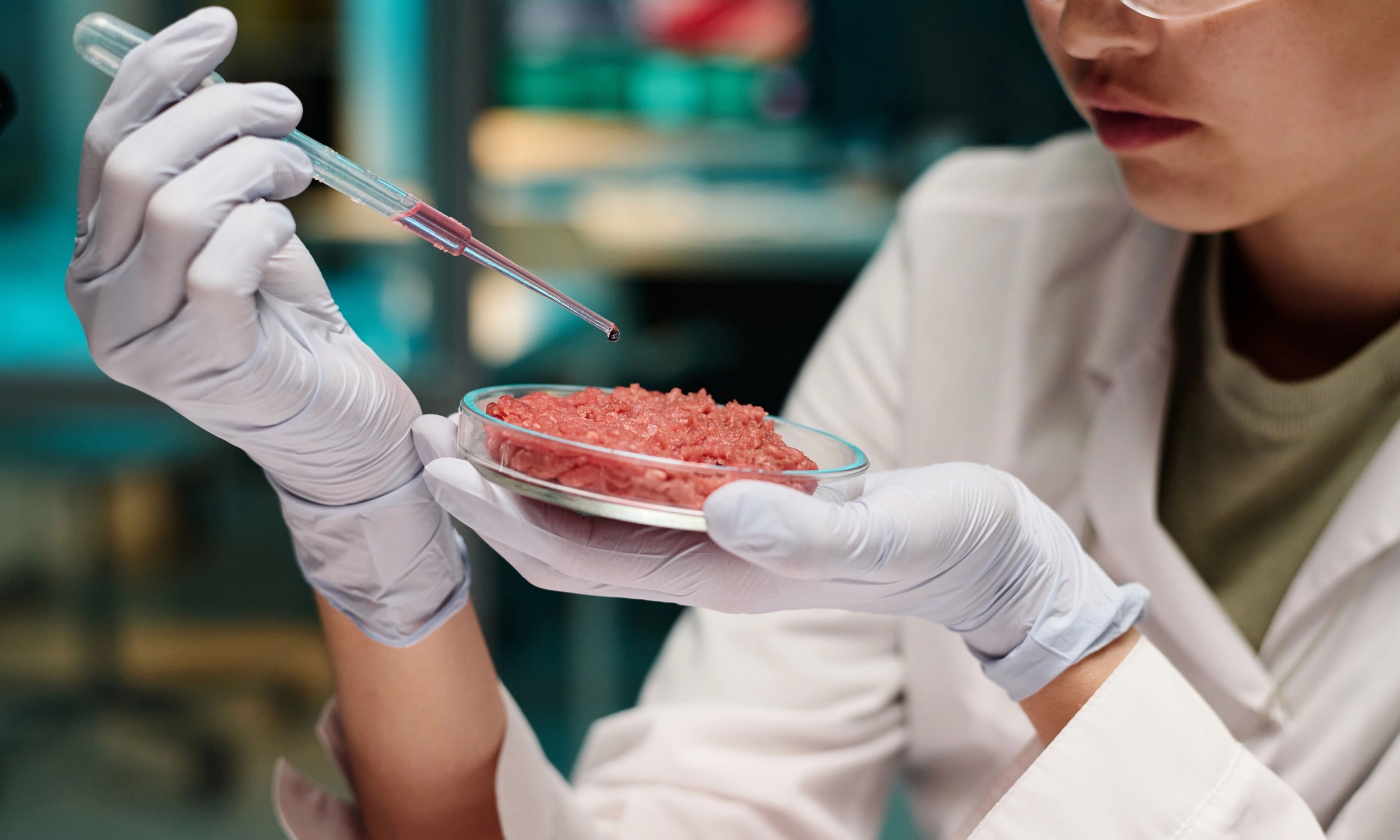
The experiment produces real animal meat without raising or killing an animal. One of Embrapa’s units has already made prototype fillets of chicken breast this way.
How Brazil’s lab-grown meat is actually made
The process begins with a tiny sample of cells, taken from a living animal in something like a small biopsy. No slaughter is involved at any stage.
Those cells are then placed in a liquid rich in oxygen and nutrients such as glucose, amino acids and minerals. In that environment they multiply, growing far beyond the original sample.
The harder part is turning a soup of cells into something that looks and feels like meat. To do that, the scientists use scaffolds, tiny structures that the cells cling to and organise themselves around.
These supports guide the cells into three-dimensional muscle tissue. They shape the texture, firmness and water content that determine whether the final product feels like real meat in the mouth.
The effort is shared between two parts of Embrapa. A poultry and pork unit in the southern town of Concórdia handles the meat side, while a nanobiotechnology lab in the capital, Brasília, develops the supporting materials.
That Brasília lab has a particular speciality. It builds its scaffolds from plant proteins, and has even created an edible film designed to act as the casing for sausages made from cultivated meat.
The same lab is exploring other future foods alongside the meat. It has produced printed, plant-based samples of salmon fillet, caviar and even squid rings.
The findings have not stayed inside the agency. The lab’s cultivated-meat work has already been written up in a peer-reviewed scientific journal.
Why a beef giant is backing the technology
The appeal is partly environmental. Traditional cattle farming drives deforestation and releases large amounts of methane, a powerful greenhouse gas, so meat grown in a lab promises a far lighter footprint.
There is also a strategic logic. By developing the know-how in-house, Brazil positions itself to shape an industry that several countries are racing to lead, rather than buying the technology from abroad.
The lead researcher, biologist Luciano Paulino da Silva, frames the project in plain commercial terms. He expects the work to be ready as an Embrapa technology package by about the middle of 2027.
After that, he says, private companies could license the methods to make and sell specific products. Several large Brazilian food groups and startups already run their own cultivated-meat research units.
A long road to the dinner table
The groundwork is further along than the science alone. Brazil’s health regulator published a formal framework for cultivated meat back in 2023, setting the rules before any product reaches shops.
Brazil is not alone in the effort. Singapore, the United States, Israel and Australia are all developing cultivated meat, with some already granting regulatory and commercial approval.
For a foreign reader, the story is a small signal of where food might be heading. When the world’s biggest beef exporter starts growing meat in a dish, the idea has moved well beyond the fringe.
Frequently Asked Questions
What is Embrapa’s lab-grown meat?
It is real animal meat grown from cultured cells rather than from a slaughtered animal. Embrapa, Brazil’s state farm-research agency, has used the method to produce prototype chicken-breast fillets.
How is it produced?
A small biopsy of cells is taken from a living animal and multiplied in a nutrient-rich liquid. The cells then grow on tiny scaffolds that shape them into three-dimensional muscle tissue.
When could it reach the market?
Embrapa expects a finished technology package by about the middle of 2027. Private companies could then license the methods, though Brazil already set regulatory rules for cultivated meat in 2023.
Connected Coverage
How Israel built an early lead in exporting lab-grown beef
Why foreign investment in Brazil is tilting toward clean industry
This article was produced by The Rio Times’ automated newsroom system. How we use AI · Report an error · Editorial responsibility: Matthias Camenzind, Editor-in-Chief