Brazil · Aerospace
Key Facts
—Third delay. Embraer’s air-taxi arm, Eve, pushed its certification and entry-into-service target to 2028, after earlier goals of 2026 and 2027.
—On the record. Eve CEO Johann Bordais confirmed the new timeline on June 12; Brazil’s regulator ANAC called 2028 “realistic.”
—The prize. Embraer CEO Francisco Gomes Neto said Eve could eventually earn US$1 billion to US$1.5 billion a year once production scales.
—Core business booming. Embraer passed 500 E2 jet orders this month and posted record first-quarter revenue of US$1.45 billion with a US$32.1 billion backlog.
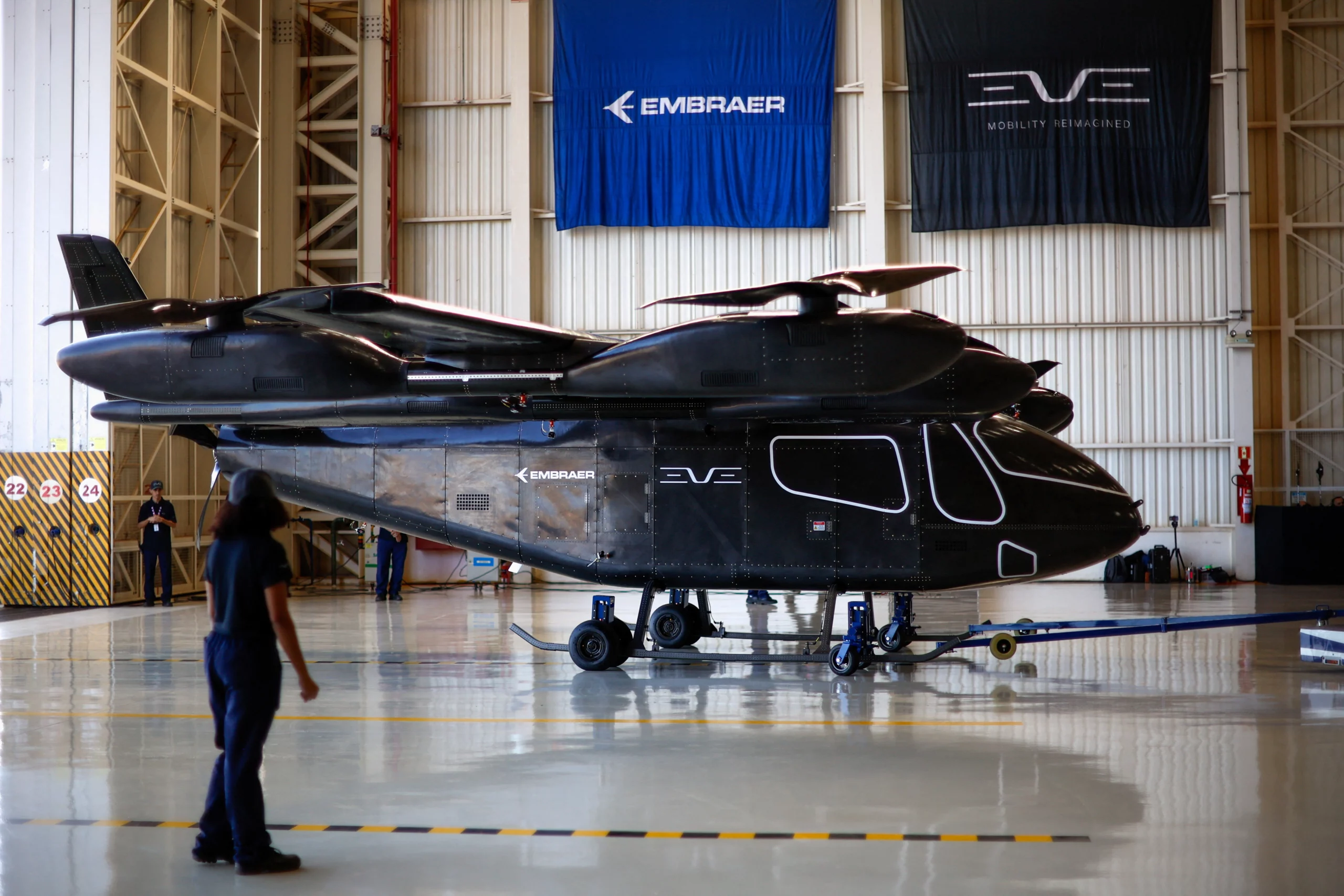
Embraer’s electric air-taxi venture, Eve, has pushed its certification target to 2028 — the third time the timeline has slipped — even as the company’s core jet business is having one of its strongest stretches in years.
Eve Air Mobility, the electric vertical-takeoff arm spun out of Brazil’s Embraer, now expects to certify its air taxi and enter service in 2028, chief executive Johann Bordais told reporters on June 12. It is the third time the goal has moved, after an original 2026 target and a later 2027 one. Brazil’s civil-aviation regulator, ANAC, told Reuters the new 2028 horizon is “realistic.”
ANAC is the Agência Nacional de Aviação Civil, the body responsible for setting and enforcing safety standards for all aircraft operating in Brazilian airspace. Its endorsement matters because Eve will need to satisfy both Brazilian and international regulators before any commercial flights can begin.
Eve still has only one full-scale prototype flying, uncrewed, and aims to begin transition flight testing — the tricky shift from vertical lift to forward flight — in the third quarter of 2026. The company ended the first quarter with US$441 million in cash and guided this year’s burn toward the low end of a US$225–275 million range, signaling it intends to spend cautiously while the timeline stretches.
Transition flight is the moment when an eVTOL aircraft shifts from hovering like a helicopter to flying forward like a plane, a maneuver that stresses the airframe and control systems in ways conventional aircraft never experience. Proving that transition is safe and repeatable under all conditions is one of the hardest certification hurdles the industry faces.
A delayed moonshot with a big number attached
Even as the date slips, Embraer is keeping expectations high. Group chief executive Francisco Gomes Neto said this week that Eve could ultimately generate between US$1 billion and US$1.5 billion in annual revenue once production reaches scale, depending on demand.
Eve says it holds non-binding letters of intent for more than 2,800 aircraft — a backlog that signals the appetite airlines and operators have for the concept.
Letters of intent are preliminary expressions of interest, not binding contracts, so they carry commercial risk and can evaporate if timelines stretch too far or competitors move faster. Still, the volume suggests that potential customers see a business case for urban and regional air mobility if the technology can be certified and operated economically.
The repeated delays are not unique to Eve. The entire eVTOL industry has slid past its early promises as regulators work out how to certify a wholly new category of aircraft.
The difference for Embraer is that it can afford to wait, because the rest of the company is thriving.
The jets are carrying the company
This month Embraer crossed 500 orders for its E2 family of commercial jets, a milestone triggered when leasing firm Azorra placed a firm order on June 5 for 15 more E195-E2s, plus 15 purchase rights. In the first quarter the company reported record revenue of US$1.45 billion, up 31%, an all-time-high firm backlog of US$32.1 billion, and 44 aircraft delivered, up 47%.
Its defense unit grew 63% to US$227 million.
The E2 family represents Embraer’s latest generation of regional jets, designed to compete in the segment below the narrow-body aircraft made by Airbus and Boeing. A firm backlog is the total value of orders already signed and not yet delivered, a key measure of future revenue visibility for aerospace manufacturers.
Defense momentum is building too. On June 11, Greece formally proposed buying three C-390 Millennium military transports as part of a roughly €1 billion package — a proposal still entering parliamentary review, not yet a signed order, and structured as a government-to-government deal routed through Portugal.
The split screen is the story: a marquee future business that keeps missing its dates, bolted onto a manufacturer whose order book and deliveries are running near records.
Whether Eve’s delays will erode customer confidence or simply reflect the industry-wide reality of certifying a new aircraft category remains an open question. So does whether Embraer’s financial cushion will prove deep enough to carry the venture through to commercial service, and whether competitors will reach the market first.
More: Brazil news in English, every day from The Rio Times.
Live Company IntelligenceEmbraer SA ADR — the full investor dossier
Wall Street view
Valuation & profitability
Price & risk
$59.2252-wk high
$66.87
Revenue trend · 6y
Ownership
Dividend
Frequently Asked Questions
Why did Embraer’s Eve air taxi delay certification to 2028?
Eve pushed its certification and entry-into-service target to 2028 — its third timeline, after 2026 and 2027 — as it works through flight testing and a still-evolving regulatory process. CEO Johann Bordais confirmed the date on June 12, and Brazil’s regulator ANAC called it realistic.
How much could Eve eventually be worth to Embraer?
Embraer CEO Francisco Gomes Neto said Eve could generate between US$1 billion and US$1.5 billion in annual revenue once production scales, depending on demand. Eve reports more than 2,800 non-binding letters of intent.
How is Embraer’s core business doing?
Strongly. It passed 500 E2 jet orders in June, and first-quarter revenue hit a record US$1.45 billion (up 31%) with an all-time-high US$32.1 billion backlog and deliveries up 47%.
Has Greece ordered the C-390?
Not yet. On June 11 Greece formally proposed buying three C-390 transports within a roughly €1 billion package; the proposal is still under parliamentary review and would be a government-to-government deal via Portugal.
This article was produced by The Rio Times’ automated newsroom system. How we use AI · Report an error · Editorial responsibility: Matthias Camenzind, Editor-in-Chief
LatAm Markets: Live Signals → — real-time movers, turnover leaders and FX across Latin America.