El Salvador Pension Reform Will Fix Finances, Not Raise Pensions, Ex-Central Banker Says
ECONOMY · EL SALVADOR
Key Facts
- —The country El Salvador, a dollarised Central American economy of about six million people, with a 40-month IMF loan programme approved in February 2025.
- —What happened In an interview El Mundo published on 28 September, former central bank president Carlos Acevedo said the pension reform planned for 2027 answers a fiscal worry, not a social one.
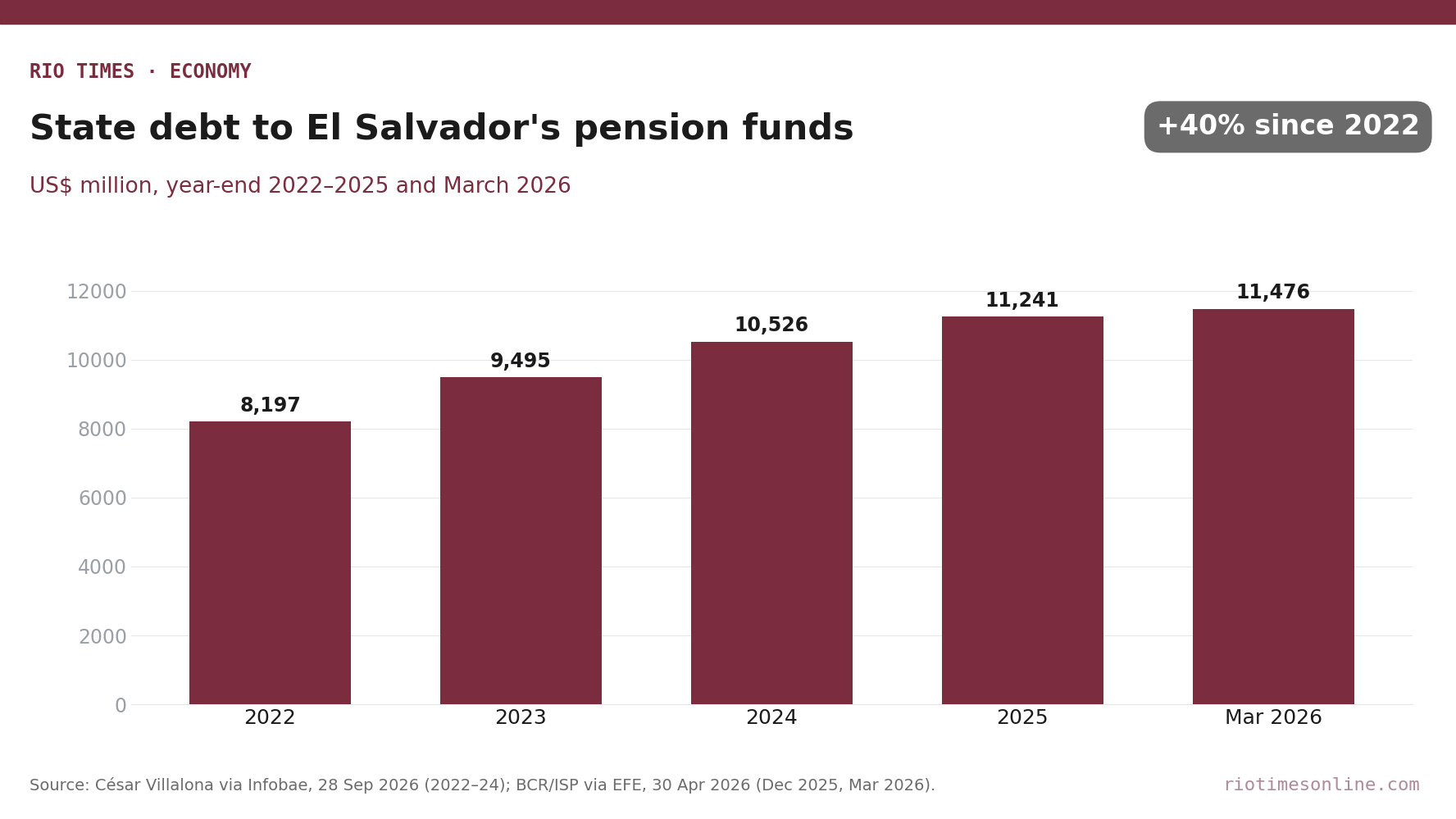
- —The numbers State debt to the pension funds reached US$11.48 billion in March 2026, up from US$8.2 billion at end-2022 (central bank data via EFE; economist César Villalona).
- —What it means for you Workers with private pension accounts should expect a later retirement age or higher contributions, not bigger pensions, if the reform follows Acevedo’s reading.
- —Still open The government has published no draft. Retirement ages, contribution rates and how unpaid interest will be repaid are all undecided.
El Salvador pension reform is being designed to steady the public finances, not to raise pensions, Carlos Acevedo said in an interview El Mundo published on 28 September. He is a former president of the Central Reserve Bank (BCR), the country’s central bank.
The reform is part of the country’s loan agreement with the International Monetary Fund (IMF). It was due in February 2026 and has been pushed to 2027.

What Acevedo said
“The pension reform, at this stage of the game, responds to a fiscal concern and not a social one,” Acevedo said. “Pensions are not going to improve; what could be achieved is to make the scheme more sustainable.”
He believes that goal is reachable if the retirement age and contribution rate rise “enough”. He named about five more years, which he called roughly the world average.
Today men retire at 60 and women at 55, after 25 years of contributions. Economist César Villalona gave those rules on YSUCA radio, Infobae reported on 28 September.
Acevedo added that a full-career worker in the private system now receives less than 30 percent of former pay. The old public system promised at least 55 percent after 15 years, he said.
A debt that keeps growing
The government pays pensions for the old public system by issuing bonds the private fund managers (AFPs) must buy. Central bank data reported by EFE put that debt at US$11.48 billion in March 2026.
A 2022 reform stopped interest payments on most of it. Villalona estimates the debt will pass US$12 billion by December, with US$3.58 billion of unpaid interest accrued since 2022.
Acevedo doubts the reform will end state borrowing from the funds. “The government has to take the money from somewhere to pay the pensions,” he said.
The case for a sober reform
Acevedo is not arguing against change. He says later retirement means fewer years to finance and larger savings for each pensioner.
He rejects a one-off wealth tax as “populist and irresponsible”. He also expects the unpaid interest to be repaid gradually, over 20 or 25 years, rather than in one payment.
He also argued the timing is political. In his view, the delay to 2027 avoids handing the opposition “electoral ammunition” before the 2027 vote. Our earlier report on the IMF deal covers its other conditions.
A separate test: the Ruth López case
Also on 28 September, El Faro published an interview with Jared Genser, a US human-rights lawyer now representing Ruth López. The anti-corruption lawyer has been jailed without trial since 18 May 2025.
“If Trump told Bukele, ‘You have to release her,’ he would do it,” Genser said. “He would have no other option.”
Genser, who says he works unpaid, has filed a petition with the UN Working Group on Arbitrary Detention. He says the state has never shown its evidence and that the charge is now illicit enrichment.
He also credited President Nayib Bukele for wanting a working relationship with the Trump administration. Our profile of Nayib Bukele explains the security model behind his popularity.
What Is Not Yet Known
No draft of the El Salvador pension reform has been published, so the new ages and rates are forecasts. The size of any repayment schedule for unpaid interest is also unknown.
In the López case, Genser says no trial date has been set. When the UN working group will rule is also unclear.
Sources: El Mundo (28 Sep 2026); El Faro (28 Sep 2026); Infobae, pension debt (28 Sep 2026); Infobae, IMF commitments (28 Sep 2026); EFE via Infobae, BCR data (30 Apr 2026).
This article was produced by The Rio Times’ automated newsroom system. How we use AI · Report an error
Read More from The Rio Times