Dollar Weakens Against Real as U.S. Inflation Surprises Markets
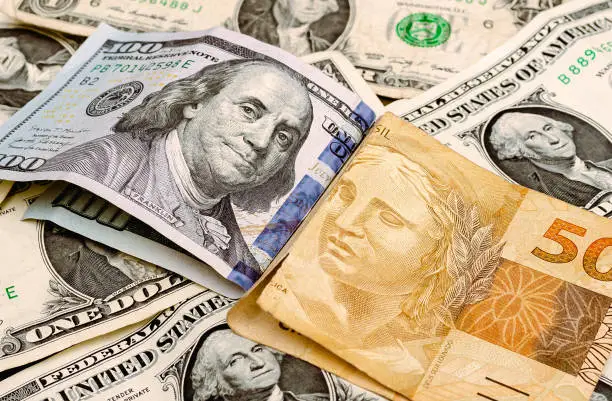
The U.S. dollar closed lower against the Brazilian real on Wednesday, reflecting global market reactions to unexpectedly high U.S. inflation data for January. The currency ended the session at R$5.7631, down 0.08%, after a volatile trading day.
This mirrored a slight decline in the U.S. Dollar Index (DXY), which measures the dollar against six major currencies, slipping 0.02% to 107.939 by 5 p.m. Brasília time.
The higher-than-expected Consumer Price Index (CPI) in the U.S., which rose 0.5% in January and 3% year-over-year, drove market adjustments. While the CPI isn’t the Federal Reserve’s preferred inflation gauge, it remains a critical tool for assessing interest rate expectations.
Following the data release, financial markets delayed their projected timeline for Federal Reserve rate cuts from June to September 2025 and reduced expectations to a single 0.25 percentage point cut that year.
Domestically, political and monetary policy developments added to the mix. President Luiz Inácio Lula da Silva expressed confidence in Central Bank President Gabriel Galípolo’s ability to manage Brazil’s interest rates effectively, emphasizing the need for gradual adjustments.
Lula described Galípolo as potentially one of the most capable leaders in the Central Bank’s history, stressing caution to avoid abrupt economic shifts. Galípolo, speaking at an event in Rio de Janeiro, highlighted the Central Bank’s approach to interest rate adjustments.
Brazil’s Selic Rate and Global Economic Concerns
He stated that while aggressive hikes may be necessary during inflationary periods, rate cuts require greater caution to maintain stability. Currently, Brazil’s benchmark Selic rate stands at 13.25%, with guidance suggesting another potential increase of one percentage point in March.
Meanwhile, international trade policies remained a secondary focus for investors as markets digested recent tariff announcements by former U.S. President Donald Trump.
Earlier this week, Trump imposed a 25% tariff on steel and aluminum imports, raising concerns about potential retaliatory measures from trading partners. Despite these factors, global attention remained fixed on U.S. inflation data and its implications for monetary policy.
Federal Reserve Chair Jerome Powell acknowledged progress toward reducing inflation to the 2% target but emphasized that further work remains to achieve this goal. Markets will likely continue monitoring economic indicators closely as policymakers navigate a complex global environment.
This article was produced by The Rio Times’ automated newsroom system. How we use AI · Report an error · Editorial responsibility: Matthias Camenzind, Editor-in-Chief
LatAm Markets: Live Signals → — real-time movers, turnover leaders and FX across Latin America.