
Key Facts
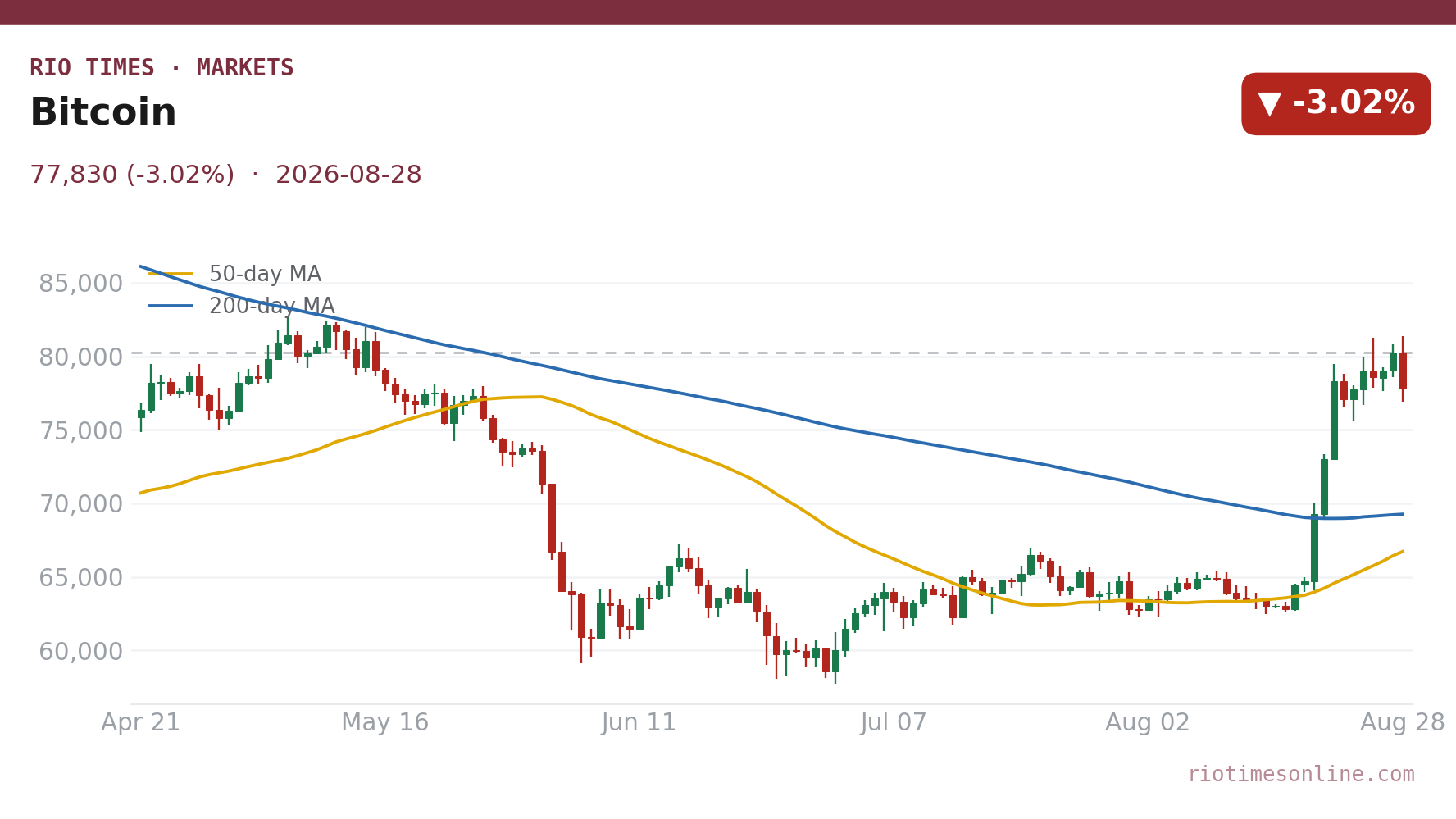
- —Bitcoin settled at US$77,838 down 3.01% on Friday, August 28, 2026, after Federal Reserve Chair Kevin Warsh’s first Jackson Hole keynote as Fed chair revived expectations of higher US interest rates.
- —Ethereum closed at US$2,443 a decline of 2.70%, while Solana fell 4.65% to US$104.13 and XRP dropped 4.80% to US$1.3833 as the broader complex retreated from recent highs.
- —A nine-day streak of spot Bitcoin ETF inflows worth about US$3 billion snapped on Friday with a roughly the Friday flow print net outflow, removing the steady bid that had pushed Bitcoin back toward US$80,000 earlier in the week.
- —Solana validators passed the ‘Double Disinflation’ proposal doubling the annual disinflation rate from 15% to 30%, cutting future SOL issuance even as the token fell on the day.
- —Stablecoins drove more than 90% of volume on Latin America’s tracked exchanges as of July 2025, and exchange-processed volume reached US$27 billion in 2024, nine times the 2021 level, according to Dune Analytics data.
- —In Argentina, USDT and USDC accounted for 72% of crypto purchases on the Bitso exchange, and about 75% of workers paid in crypto opted for stablecoin salaries, a pattern described as bottom-up dollarisation.
Today’s Focus
Bitcoin ended Friday, August 28, 2026 at US$77,838, down 3.01%, after Federal Reserve Chair Kevin Warsh’s first Jackson Hole keynote as Fed chair sent traders pricing in possible rate rises. The speech hit a market that had just absorbed nine straight days of spot ETF inflows worth about US$3 billion.
Ethereum slid 2.70% to US$2,443, Solana declined 4.65% to US$104.13 and XRP fell 4.80% to US$1.3833. Solana’s drop came even as validators approved a proposal to cut future token issuance, a day after Charles Schwab confirmed plans to add Solana, Avalanche and Chainlink to its retail crypto offering.
For Latin America, the day matters less for price than for plumbing. Stablecoins account for more than 90% of the region’s tracked exchange volume, and Argentina and Brazil are each charting distinct paths for regulating that dollar-substitute economy.
What matters today. Friday’s pullback shows that crypto’s rally still leans on Federal Reserve signals, while Latin America’s real adoption story remains anchored in stablecoins, not volatile token prices.
01 The session in one read
Bitcoin settled at US$77,838 on Friday, August 28, 2026, down 3.01% for the session, after Federal Reserve Chair Kevin Warsh warned at Jackson Hole that inflation was not yet beaten. The pullback followed repeated failures to hold above US$80,000 and forced a wave of liquidations in leveraged positions.
The hawkish tone hit the whole complex. Ethereum fell 2.70% to US$2,443, while Solana lost 4.65% to US$104.13 and XRP dropped 4.80% to US$1.3833, leaving little place to hide outside stablecoins.
The 3.01% decline in Bitcoin to US$77,838 reads as a macro-driven de-risking: a Federal Reserve chair warning on inflation into a market that had just enjoyed a nine-day ETF inflow streak.
Whether Friday’s ETF flow turns negative matters as much as the speech itself, because the nine-day inflow run was the marginal bid that had stabilised the market near US$80,000. Watch whether Monday brings a resumption of spot ETF inflows or a deeper unwinding of leveraged long positions.
02 The board
The price board shows a uniform retreat, but the scale differs by token. Bitcoin’s 3.01% decline was smaller than Solana’s 4.65% fall and XRP’s 4.80% drop, a sign that traders were quickest to unwind positions in coins that had rallied hardest on recent news such as Schwab’s planned Solana listing.
Ethereum’s 2.70% slide to US$2,443 reflected its middle position: less speculative than Solana or XRP, but still vulnerable to a macro-driven pullback that punished anything without a fresh domestic catalyst.
| Asset | Level | Change |
|---|---|---|
| Bitcoin | US$77,838 | -3.01% |
| Ethereum | US$2,443 | -2.70% |
| Solana | US$104.13 | -4.65% |
| XRP | US$1.3833 | -4.80% |
Source: Yahoo Finance daily data; levels at 00:00 UTC on August 29, 2026 (close of Friday’s 24-hour session).
Live Market IntelligenceThe live market board
Rio Times · Live Market Intelligence
Latin America — Cross-Market Board
| Instrument | Last | Change | YoY | Prev. | High | Low | Volume |
|---|---|---|---|---|---|---|---|
| IBOV | 207,527.17 | -0.74% | +21.85% | 209,066.90 | 168,310 | 167,142 | — |
| IPSA | 11,034.64 | -0.08% | — | 11,043.36 | 11,210 | 10,984 | 1,513,213,483 |
| IPC MEX | 66,746.78 | +1.06% | +12.17% | 66,048.57 | 66,121 | 65,405 | 108,886,187 |
| MERVAL | 2,828,027 | -0.16% | +30.51% | 3,022,485 | 3,042,365 | 2,991,150 | — |
| COLCAP | 2,531.15 | +0.00% | — | 9.04 | 9.05 | 9.02 | 4,133 |
| BVL PERÚ | 60,956.11 | -0.51% | — | — | — | — | — |
| USD/BRL | 5.16 | +0.01% | -5.13% | 5.16 | 5.18 | 5.14 | — |
| EUR/BRL | 5.95 | +1.01% | -5.83% | 5.89 | 5.98 | 5.94 | — |
| USD/MXN | 17.06 | -0.24% | -8.58% | 17.10 | 17.08 | 17.01 | — |
| USD/CLP | 913.98 | +0.04% | -5.67% | 913.65 | 915.11 | 906.68 | — |
| USD/COP | 3,140 | +0.03% | -22.04% | 3,139 | 3,141 | 3,105 | — |
| USD/PEN | 3.36 | -0.66% | -4.82% | 3.38 | 3.38 | 3.35 | — |
| USD/ARS | 1,493 | +0.10% | +12.96% | 1,491 | 1,494 | 1,480 | — |
| USD/UYU | 40.27 | +1.24% | +1.80% | 39.77 | 40.27 | 40.23 | — |
| USD/PYG | 5,939 | +1.68% | -19.54% | 5,841 | 5,939 | 5,925 | — |
| USD/BOB | 11.64 | -0.76% | +72.04% | 11.73 | 11.72 | 11.64 | — |
| USD/DOP | 58.34 | +1.25% | -3.44% | 57.62 | 58.34 | 58.04 | — |
| USD/CRC | 445.92 | +0.89% | -9.71% | 441.97 | 448.50 | 445.92 | — |
03 What moved it
Kevin Warsh’s Jackson Hole keynote was the headline driver. He called the 2% inflation goal a “firm, fixed target”, said forward guidance had “overstayed its welcome” and warned that unless underlying inflation moved to target “clearly and at sufficient speed”, “we have work to do”, pointing to 3.7% PCE inflation over the past year.
The response was immediate: CME futures moved the implied odds of a September rate rise to about 57% from about 35%, and the two-year Treasury yield climbed 0.14 percentage points to 4.34%. Leverage then amplified the move, with about US$488 million of crypto positions liquidated on Friday, most of them longs, across nearly 98,000 traders, according to CoinGlass.
The third leg was flows. Spot Bitcoin ETFs had just run nine straight days of inflows worth about US$3.04 billion between August 17 and August 27, on Farside Investors figures.
Friday’s flow data had not been published when this went to press.
04 The Latin American read
None of this changes Latin America’s core crypto dynamic. Exchange-processed volume in the region reached US$27 billion in 2024, nine times the 2021 figure, and stablecoins accounted for more than 90% of that exchange volume by July 2025, according to Dune Analytics data.
Brazil remains the engine: Chainalysis put the country’s on-chain volume at US$318.8 billion in the twelve months to June 2025, with stablecoins above 90% of the total. Tax authority figures cited by CoinDesk show Brazilians reporting US$6 billion to US$8 billion of crypto transactions a month, with stablecoins reaching up to 90% of reported volume in some months.
In Argentina, USDT and USDC together made up 72% of crypto purchases on the Bitso exchange, according to figures cited by Bitwage. Bitwage data also show roughly three-quarters of workers paid in crypto choosing stablecoin salaries, a bottom-up dollarisation that no central bank speech can unwind.
05 The names to watch
Solana remains the most instructive story despite Friday’s decline. Validators passed SGP-0002, dubbed ‘Double Disinflation’, with 72.7% of decisive stake against a two-thirds threshold.
The result looked far tighter on the all-ballot display, at 67%, because abstentions were shown but did not count against approval. The measure doubles the annual disinflation rate to 30% and pulling the 1.5% terminal inflation rate forward to around 2029 from 2032.
The change still needs technical implementation under a proposal known as SIMD-0550, and a companion fee-burn measure failed with 53.9% support. Charles Schwab added a separate tailwind on Thursday, confirming plans to list Solana, Avalanche and Chainlink on its retail crypto platform in the coming months.
On the institutional side, Bullish announced a US$100 million stablecoin debt facility for USD.AI, which lends against AI computing hardware. The deal signals how stablecoin liquidity is being routed into new collateral markets, a model Latin American fintechs are watching for dollar-linked lending products.
06 The outlook
The path from here depends on whether Friday’s selling stops at a one-day reaction or turns into a run of ETF outflows. A return to inflows could steady Bitcoin above US$77,000 and let altcoins recover; continued outflows would test the idea that spot ETFs have permanently deepened crypto’s demand base.
07 What to watch
- US spot Bitcoin ETF flows: Farside’s Friday and Monday prints will show whether the nine-day US$3 billion inflow streak survived the speech, the single most important short-term signal for Bitcoin.
- Solana issuance implementation: the approved disinflation change must still be shipped and activated on-chain; any delay or friction could reverse the positive supply story even as Schwab moves to add SOL.
- Brazil VASP licensing: Resolutions 519, 520 and 521 created a full authorisation regime from February 2, 2026, with existing operators facing an October 30, 2026 deadline; the pace of approvals will shape how much of Brazil’s stablecoin-heavy volume moves into regulated venues.
- Fed policy signals: Warsh’s Jackson Hole message leaves markets sensitive to every US inflation print; a softer reading would likely trigger a rapid rebound across crypto.
Frequently Asked Questions
Why did Bitcoin fall on Friday, August 28, 2026?
Bitcoin dropped 3.01% to US$77,838 after Federal Reserve Chair Kevin Warsh’s hawkish Jackson Hole speech sent traders pricing in possible US interest-rate rises.
How much did Ethereum, Solana and XRP fall?
Ethereum closed at US$2,443, down 2.70%; Solana ended at US$104.13, down 4.65%; and XRP settled at US$1.3833, down 4.80%.
What does this mean for Latin America?
The price move matters less than stablecoin adoption, which now accounts for over 90% of the region’s tracked exchange volume; Argentina and Brazil remain the main stablecoin engines.
Is Solana still a relevant story despite the drop?
Yes, because validators approved a disinflation change that cuts future SOL issuance and Charles Schwab plans to add Solana to its retail crypto trading platform.
Market data: Yahoo Finance daily data, 00:00 UTC cut-off. ETF flows: Farside Investors.
Liquidations: CoinGlass.
This article was produced by The Rio Times’ automated newsroom system. How we use AI · Report an error · Editorial responsibility: Matthias Camenzind, Editor-in-Chief
LatAm Markets: Live Signals → — real-time movers, turnover leaders and FX across Latin America.