
BUSINESS · COSTA RICA
Key Facts
- —The country Costa Rica is a Central American democracy of about five million people, known abroad for ecotourism and strict environmental rules.
- —Why it matters A plant owned by Sigma, one of Latin America’s largest packaged-food groups, failed national wastewater limits in an official Health Ministry review.
- —Why now The health order and technical report became public on Tuesday 13 October and were filed as new evidence before the Constitutional Court.
- —What happened Wastewater sampled on Friday 7 August broke three of eight legal limits, and a health order followed on Tuesday 25 August.
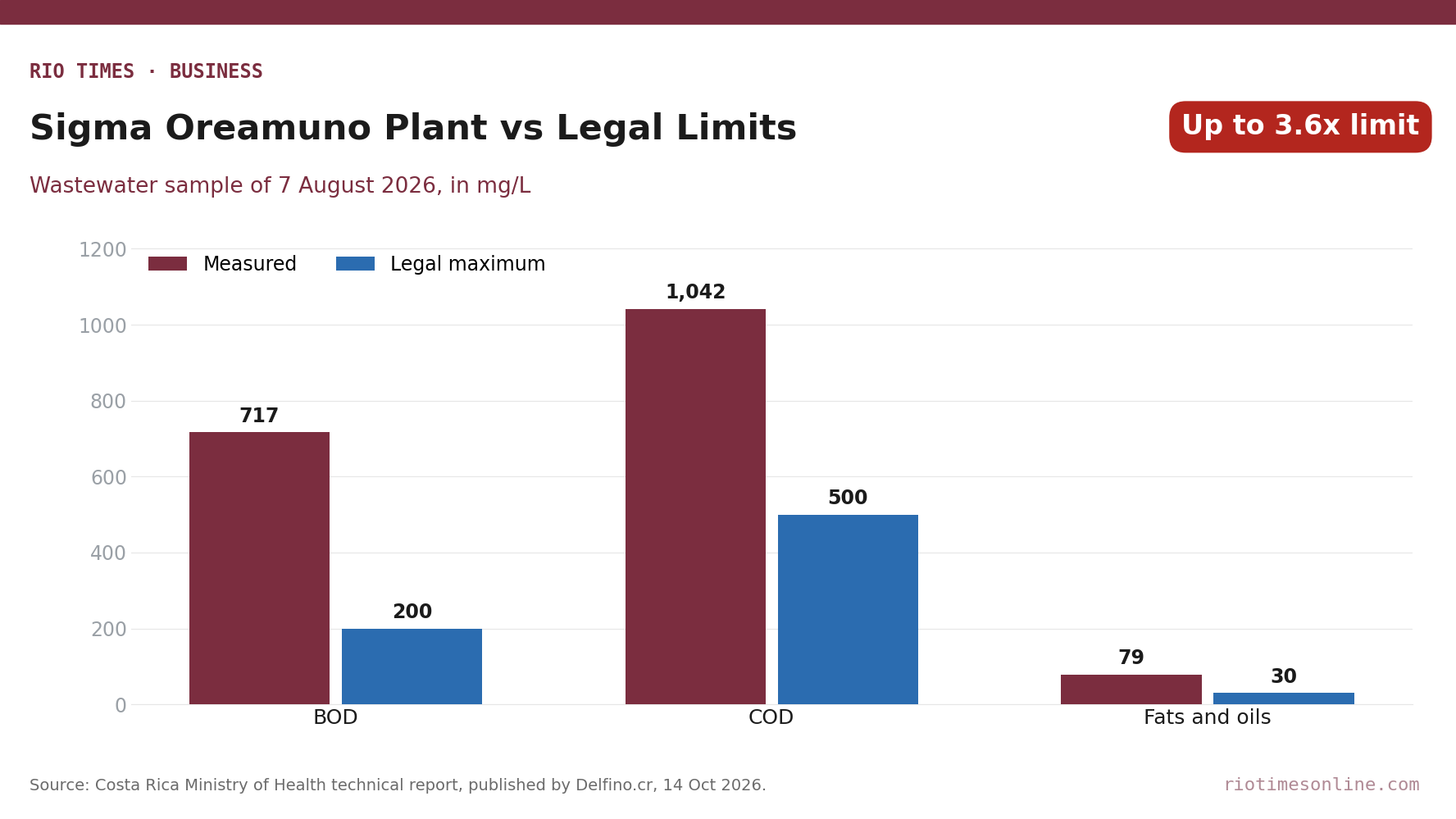
- —The numbers Biochemical oxygen demand 717 mg/L against a 200 mg/L limit; chemical oxygen demand 1,042 against 500; fats and oils 79 against 30.
- —What it means for you Sigma sells across the Americas, including the United States. The case shows Costa Rican regulators acting on community complaints against a foreign-owned plant.
- —Still open Whether Sigma met its deadlines, whether new tests show compliance and how the Constitutional Court rules on the residents’ appeal.
- —Power Index Costa Rica ranks 9th of 14 in The Rio Times Latin America Power Index, with 36.5 points (October 2026 edition).
Sigma Alimentos broke three legal wastewater limits at its plant in Oreamuno, Cartago province, an official Costa Rican Health Ministry review found. The ministry ordered the Mexican-owned food maker to fix its treatment system and warned that failure could close the site.
The documents became public on Tuesday 13 October, when local environmental group Frente Ecologista Cipreses released them. The case matters to foreign investors because Costa Rica sells itself on clean water and green credentials, and regulators are now testing a multinational on both.
What the Health Ministry Found
The sample was taken on Friday 7 August at the outlet of the plant’s wastewater treatment system in San Rafael de Oreamuno. The private laboratory Chemlabs ran the tests, and the ministry’s environmental health unit then assessed them against national rules.
The yardstick was Executive Decree 33601, Costa Rica’s regulation on the discharge and reuse of wastewater. Three of the eight physical and chemical parameters checked were above the permitted maximum, Delfino.cr reported after reviewing the technical report.
Biochemical oxygen demand, a measure of how much oxygen microbes need to break down organic matter, reached 717 milligrams per litre. The legal limit is 200 milligrams per litre, so the reading was about 3.6 times the cap.
Chemical oxygen demand, which tracks substances that consume oxygen through chemical reactions, measured 1,042 milligrams per litre against a limit of 500. Fats and oils came in at 79 milligrams per litre, against a maximum of 30.
The other five parameters, including pH, temperature, total suspended solids and settleable solids, were within the limits. The ministry’s report stressed that passing some tests does not offset failures in others, because each must comply on its own.
Inspectors also noted that, during the 7 August visit, Sigma Alimentos staff were adding a chemical directly into the secondary settling tank. The ministry judged this a possible stopgap measure, not a structural fix for the system’s shortcomings.
Sigma Alimentos Faces an 80-Day Deadline
The Oreamuno health area office issued sanitary order MS-DRRSCE-DARSO-OS-039-2026, dated and served on Tuesday 25 August. It gave Sigma Alimentos ten working days to file a corrective action plan with a timetable, named managers and checks.
Once health officials approve that plan, the company has at most 80 working days to carry it out. Sigma also had 20 working days to deliver a full assessment of the capacity and performance of its treatment plant.
The order requires the company to cut the excess concentrations and to remove or control the offensive odours found during inspections. Sigma must then prove with fresh laboratory tests that its discharges meet the legal limits.
The ministry warned that breaching the order or its deadlines could lead to immediate closure, fines and a criminal complaint for disobeying authority. It is not public whether Sigma has filed its plan or whether officials have approved it.
How the Dispute Began
Residents of the nearby Takiscú housing estate first complained to the Health Ministry in 2025 about smells and pollution in a local stream. In July 2026 Frente Ecologista Cipreses made the complaint public with tests from the University of Costa Rica’s environmental pollution lab, CICA-UCR.
At the time, Sigma Alimentos told Semanario Universidad that its regular checks by certified laboratories showed it complied with environmental rules. The company also said it was addressing the concerns raised by the community, Delfino.cr reported in July.
The Ombudsman’s Office, Costa Rica’s independent public rights watchdog, opened its own inquiry in early August. Health officials visited the site on Tuesday 4 August and returned three days later to take the decisive sample.
Two complainants have a pending appeal before the Constitutional Court, case 26-022200-0007-CO, against the Health Ministry and the Environment Ministry. The group has now filed the health order as new evidence and asked the court to rule in its favour.
What It Means for You
Sigma is a Mexican maker of packaged meats and dairy products whose parent company trades on the Mexican stock exchange. It also sells in the United States, so environmental findings abroad can matter to US shareholders and lenders.
For investors watching Central America, the case shows Costa Rica’s regulators can be slow but do eventually act on documented complaints. For Americans living in the Cartago area, the issue is local and not a public drinking water alert.
The order is a correction notice, not a fine or a closure, so the plant keeps operating while it upgrades its system. The financial impact on Sigma is likely small, but the reputational risk in an eco-conscious market is real.
Readers can follow Sigma’s wider business on our Sigma Foods, S.A.B. de C.V. company page. For country context, see Costa Rica Explained: The Country, Its Politics, Its Economy and What to Watch.
Expats weighing a move can also read Safety in Costa Rica 2026: What the Numbers Say and What Foreigners Actually Face. Our San José city page covers life in the capital, a short drive west of Cartago.
What Is Not Known
We could not find a public statement from Sigma on the August findings or the health order. It is also unclear whether the company met its ten-day and twenty-day deadlines.
The health order and technical report are not published on the ministry’s website, so this article relies on the documents as released and reported. No later test results showing whether the plant now complies have been made public.
It is not known when the Constitutional Court will rule on the residents’ appeal. The court could order closer oversight of the plant, or it could find that authorities have already acted.
Frequently Asked Questions
What did Costa Rica’s Health Ministry find at the Sigma Alimentos plant?
A wastewater sample from 7 August broke three of eight legal limits at the Oreamuno plant. Organic matter, chemical oxygen demand and fats and oils were between 2.1 and 3.6 times the permitted maximum.
Has the Oreamuno plant been closed?
No, the ministry issued a sanitary order requiring corrective measures, not a closure. It warned that missing the order’s deadlines could lead to closure, fines and a criminal complaint.
How long does Sigma have to fix the problem?
Sigma had ten working days to file a corrective plan after the order was served on 25 August. Once the plan is approved, it has at most 80 working days to carry it out.
Who made the documents public?
The environmental group Frente Ecologista Cipreses released them on Tuesday 13 October. It filed them as new evidence in a Constitutional Court appeal over the plant.
Is drinking water in Cartago affected?
The findings concern discharges into a stream near the plant, not the public water supply. No drinking water alert has been issued in connection with the case.
Sources: Delfino.cr, Health Ministry report and order · Delfino.cr, Ombudsman inquiry and court appeal · Delfino.cr, original complaint and Sigma response
Editorial responsibility: Matthias Camenzind, Editor-in-Chief · Editorial standards · Report an error