Copper Squeeze Deepens as LME Spot Premium Hits US$434
Key Facts
- LME cash copper settled at US$14,545.00 per tonne on 14 August 2026, up 1.82 percent from US$14,285.00.
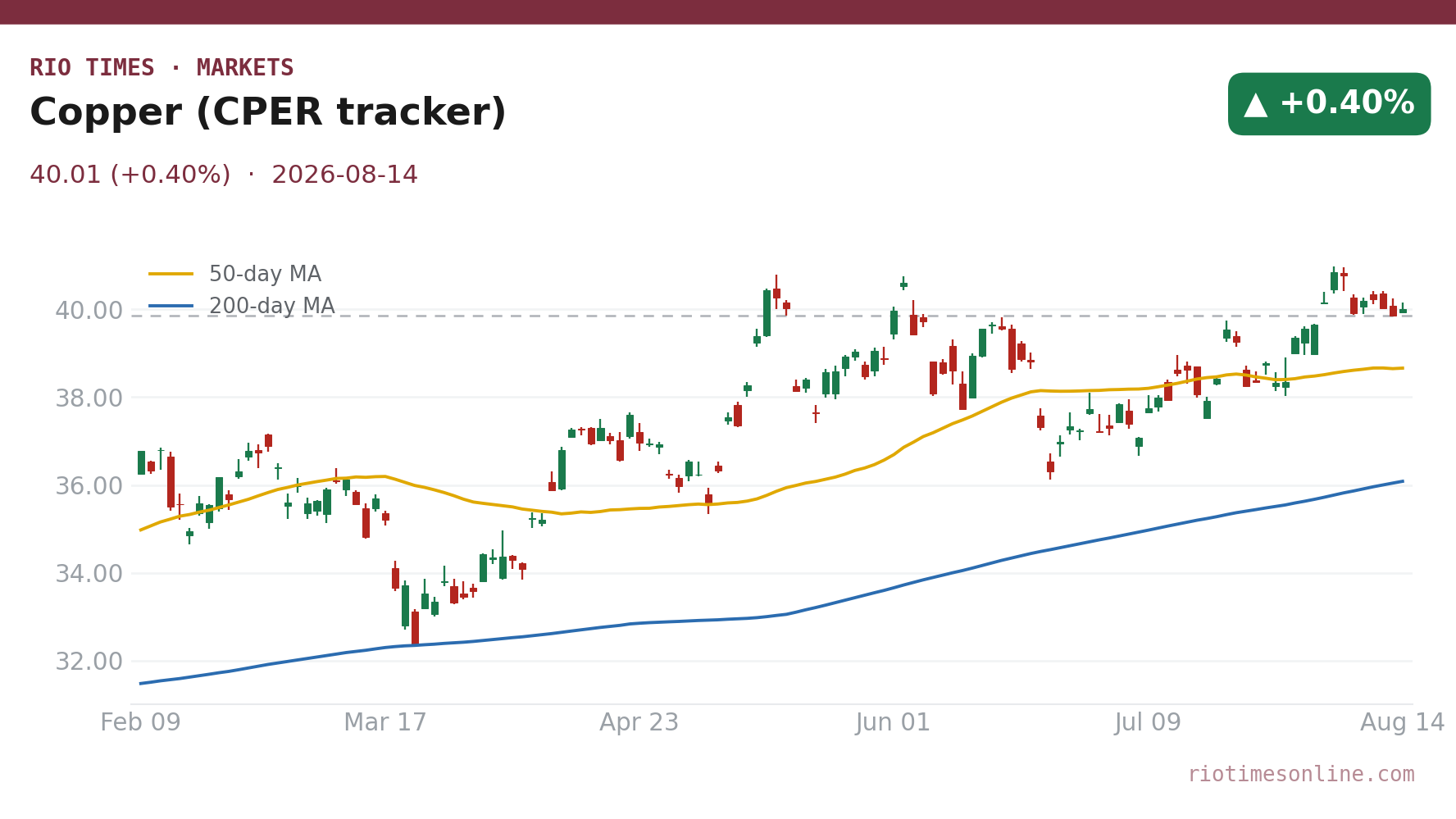
- The copper-tracking fund CPER closed at US$40.01 up 0.40%, tracking futures rather than physical copper.
- Southern Copper shares fell to US$184.61 down 1.59%, lagging the metal.
- Freeport-McMoRan closed at US$66.49 a decline of 0.51% as investors trimmed big-producer equity positions.
- The Global X Copper Miners ETF ended around US$85.70 up 0.21%, on selective buying of producers.
- LME warehouse stocks fell to 204,975 tonnes on 14 August, a 42nd straight daily fall.
Today’s Focus
A physical copper squeeze on the London Metal Exchange broke open on Friday, August 14, 2026. LME cash copper settled at US$14,545.00 a tonne, up from US$14,285.00 on August 13, a rise of 1.82 percent in one session.
The three-month contract settled at US$14,134.00, up from US$14,082.00. Cash traded about US$411 a tonne over three-month metal on those settlements. Reported cash-to-three-month backwardation reached US$434 a tonne, a five-year high, with the August to September spread at US$370 a tonne, the widest since 2021. That spread was about US$34 at the end of July and US$207.50 on August 11.
COMEX September copper set a record US$6.7140 a pound on Wednesday, August 12. It fell below US$6.55 on the 13th and closed Friday around US$6.5995, up marginally on Thursday. Copper was up about 18 percent year to date and 46 percent over 12 months.
The copper-futures tracker CPER rose 0.40% to US$40.01, while producer shares diverged. Southern Copper fell 1.59% to US$184.61 and Freeport-McMoRan slipped 0.51% to US$66.49. The miners ETF COPX, by contrast, inched up 0.21%, suggesting selective buying of copper equities.
What matters today. The copper squeeze is real and driven by supply losses, not by flat trading or balanced markets.
01 What to watch
- LME stock data: Further declines in warehouse inventories would intensify the squeeze on short-position holders.
- White House tariff decision: The delayed ruling on refined copper imports remains the market’s main catalyst, per StoneX.
- US dollar direction: A stronger dollar typically weighs on dollar-priced copper futures.
- COMEX front-month action: Record levels near US$6.71 per pound leave room for volatility as the squeeze plays out.
What is driving the copper squeeze
The Democratic Republic of Congo imposed a concentrate export ban, affecting under a fifth of national output, which triggered the panic bid. United States tariff expectations on refined copper pulled metal into US warehouses, with imports exceeding 200,000 tonnes in July 2026, a 12-year high. Chinese smelter output cuts on tight feedstock saw refined output down a second straight month.
Chile, the world’s top copper producer, added to the squeeze. Antofagasta cut guidance by about 5 percent, and Codelco’s Andes Norte project slipped to 2029. Indonesia’s PT Smelting Gresik plant has been halted since August 8 for furnace repairs. Global mine production fell 1.6 percent in the first five months of 2026.
Natalie Scott-Gray, senior metals demand strategist at StoneX, said “the delayed White House tariff decision remains the market’s main catalyst.” Every named driver was a supply loss, with no rising supply signals from Latin America or elsewhere.
Producers and Chinese demand
Codelco has abandoned its 2026 growth target. The Chilean state miner had planned 1.34 million tonnes this year against 1.307 million in 2025, and Bloomberg reported on August 12 that it now expects to produce less than last year. No revised figure has been published.
Peru has issued no 2026 national output figure either, so the supply side of the squeeze remains partly unmeasured. Indonesia is the clearer loss: the Gresik smelter that processes Grasberg concentrate has been down since a boiler leak on August 8.
Chinese buyers are stepping back rather than chasing the tape. The Yangshan premium paid for copper imported into China fell to US$96 a tonne from US$115, reported on August 13. COMEX copper meanwhile traded about US$400 a tonne above the LME three-month price, keeping metal flowing to US warehouses instead of Shanghai.
Warehouse dynamics behind the copper squeeze
LME warehouse stocks fell to 204,975 tonnes on August 14 from 207,725 on the 13th, a 42nd consecutive daily decline, the longest unbroken run since 2014. Stocks were above 400,000 tonnes earlier in 2026 and fell 14 percent, more than 35,000 tonnes, from the end of July alone. Nearly half the remaining metal was already earmarked for withdrawal, raising the prospect of a warehouse bidding war among short-position holders. Full settlement and stock series are published by the London Metal Exchange, and our reporting on Codelco’s El Teniente pause tracks the regional producers behind it.
That tightness explains the backwardation, where cash commands a premium over future delivery. The US$434 a tonne cash-to-three-month backwardation is a five-year high, signaling acute near-term scarcity. The August to September spread at US$370 a tonne, the widest since 2021, shows the market expects no quick relief.
Frequently Asked Questions
Why did copper surge on Friday?
A physical copper squeeze on the LME broke open, with cash copper up 1.82 percent to US$14,545 a tonne, driven by supply losses from Congo, Chile, China and Indonesia.
What does CPER track?
CPER tracks copper futures contracts, not physical spot copper, so its price reflects COMEX-style futures index moves.
Why is the LME backwardation so wide?
Warehouse stocks fell for a 42nd straight day to 204,975 tonnes, with nearly half the metal earmarked for withdrawal, forcing short holders to compete for supply.
How does the energy transition affect copper?
Electric vehicles, charging networks and renewable power require more copper wiring than fossil-fuel systems, creating structural demand, though Friday’s move was about immediate supply.
This article was produced by The Rio Times’ automated newsroom system. How we use AI · Report an error · Editorial responsibility: Matthias Camenzind, Editor-in-Chief
LatAm Markets: Live Signals → — real-time movers, turnover leaders and FX across Latin America.
Read More from The Rio Times